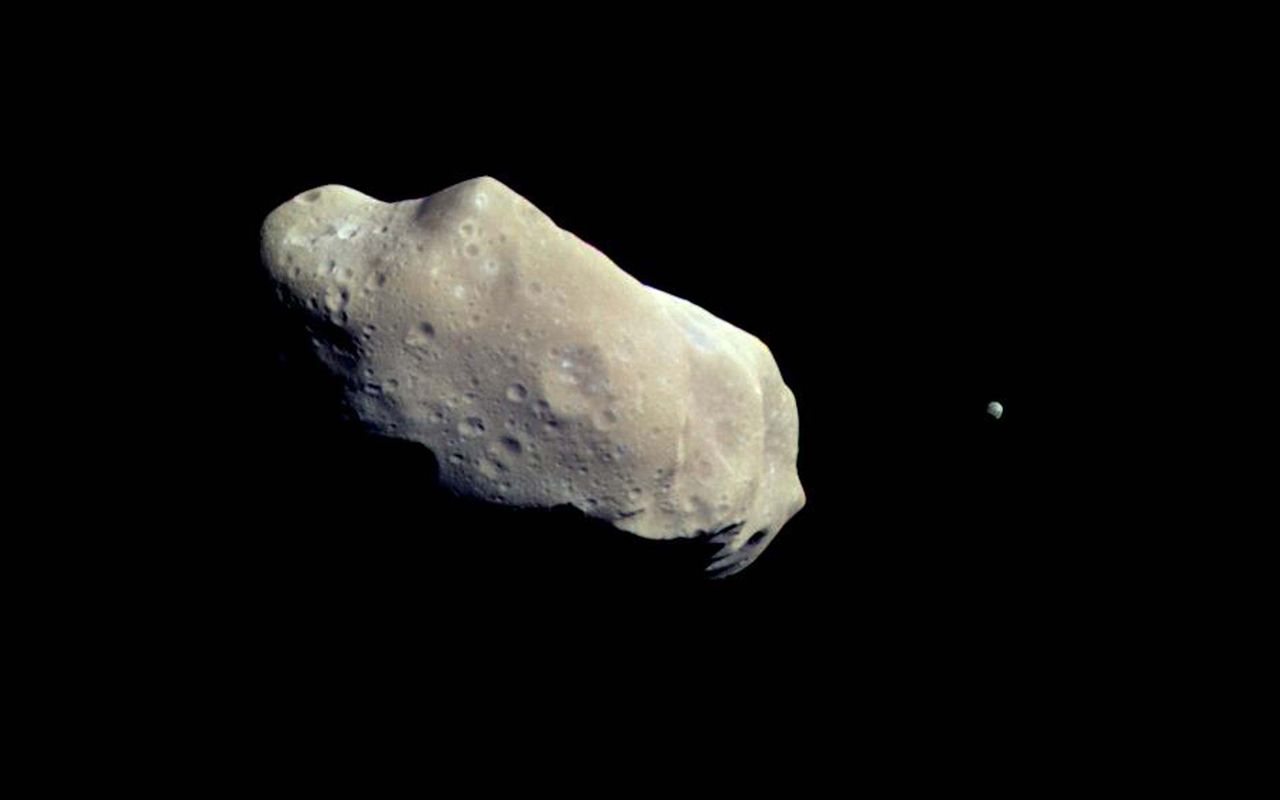
On Aug. 28, 1993, NASA's Galileo spacecraft performed a close flyby of asteroid 243 Ida, a routine encounter on its long journey to Jupiter. The flyby became anything but routine when mission scientists examined the returned images and spotted something unexpected: a tiny moon orbiting the asteroid. The object, later named Dactyl, became the first confirmed satellite of an asteroid ever discovered.
Galileo was launched in October 1989 and was making its way toward Jupiter, where it would arrive in December 1995. The spacecraft's trajectory included several gravity-assist flybys of planets and asteroids to gain the velocity needed to reach the outer solar system. The encounter with Ida occurred in the main asteroid belt between Mars and Jupiter, roughly 240 million miles from Earth at the time of the flyby.
During the encounter, Galileo passed within about 1,500 miles of Ida, capturing dozens of images of the irregular, elongated asteroid. Ida measures approximately 35 miles in length and is a member of the Koronis family of asteroids, a group of rocky bodies believed to share a common origin from a larger parent asteroid that broke apart long ago. The images revealed a heavily cratered surface, indicating a long history of impacts.
It was only after the spacecraft transmitted its data back to Earth that scientists noticed the small companion in the images. Dactyl, measuring roughly one mile across, appeared as a tiny dot in several frames. The discovery was announced in early 1994 after careful analysis confirmed that the object was indeed in orbit around Ida rather than a background star or an artifact of the imaging system.
The finding was significant for planetary science. Before Dactyl's discovery, astronomers had no direct evidence that asteroids could have moons. The existence of a satellite around Ida raised new questions about the formation and evolution of asteroids, including how such a small body could remain gravitationally bound to another. Scientists proposed that Dactyl may have formed from debris ejected when a larger parent body broke apart, or that it could be a captured fragment from a collision.
Dactyl was named after the Dactyls, mythical beings who lived on Mount Ida in ancient Greek mythology. The name follows the convention of naming asteroids and their features after mythological figures associated with the location of discovery.
The Galileo mission continued to make history after the Ida encounter. In July 1994, the spacecraft observed the fragments of Comet Shoemaker-Levy 9 as they crashed into Jupiter's atmosphere, providing the first direct views of a major planetary impact. Galileo also performed a flyby of the asteroid Gaspra in October 1991, making it the first asteroid ever visited by a spacecraft.
When Galileo finally arrived at Jupiter in December 1995, it deployed a probe into the planet's atmosphere and began an extended orbital mission that lasted until 2003. During its eight years in the Jovian system, Galileo made numerous discoveries about Jupiter's moons, including evidence for a subsurface ocean on Europa and active volcanism on Io.
The discovery of Dactyl opened a new field of study. Since 1993, astronomers have identified moons around hundreds of asteroids, and binary asteroid systems are now recognized as common throughout the solar system. The finding also informed later missions, including NASA's Dawn spacecraft, which orbited the asteroids Vesta and Ceres, and the ongoing efforts to study near-Earth asteroids for both scientific and planetary defense purposes.
The Ida flyby remains a landmark moment in space exploration, demonstrating that even a routine encounter on the way to a primary target can yield major discoveries when spacecraft and scientists are prepared to look closely.
152