Russia does not yet have a second Starlink. It does, however, have something more consequential than a paper project.
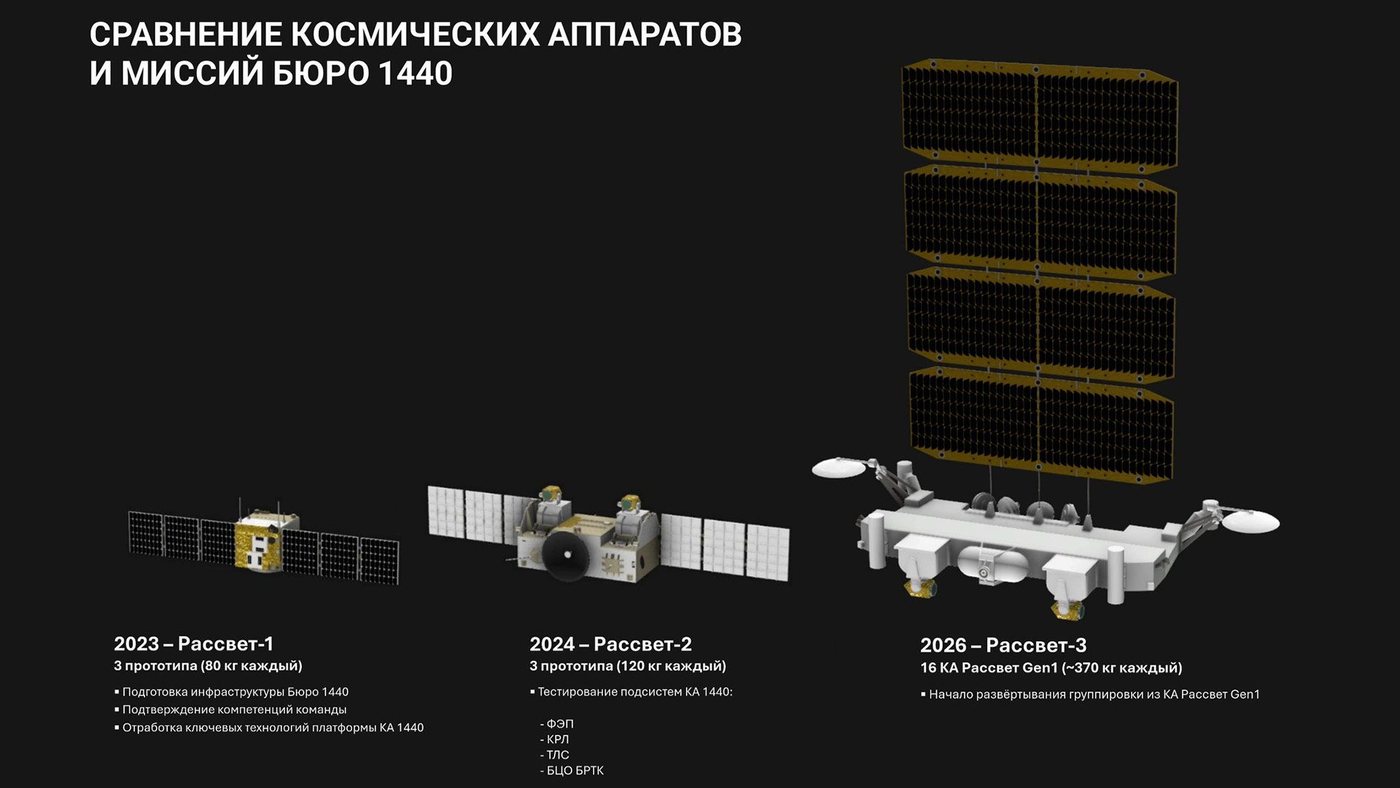
The Rassvet broadband constellation built by Bureau 1440 has moved from six experimental spacecraft to serial deployment. Sixteen production-class satellites were launched from Plesetsk on March 23, 2026. One later failed to raise its orbit and re-entered. A second batch went up on July 19; Bureau 1440 confirmed the deployment the following day, while independent launch databases identify another 16 spacecraft.
That makes the most useful open-source estimate roughly 37 Rassvet-related spacecraft still in orbit if all six earlier prototypes remain there: six experimental satellites, 15 survivors from the March batch and 16 from July. Ukrainian officials have recently used both “16” and “up to 40,” a discrepancy that probably reflects different counting conventions or information cutoffs. The important point is simpler: the constellation is still small, but it is no longer hypothetical.
The technology is also credible enough to take seriously. Bureau 1440 says its operational network is designed for an altitude of about 800 kilometers, with user links up to 1 gigabit per second and latency below 70 milliseconds. Its earlier Rassvet-2 prototypes demonstrated a 5G NTN link to a company-built terminal and laser communications between satellites at 10 gigabits per second. The target spacecraft combine those technologies with electric propulsion and inter-satellite routing.
Those are meaningful engineering milestones. They are not proof that a mass service can already deliver the advertised performance to thousands of users under battlefield conditions.
The satellites will not hover over Ukraine
A low-orbit broadband constellation works very differently from the communications satellites that appear fixed in the sky.
A geostationary satellite can remain over the same longitude because it circles Earth once every 24 hours at roughly 35,786 kilometers above the equator. Rassvet is designed to fly more than 40 times closer to Earth. At an 800-kilometer circular orbit, one revolution takes about 100.7 minutes. A spacecraft therefore circles the planet roughly 14.3 times a day while Earth rotates beneath it.
That is the source of both the advantage and the problem. The short distance lowers latency and allows smaller antennas, but an individual satellite is only useful to a given user for minutes at a time. Continuous service requires another satellite to rise into view before the first one disappears below the useful elevation angle. The terminal must track and hand off between moving spacecraft automatically.
At 800 kilometers, basic geometry gives a coverage radius of about 1,260 kilometers if a terminal requires the satellite to remain at least 25 degrees above the horizon. A favorable pass across the center of that footprint lasts on the order of six minutes. With a lower 10-degree elevation threshold, a pass can approach nine or ten minutes, at the cost of a longer atmospheric path, more obstruction risk and a more demanding link budget.
That is why a few dozen spacecraft cannot simply be parked above a battlefield. They move. What matters is how many orbital planes exist, how satellites are phased within those planes and how much overlap the network can maintain over the target latitude.
Why 250 satellites is not an absurd number
Russia’s public planning documents have described a ramp to 156 spacecraft in 2026, 292 in 2027 and 318 in 2028. Bureau 1440 executives have also described a global-coverage architecture using 12 orbital planes with more than 20 satellites in each plane. The July batch was inserted at an inclination close to 82.3 degrees, a near-polar geometry well suited to high northern latitudes.
A simple Walker-style constellation illustrates what those numbers mean. Place 21 satellites in each of 12 evenly spaced planes at 800 kilometers and 82.3 degrees inclination: 252 spacecraft in total. Over Kyiv, a 24-hour geometry simulation with a 25-degree minimum elevation does not produce a coverage gap. Usually two or three satellites are in view; at least one remains available even during the thinnest parts of the cycle. Raise the minimum elevation to 40 degrees and gaps appear for roughly a fifth of the day.
The exact Rassvet network will not match this simplified model. Its final plane spacing, phasing, beam layout, minimum operating elevation, gateway topology and traffic-management rules are not public. But the calculation explains why independent estimates repeatedly put the threshold for continuous service in the 200–300-satellite range. At an 800-kilometer orbit, a few hundred well-arranged spacecraft can indeed create persistent line-of-sight coverage over Ukraine and Russia.
That still does not make 250 Rassvet satellites equivalent to Starlink.
Starlink had roughly 10,800 operational spacecraft in late July 2026, and early-August launches pushed the active fleet higher. Much of that scale buys capacity, redundancy, dense overlapping beams, geographic flexibility and the ability to absorb failures while serving many users simultaneously. Public Rassvet material gives an advertised user-link speed, but it does not disclose enough about aggregate throughput per satellite, beam capacity or simultaneous terminal loads to support claims that the Russian system already equals or exceeds Starlink.
For military use, however, Russia does not need equality.
A military network can become useful before it becomes global
The first military value may arrive well before 24/7 consumer service. A sparse constellation can create predictable communications windows. Those windows are inconvenient for ordinary broadband, but they can still be useful for scheduled data transfers, command updates, maritime platforms or long-range drones whose missions can be timed around satellite visibility.
With only one or two populated orbital planes, coverage over Ukraine would arrive in clusters rather than continuously. More planes matter as much as the raw spacecraft count because they spread passes across the day. As the constellation grows from dozens toward a hundred or more satellites, the gaps shrink quickly. Near the 200–250 range, continuous geometry becomes plausible if the spacecraft are distributed as planned.
That is the practical meaning behind President Vladimir Putin’s June statement that the system could support heavy combat drones. He also acknowledged the part of the problem that matters most: 16 satellites were “absolutely insufficient,” and scaling was still required.
Terminal design is another constraint. Space analyst Vitalij Egorov has said current Rassvet terminals are several times larger and heavier than Starlink hardware. A large terminal can be acceptable on a ship, command vehicle, fixed headquarters or heavy drone while being unsuitable for small tactical aircraft or infantry teams. Antenna size, power draw, electronic-warfare resistance and the speed of satellite handoffs may matter more on the battlefield than a laboratory peak of 1 gigabit per second.
The schedule is the least convincing part
Ukraine’s military-intelligence deputy chief Vadym Skibitskyi said on August 10 that Russia was launching the constellation faster than his service had originally expected. That assessment may reflect a classified baseline. It should not be confused with the project’s earlier public calendar.
The open record shows delay, not acceleration. The first mass launch was originally discussed for December 2025 and slipped to March 2026. The second batch was at one stage expected as early as April, then circulated as a June mission, and finally flew in July.
The arithmetic becomes demanding from here. If roughly 37 Rassvet-related spacecraft are now in orbit, reaching the published 156-spacecraft milestone by December 31 would require about 119 more. With batches of 16, that means eight launches in the remaining 142 days of 2026 — one about every 18 days.
For perspective, engines built by Russia’s United Engine Corporation supported 13 Soyuz-2 launches across all Russian launch sites during the whole of 2025. Eight extra Rassvet missions in less than five months would therefore be a major additional demand, even before military, navigation, weather and other spacecraft are considered.
The 2027 target is less impossible if interpreted as an end-of-year goal. From an estimated 37 satellites today, reaching 292 by the end of 2027 would require roughly 16 more 16-spacecraft missions, or about one a month on average. Russia has the launch vehicle and the Plesetsk infrastructure to do this. The harder question is whether Bureau 1440 can manufacture, test and finance hundreds of flight-ready satellites and terminals at that cadence while the launch system also serves other state priorities.
One failure in the first batch does not establish a reliability problem, but it is a reminder that a constellation must replace losses as well as grow. Large LEO networks are industrial systems, not one-off spacecraft programs.
What is realistic by 2027
The physics is not the obstacle. Russia has demonstrated the basic radio link, laser crosslinks, satellite bus and batch-launch concept. A constellation of roughly 250 properly phased spacecraft at 800 kilometers can plausibly give persistent geometric coverage at Ukrainian latitudes. That is enough to support a sovereign low-latency network with genuine military value.
The open evidence is much weaker for two broader claims: that Rassvet is already on an accelerated public schedule, and that it is technologically or operationally superior to Starlink. The first conflicts with documented delays. The second cannot be tested without aggregate capacity, terminal performance and operational reliability data.
The more realistic risk is also the more important one. Russia does not need 10,000 satellites to change battlefield communications. If it can industrialize a few hundred Rassvet spacecraft, distribute them across enough near-polar orbital planes and field terminals that survive jamming and combat conditions, it could obtain the part of Starlink’s advantage that matters most in war: a moving, redundant communications layer that no single tower, fiber route or ground relay can provide.
The next decisive evidence will not be another statement about a “Russian Starlink.” It will be the interval between the next three or four launches, the number of satellites in each batch, how quickly they reach the 800-kilometer operating orbit, and whether user terminals begin appearing outside controlled demonstrations. Those signals will show whether Rassvet is becoming an operational network or remains an ambitious constellation whose deployment calendar outruns its factory floor.
139