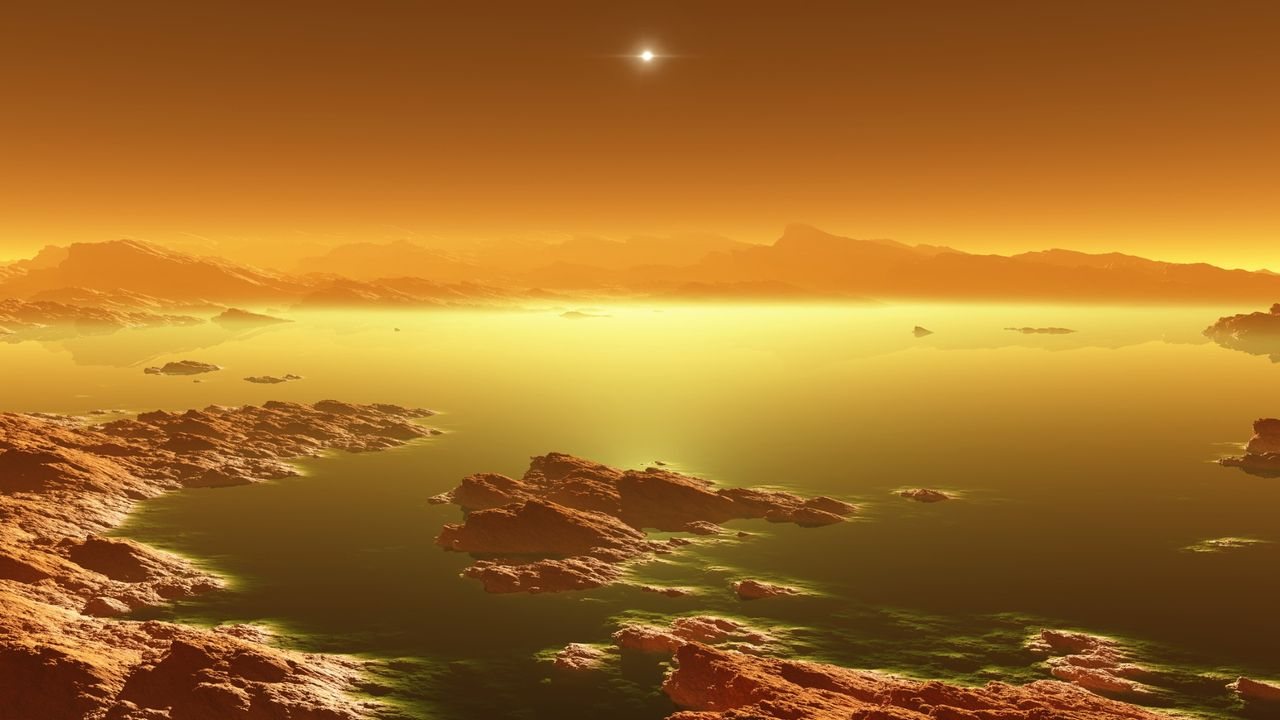
The exploration of Saturn’s largest moon, Titan, may ultimately be carried out by humanoid robots rather than human astronauts, according to recent discussions among space scientists and engineers. Titan, with its thick atmosphere, liquid methane lakes, and organic-rich surface, is considered one of the most promising locations in the solar system for studying prebiotic chemistry and the potential for life beyond Earth. However, the moon’s extreme cold, low gravity, and immense distance from Earth present formidable challenges for human exploration.
NASA’s Dragonfly mission, a rotorcraft lander scheduled to launch in 2027 and arrive at Titan in the mid-2030s, represents the next step in robotic exploration of this distant world. Dragonfly will fly between multiple locations on Titan, sampling materials and analyzing the surface composition. While this mission is designed to gather crucial data, it is not a humanoid robot. The concept of sending humanoid robots — machines with human-like form and dexterity — to Titan builds on the success of robots like NASA’s Robonaut and Valkyrie, which have been tested on Earth and aboard the International Space Station.
Humanoid robots could perform many tasks that human astronauts would carry out, such as setting up habitats, conducting repairs, and collecting samples, without the need for life-support systems or protection from radiation and extreme temperatures. Titan’s surface temperature hovers around minus 290 degrees Fahrenheit (minus 179 degrees Celsius), and its atmosphere is mostly nitrogen with a small amount of methane. These conditions would require any human visitor to wear a highly advanced spacesuit and live in a pressurized, heated habitat. Humanoid robots, by contrast, could be designed to withstand the environment directly, using advanced materials and electronics that function in the cold.
The distance between Earth and Titan also complicates human exploration. Titan orbits Saturn, which is about 886 million miles (1.4 billion kilometers) from the Sun, or roughly 10 times farther than Earth. A one-way communication signal takes about 80 minutes to travel between Earth and Titan, making real-time control of robots impossible. Humanoid robots would need to be highly autonomous, using artificial intelligence to make decisions and navigate the terrain without constant input from Earth. This is a significant technical hurdle, but advances in machine learning and autonomous systems are making such capabilities increasingly feasible.
Proponents of humanoid robots argue that they offer a practical intermediate step before sending humans to Titan. Robots could prepare the way by constructing landing pads, deploying power systems, and verifying that the environment is safe. They could also conduct detailed surveys of potential landing sites and resource deposits. If humans eventually travel to Titan, the robots could serve as assistants, performing dangerous or repetitive tasks while astronauts focus on scientific research and exploration.
Critics of the robot-first approach point out that human explorers bring intuition, creativity, and the ability to adapt to unexpected situations — qualities that are difficult to replicate in machines. They also note that the public imagination is more strongly captured by the idea of humans walking on another world, which can drive funding and political support for space exploration. However, the extreme environment of Titan may make human visits impractical for decades, if not centuries, to come. The cost and complexity of sending humans to the outer solar system are enormous, and the risks to crew health from radiation and isolation are not fully understood.
NASA and other space agencies are actively researching both human and robotic exploration strategies. The Artemis program aims to return humans to the Moon and establish a sustainable presence there, which will serve as a testbed for technologies needed for longer missions to Mars and beyond. Lessons learned from operating humanoid robots on the Moon and Mars could then be applied to missions to Titan and other outer solar system destinations.
In the near term, robotic missions like Dragonfly will provide essential data about Titan’s surface, atmosphere, and potential for life. This information will help engineers design future humanoid robots that can withstand Titan’s conditions and perform useful work. It will also inform decisions about whether and when to send human explorers. For now, the most likely path forward involves a gradual progression from simple robotic landers to increasingly capable humanoid machines, with human exploration remaining a long-term goal.
The question of who — or what — will first explore Titan is not merely academic. It shapes the direction of space policy, technology development, and international collaboration. If humanoid robots prove capable of handling the challenges of Titan, they could become the standard for exploring other hostile environments in the solar system, from the volcanic plains of Io to the subsurface oceans of Europa and Enceladus. In that scenario, the first footprints on Titan might not be human footprints at all, but the imprints of robotic hands and feet.
159