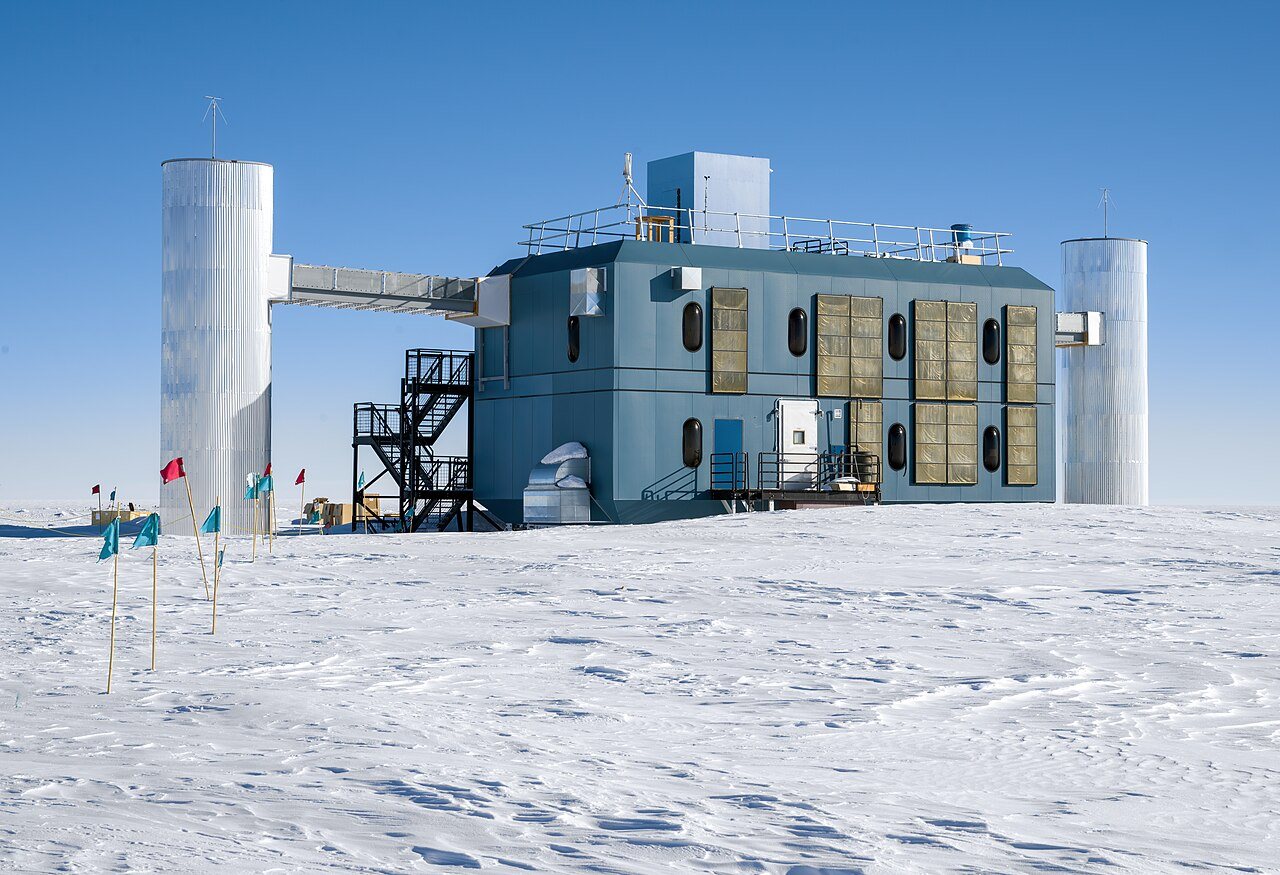
The IceCube Neutrino Observatory, a massive particle detector buried more than a mile deep in the Antarctic ice at the South Pole, has detected high-energy neutrinos from deep space, providing scientists with a new way to study the most violent and distant phenomena in the cosmos.
Neutrinos, often called «ghost particles» because they rarely interact with matter, are produced in some of the universe's most powerful events, such as supernovae, black holes, and gamma-ray bursts. Because they pass through planets, stars, and galaxies almost unimpeded, they carry information that light cannot deliver. IceCube was built to catch the rare occasions when a neutrino collides with an ice molecule, producing a faint flash of blue light that the detector's thousands of sensors can record.
The observatory consists of 5,160 digital optical modules suspended on strings like beads, frozen into a cubic kilometer of ice. When a neutrino interacts, the resulting charged particle emits Cherenkov radiation, which the sensors pick up and transmit to the surface for analysis. By reconstructing the direction and energy of the incoming neutrino, researchers can trace it back to its cosmic origin.
Since it began full operation in 2010, IceCube has detected dozens of high-energy neutrino events, including a notable 2017 detection that was linked to a blazar, a galaxy with a supermassive black hole at its center. That discovery marked the first time a neutrino source had been identified, ushering in a new era of multimessenger astronomy, where neutrinos, cosmic rays, and electromagnetic radiation are used together to study the universe.
The South Pole location is crucial. The ice is extremely clear and stable, and the rotation of the Earth allows the detector to scan the entire sky. The extreme cold and isolation also reduce background noise from human activity. Maintaining the facility requires a dedicated team of scientists and support staff who winter over at the Amundsen-Scott South Pole Station, enduring months of darkness and temperatures that can drop below minus 100 degrees Fahrenheit.
IceCube is supported by the National Science Foundation and an international collaboration of more than 300 scientists from 14 countries. Its findings have implications for astrophysics, particle physics, and cosmology, helping to explain how cosmic rays are accelerated and what happens in the most extreme environments in the universe.
Looking ahead, plans are underway for an expansion called IceCube-Gen2, which would increase the detector's volume by a factor of eight and improve its sensitivity tenfold. This next-generation observatory could detect thousands of neutrinos per year, allowing scientists to map the neutrino sky with unprecedented detail and potentially discover new physics beyond the Standard Model.
For now, IceCube continues to monitor the cosmos from its remote outpost, proving that some of the universe's deepest secrets can be revealed by listening for the faintest whispers in the ice.
18