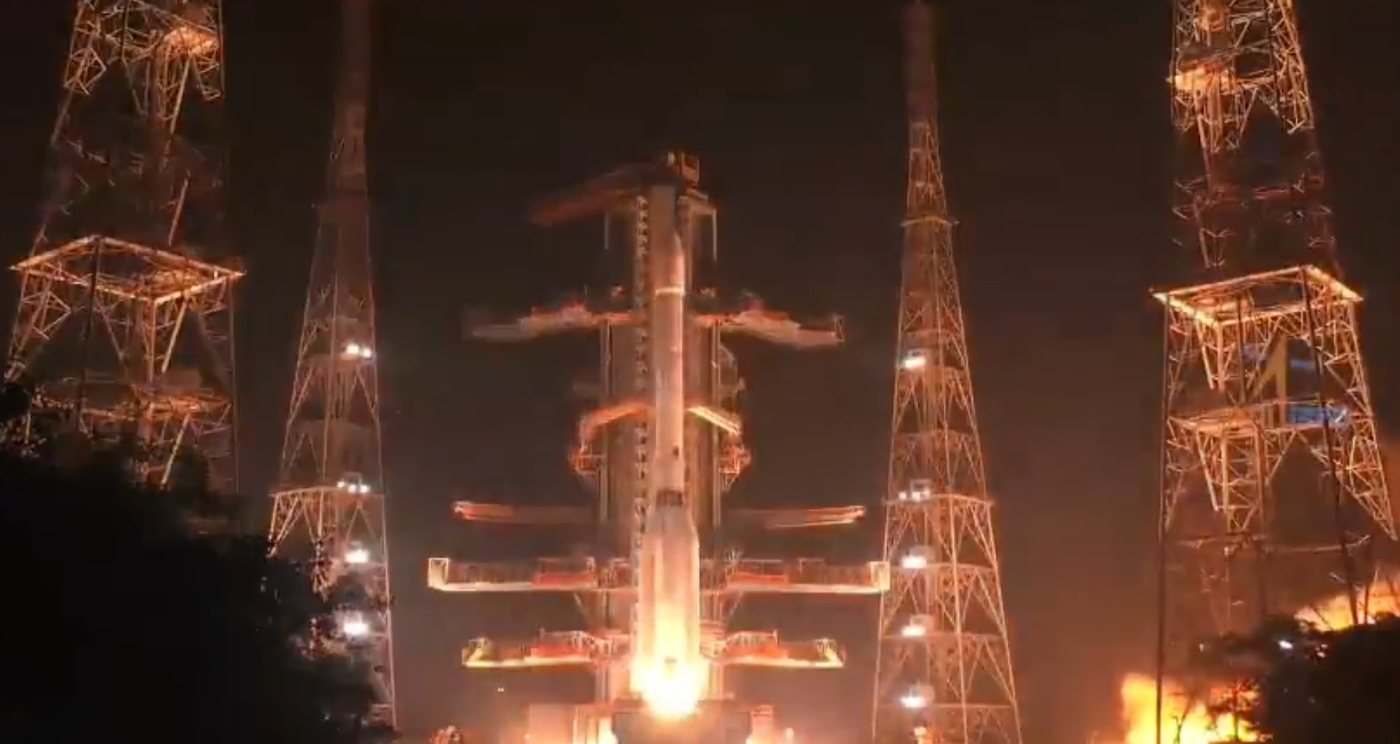
India’s space agency launched its next-generation navigation satellite, NVS-03, on Friday, a step that Prime Minister Narendra Modi said would strengthen the country’s indigenous satellite navigation system, NavIC. The Indian Space Research Organisation (ISRO) carried out the launch aboard its Geosynchronous Satellite Launch Vehicle, GSLV-F18, from the Satish Dhawan Space Centre in Sriharikota, Andhra Pradesh.
The rocket lifted off at 11:51 p.m. Indian Standard Time from the Second Launch Pad at the centre. ISRO announced the liftoff on X, describing the mission as the start of its effort to rescue and expand the NavIC system. The 50-metre-tall, three-stage rocket carried the 2,232-kilogram NVS-03 satellite toward a Geosynchronous Transfer Orbit. After deployment, the satellite will carry out orbit-raising manoeuvres to reach its designated geosynchronous slot at 32.5 degrees East. Reaching that slot is the step that will place the satellite in its operational position above the region it is meant to serve.
In a post on X, Modi congratulated the scientists and engineers at ISRO, saying the mission marks an important step in strengthening NavIC. He said the satellite’s enhanced capabilities would further India’s pursuit of self-reliance in critical technologies and support navigation services that benefit the public. He added that the dedication and ingenuity of the country’s space scientists continue to make the nation proud. The Prime Minister’s post was published on Saturday, a day after the launch, and was carried by the news agency IANS.
NVS-03 is the third satellite in the second-generation NVS series and is intended to augment the Navigation with Indian Constellation, the full name of NavIC. Its purpose is to ensure continuity of navigation services. The satellite carries an indigenous atomic clock alongside procured atomic clocks. It also incorporates the L1 navigation signal in addition to the existing L5 and S signals, which ISRO’s design adds to enhance the system’s navigation capabilities.
NavIC is India’s independent regional navigation satellite system, developed to provide accurate Position, Velocity and Timing services to users across the country. Its coverage extends about 1,500 kilometres beyond the Indian landmass. ISRO has envisaged launching five second-generation navigation satellites to augment the existing constellation, introduce enhanced capabilities and ensure continuity of services. Each addition to the constellation is meant to keep the system working reliably as older satellites age and as demand for precise positioning grows.
The latest mission is part of India’s wider effort to strengthen its indigenous space-based navigation infrastructure and reduce its dependence on foreign satellite navigation systems. Navigation satellites underpin services ranging from mapping and transport to timing for communications and financial networks, which is why the government has framed domestic capability as a question of self-reliance. The NVS-03 launch therefore marks progress on a long-running programme rather than a standalone event.
37