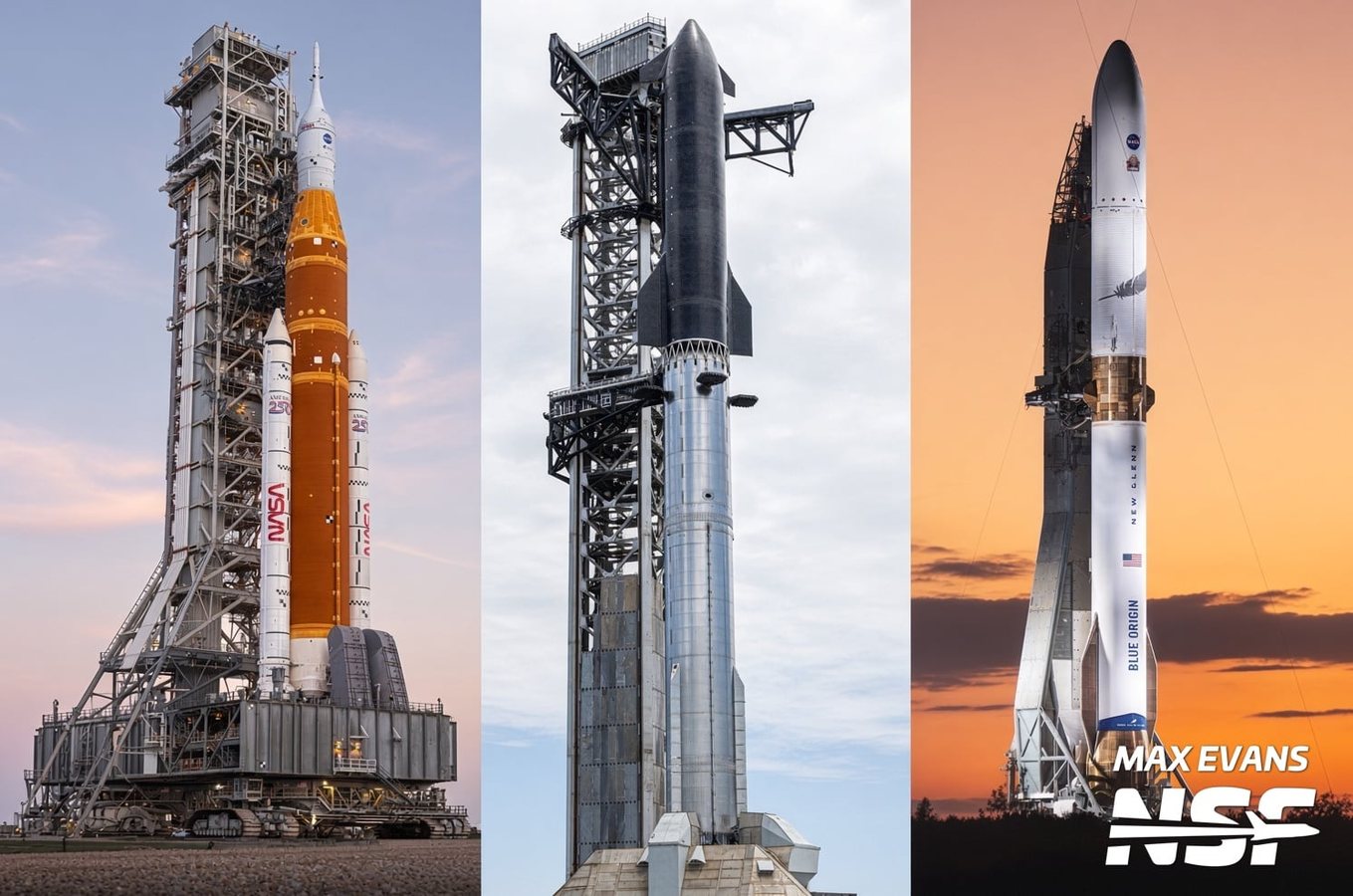
NASA will not commit its Space Launch System rocket to the Artemis III mission until Blue Origin's lander is already in orbit, NASA Administrator Jared Isaacman said in a recent interview. The mission will depend on a sequence of three launches involving three different vehicles and providers, a structure Isaacman described as unprecedented for a NASA crew mission.
"We're not going to launch without Blue Origin in it," Isaacman said. "That's why they're going to launch first. Like they need to be up there, do some checkouts, and then we commit SLS." Under the current plan, an initial New Glenn launch will carry Blue Origin's Blue Moon lander into orbit, where it is expected to loiter for roughly 30 days. The SLS and Orion crew launch will follow, and a Starship launch will complete the sequence.
Artemis III is planned as a complex low-Earth-orbit checkout and rendezvous campaign rather than a lunar landing. Its purpose is to exercise the three major flight elements together, gather operational data and build experience before a later crewed lunar landing attempt. The approach departs from the Apollo model and from earlier Artemis concepts that assumed a more tightly coupled architecture. It reflects both the realities of available hardware and NASA's interest in gaining experience with multi-vehicle rendezvous and docking before attempting a surface landing.
Isaacman said he sees the multi-launch profile as a preview of how future space infrastructure will be built. "That in itself is interesting in my mind because it's a signal of where we're going, which is everything we're going to build from here forward. You're going to have these multi-launch campaigns," he said. He added that the same approach would apply to autonomous assembly in orbit, noting that fleets of fission-powered spacecraft, if realized, would themselves require many launches to build.
Once SLS and Orion are committed and in orbit, the agency intends to extract as much value as possible from the Blue Moon element. Starship is expected to contribute high-definition imagery, controllability testing, and rendezvous and docking practice during a roughly two-week period that includes two planned rendezvous events. Isaacman described the visual and operational return from having all three vehicles in the same vicinity as "just so cool." He emphasized that the most important operational learning is expected from the Blue Origin side, noting that the company has not previously kept people alive outside the New Shepard suborbital environment for extended periods.
On schedule, Isaacman identified the lander as the primary remaining bottleneck. "For sure, the lander. We don't have a fully assembled Blue test article yet," he said, while acknowledging that Blue Origin is making substantial progress. He pushed back, however, on narratives that place sole responsibility for timeline pressure on the lander providers. He said NASA would insist on an Apollo 9-style low-Earth-orbit rehearsal even if the landers were fully ready today. That rehearsal would include undocking, translation and re-rendezvous before any lunar attempt. "The landers could be ready right now and we would still, and NASA would still insist on an Apollo 9 mission in low Earth orbit," he said.
Isaacman also said the agency has already made substantial changes to protect the overall schedule. NASA is embedding personnel and, in some cases, building hardware itself to keep multiple elements on track. He cited subcontractors that have had to prioritize higher-rated Department of Defense work, saying that without NASA's direct involvement the core stage would not be ready to meet the planned timeframes. He framed the effort as building operational experience, adding that the agency needs to "launch the big rocket" and extract as much as possible from each mission.
23