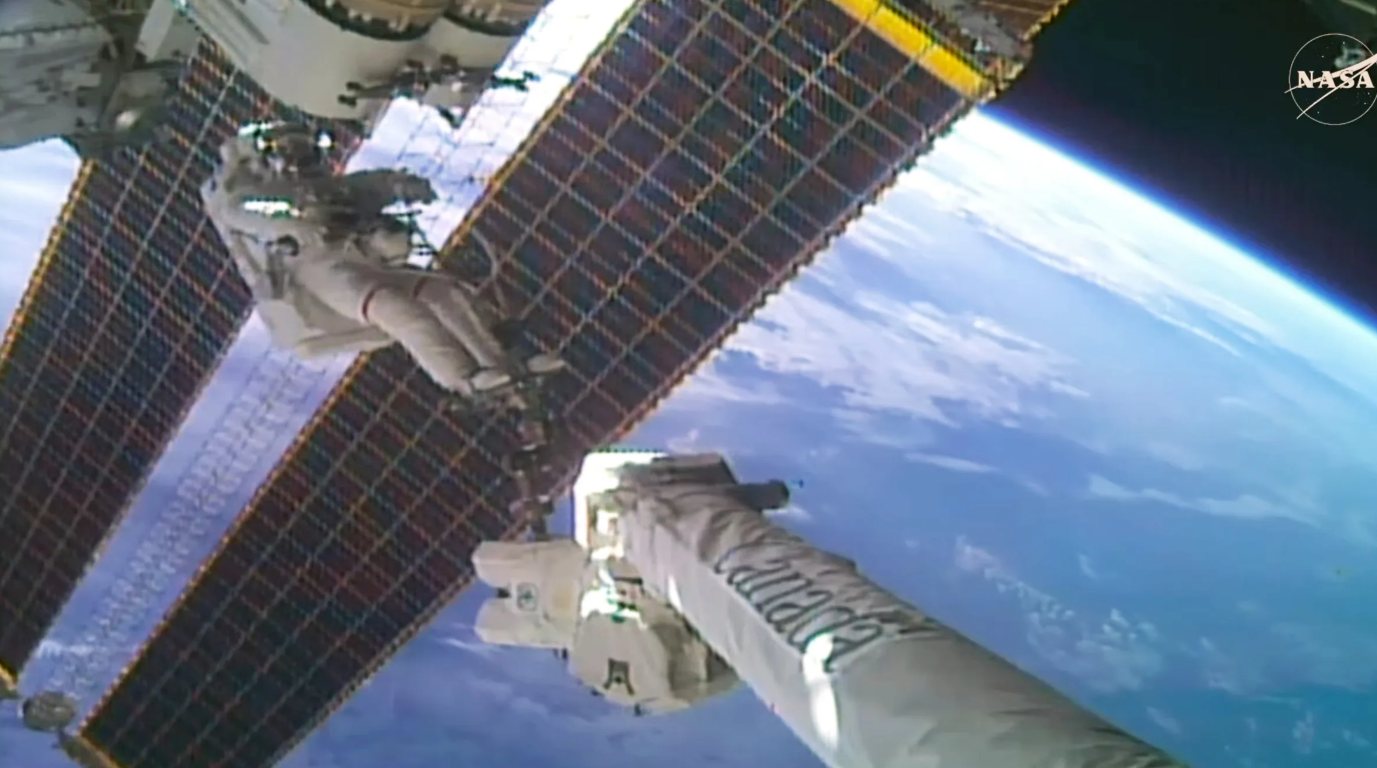
Two astronauts aboard the International Space Station completed a spacewalk that installed a new solar array and added power to the orbiting laboratory, NASA said. The mission was the 285th spacewalk at the station and the 100th conducted from the Quest airlock without the space shuttle present, a milestone that reflects how routinely the station's crews now carry out this kind of work from its own airlock.
NASA astronaut Anil Menon and Canadian Space Agency astronaut Joshua Kutryk were tasked with installing and deploying the International Space Station Roll-Out Solar Array, known as IROSA. The array helps provide additional power to the station, which relies on solar arrays to run its systems and scientific experiments. NASA said the mission was completed in 7 hours and 11 minutes, and the agency highlighted the outing on its official station account, where it announced the mission was accomplished after the new array was installed and the crew prepared for the next spacewalk.
After the installation, Menon and Kutryk returned to the Quest airlock, which ended the spacewalk. During the same outing, the astronauts also completed what NASA described as « get-ahead tasks » in advance of their next excursion. Those preparatory steps mean less work remains for the crew when they go back outside, a practical benefit for a schedule built around a sequence of solar array installations.
The next spacewalk is scheduled for November 5 and is expected to start early that morning, with NASA coverage beginning at 6:45 a.m. During that mission, the astronauts will install the eighth and final solar array to the 3B power channel. Installing the final array in that channel completes the upgrade sequence that began with the earlier installations.
Once the November 5 spacewalk is complete, NASA said all solar arrays will have been installed. That work is expected to increase the power available to the station by 30 percent. NASA said it will raise the station's generation ability from 160 kilowatts to 215 kilowatts, a gain that gives the orbiting lab more margin to operate its systems and the research carried out aboard it.
The report that accompanied the spacewalk drew on information released by NASA along with previous reporting by FOX 35, which has followed the station's operations. The spacewalks are part of a broader effort to keep the 25-year-old orbiting laboratory supplied with the electricity it needs for crew life support, experiments and station maintenance.
13