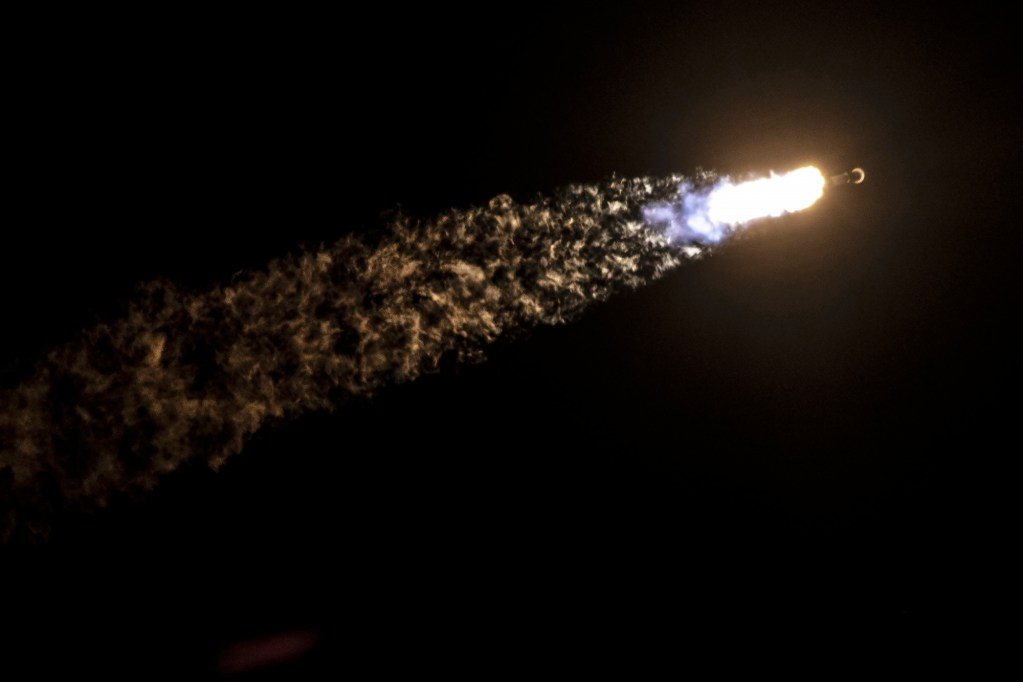
SpaceX is working with NASA on ways to prevent future upper-stage collisions with the moon, as a Falcon 9 upper stage is expected to hit the lunar surface this week. The cooperation reflects growing concern among space operators about what happens to rocket hardware left in unstable orbits after it finishes its main job.
The incoming stage was part of a Falcon 9 rocket that operated years ago and was left in a high orbit around Earth after its payload was released. In the time since, its path has been altered by the combined gravitational pull of the Earth, the moon and the sun. Trajectory models show the stage is now on course for an impact on the lunar surface, most likely on the far side of the moon.
SpaceX said it is studying the problem with NASA, but neither organization has publicly detailed the measures under consideration. In general, rocket operators can reduce the risk of unintended impacts by planning for the disposal of upper stages before launch. One approach is to reserve propellant for a final burn after payload deployment, allowing the spent stage to be sent away from the Earth-moon system or into a disposal orbit. Another is to design upper stages with better passivation and power systems so that, once their mission is complete, they are less likely to remain active or follow unpredictable paths.
The issue has become more pressing as the number of launches grows. Most missions to the moon, as well as many deep-space missions, place their upper stages in orbits that extend far beyond low Earth orbit. Those orbits can remain stable for years, but small variations in gravitational forces can gradually push unchecked hardware onto a collision course with the moon. The upcoming impact would be one of the first known cases of an uncontrolled rocket body striking the lunar surface.
Although the moon is uninhabited, the collision itself will not endanger people, but the event is not without consequence. A spent upper stage hitting the moon at high speed will create a new impact crater and scatter debris across the surrounding area. That matters at a time when NASA and its international and commercial partners are preparing to return astronauts to the moon and build a long-term presence there. Future landing sites and surface infrastructure could be affected by debris from older missions if disposal is not handled carefully.
The discussions between NASA and SpaceX are part of a broader push inside the space industry to improve the sustainability of operations beyond Earth orbit. For decades, operators focused on clearing debris from low Earth orbit, where satellites and station crews are at risk. The lunar environment received far less attention, largely because the moon has no atmosphere, no people and relatively little infrastructure. That is now changing as Artemis and commercial lunar landers make the moon a more active destination.
One of the difficulties is tracking objects far from Earth. Radar and optical telescopes that monitor satellites in low Earth orbit are not always suited to following small objects in highly elliptical orbits around the moon. The Falcon 9 upper stage was tracked with the help of astronomers and trajectory analysts, whose observations have been used to refine predictions of when and where it will hit. The final impact time and location may still shift slightly as new data arrives.
For SpaceX and NASA, the immediate goal is to understand how such collisions can be avoided in the future. That could mean changes to the way missions are designed, including how much fuel is set aside for end-of-mission maneuvers, how upper stages are built, and how disposal trajectories are chosen at the moment of launch. Whatever measures emerge, the episode is a reminder that the moon is no longer a distant destination beyond responsibility; it is an environment that will need the same care and planning as any place where human activity is expanding.