Student archaeologists working at a Roman frontier site in Redesdale, in northeastern England, have recovered a collection of military and personal objects that point to the presence of both soldiers and people of high standing. The finds, reported by Newcastle University, include a small gold chain, a lead sheet bearing a Latin inscription, and a gemstone engraved with a classical scene.
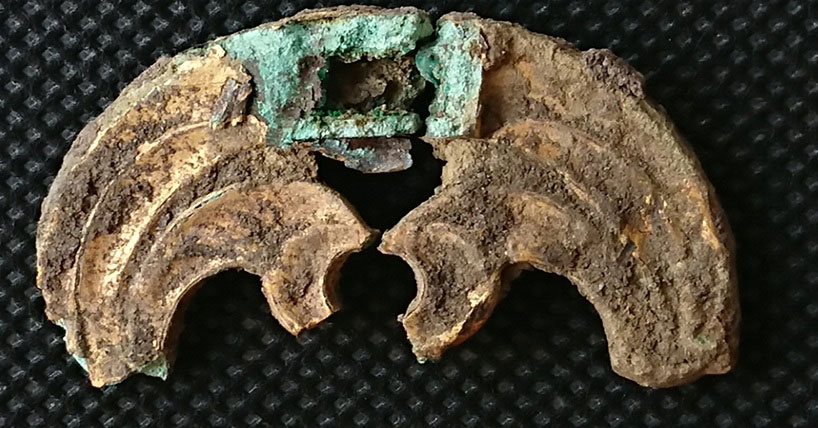
The most striking item is the gold chain, nearly three inches long and made of interlocking figure-eight rings. Alongside it, the excavators found a gilded bronze crescent-shaped fitting, which may have decorated a belt, a horse harness, or the scabbard of a sword. Such fittings suggest the owner was equipped and prominent, though the exact function of the piece remains open.
Perhaps the most intriguing find is the lead sheet with its Latin inscription. Researchers have not yet settled on its purpose. It could have carried a personal message, served as a curse tablet, or functioned as a commercial seal. Each possibility would reveal something different about daily life on the frontier, from private communication to trade and belief.
The team also recovered a carnelian intaglio, a small engraved gem showing the god Jupiter, the goddess Victory, and an eagle. It is the fourth such gem found at the site so far, a number that adds weight to the idea that the settlement attracted people of means. Other objects include coins, spearheads, and dress accessories, along with a bowl bearing the partial name "Martin," likely a shortened form of Martinus.
Taken together, the finds suggest a community linking military service with elite display and personal identity. The work also shows how student fieldwork can contribute to major archaeological discoveries, and the team is expected to continue analysing the material as the excavation proceeds.
Credit. Based on reporting by Jessica Esther Saraceni for Archaeology Magazine. Is this your work? Write to us.
18