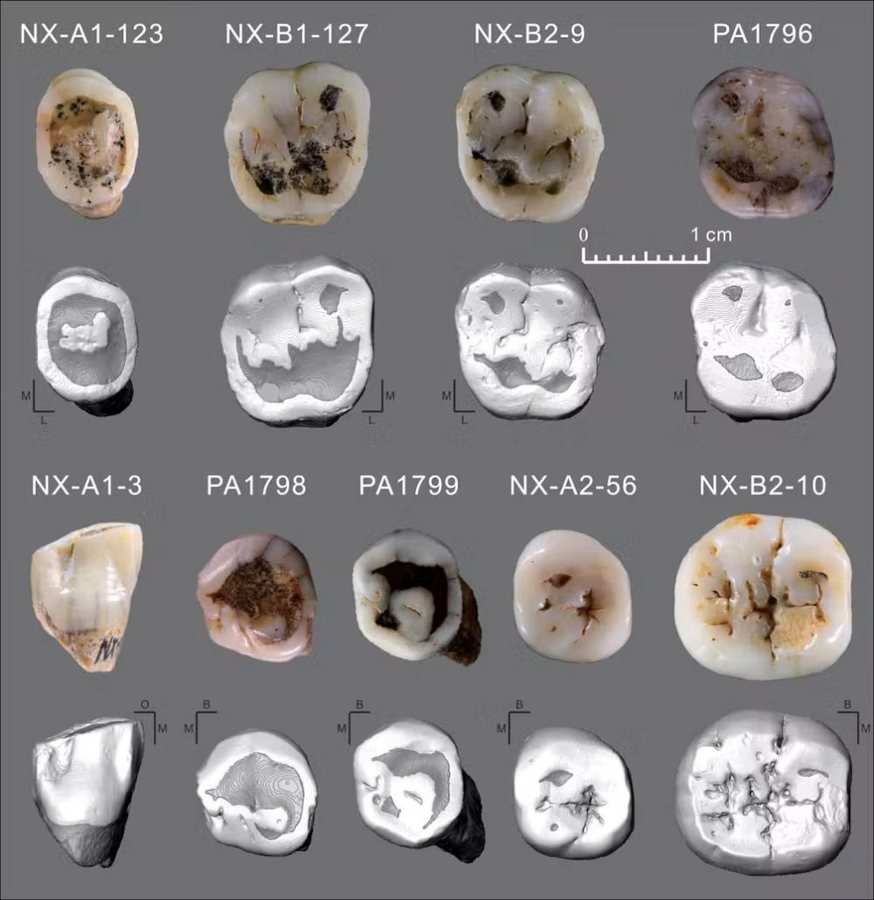
Eight teeth and other fossil remains found in two limestone caves in southern China indicate that Homo erectus survived in tropical rainforest environments until about 184,000 years ago, far later than researchers had assumed. The discovery, reported in the journal Nature by an international team that includes researchers from Macquarie University, suggests the species persisted in the region for a considerably longer period than previously believed.
The fossils come from the Baxian and Naxian caves, located about nine miles apart in steep limestone hills covered with dense tropical vegetation. Scientists dated the remains to a span of roughly 324,000 to 184,000 years ago, using the sediments and surrounding mineral formations in which the material was found. The teeth were identified as belonging to Homo erectus based on their physical traits and genetic signatures.
Chemical analysis of the teeth adds a further dimension to the findings. Strontium isotopes preserved in the enamel point to a rainforest habitat, and the individuals appear to have moved across a wide area of the landscape. That pattern undercuts the long-standing view that Homo erectus depended on open grassland or woodland and could not thrive in dense forest. It also challenges the idea that only modern humans were capable of surviving in rainforests.
Kira Westaway, a member of the research team, said the timeline has significant implications for how scientists understand the species' final chapter in East Asia. Researchers say the discovery reshapes the picture of where and how long these early humans lived, although the question of why Homo erectus eventually disappeared from the region remains unresolved.
Credit. Based on reporting by Jessica Esther Saraceni for Archaeology Magazine. Is this your work? Write to us.
17