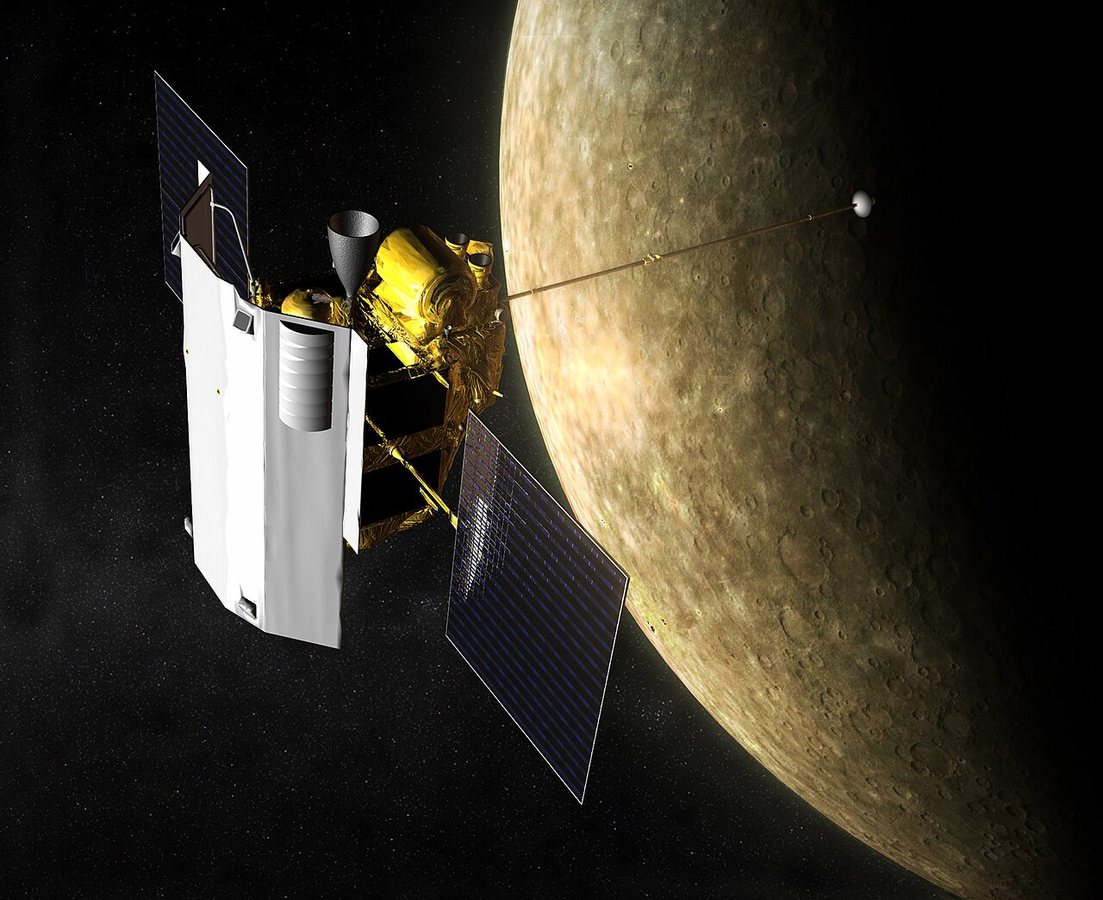
A joint European-Japanese spacecraft has arrived at Mercury, the smallest planet in the solar system and the one closest to the sun. The probe, BepiColombo, has completed a journey of more than eight years and roughly 6 billion miles, and it is now preparing to become only the second mission ever to enter orbit around the planet.
The critical step is a thruster firing scheduled for Saturday, which will slow the spacecraft enough for gravity to capture it into orbit. Everything depends on that burn. If it succeeds, the probe will begin the work it was built for. If it does not, the mission's plans around Mercury will be placed in serious doubt, which is why the maneuver is being watched closely by the teams running the project.
Mercury remains one of the least explored worlds in the inner solar system. Its surface has been studied only in limited detail, and many basic questions about its geology and history are still open. BepiColombo is designed to change that by mapping the planet's surface in fine detail and examining how its interior is structured.
Scientists are particularly interested in the planet's unusually large core, which makes up a far greater share of Mercury's size than in most rocky worlds. Understanding why the core is so large could shed light on how Mercury formed and evolved close to the sun. However, the researchers have not yet produced findings on the core, and those conclusions will only come once the orbital data has been collected and analyzed in the months ahead.
For now, the focus remains on Saturday's burn. Its outcome will determine whether one of the most ambitious planetary missions in recent years can begin returning the observations it was sent to gather.
Credit. Based on reporting by Ian Sample for The Guardian. Is this your work? Write to us.
13