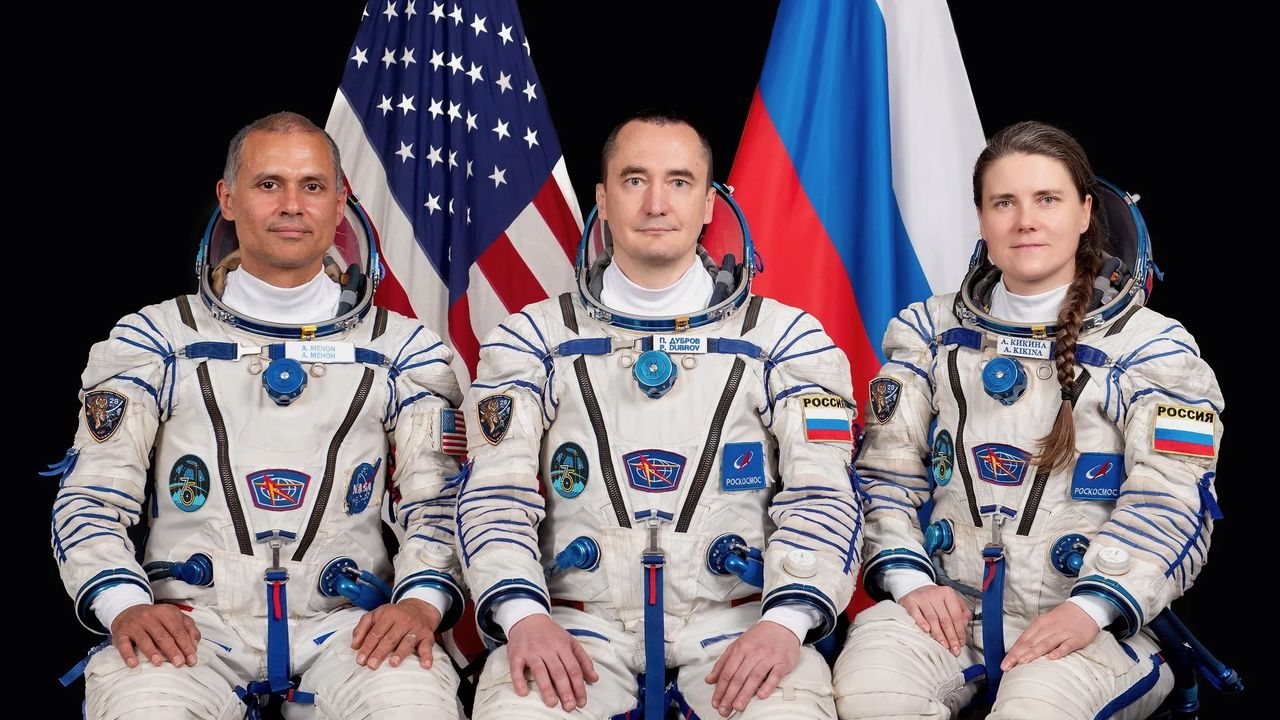
NASA astronaut Anil Menon and two Russian cosmonauts are scheduled to launch to the International Space Station (ISS) on July 14, marking another milestone in international space cooperation. The mission, designated Soyuz MS-29, will lift off from the Baikonur Cosmodrome in Kazakhstan, with live coverage provided by NASA and Roscosmos.
Menon, a NASA astronaut selected in 2021, will be joined by cosmonauts Alexei Ovchinin and Ivan Vagner of Roscosmos. The trio will travel aboard a Soyuz spacecraft, a workhorse of the Russian space program that has been ferrying crew to the ISS for decades. This launch continues the long-standing partnership between the United States and Russia in human spaceflight, even amid geopolitical tensions on Earth.
The Soyuz MS-29 mission is part of the regular rotation of crew to the ISS, which has been continuously inhabited since November 2000. The crew will spend approximately six months aboard the orbiting laboratory, conducting scientific experiments, maintaining station systems, and participating in educational outreach. The ISS serves as a unique platform for research in microgravity, with benefits for medicine, materials science, and technology development.
Anil Menon is a physician and former NASA flight surgeon who was selected as an astronaut candidate in 2021. He holds degrees from Stanford University and the University of Texas Medical Branch, and he has experience in emergency medicine and aerospace medicine. His inclusion in the crew highlights NASA's commitment to diversity and the integration of medical expertise into space missions.
Alexei Ovchinin is a veteran cosmonaut who has flown multiple missions to the ISS, including a 2018 launch that was aborted mid-flight due to a booster failure, from which the crew safely returned. Ivan Vagner is also an experienced cosmonaut, having completed a previous mission to the station. Their combined experience will be valuable for the mission's objectives.
The launch is scheduled for July 14 at 9:18 p.m. EDT (0118 GMT on July 15). NASA will provide live coverage starting at 8:30 p.m. EDT on NASA Television and the agency's website. Viewers can watch the launch, docking, and hatch opening events, which will occur over several hours. The Soyuz spacecraft is expected to dock with the ISS's Rassvet module about three hours after launch, following a two-orbit rendezvous.
This mission underscores the continued reliance on Russian Soyuz vehicles for crew transportation, even as NASA's Commercial Crew Program, with SpaceX's Crew Dragon and Boeing's Starliner, provides alternative options. The partnership has been a cornerstone of ISS operations, ensuring redundancy and resilience in crew transport. The Soyuz MS-29 launch will be the third crewed Soyuz mission of 2025, reflecting the steady pace of ISS crew rotations.
The ISS remains a symbol of international collaboration, involving space agencies from the United States, Russia, Europe, Japan, and Canada. Despite challenges, the partnership has endured, with crew exchanges and joint experiments continuing. The upcoming launch of Menon, Ovchinin, and Vagner is a testament to this enduring cooperation.
For those interested in watching the launch, NASA's coverage will include commentary, pre-launch interviews, and post-launch analysis. The event is expected to draw significant public interest, as space exploration continues to captivate audiences worldwide. The Soyuz MS-29 mission represents another step in humanity's ongoing presence in space, with the crew set to contribute to scientific discovery and international goodwill.
99