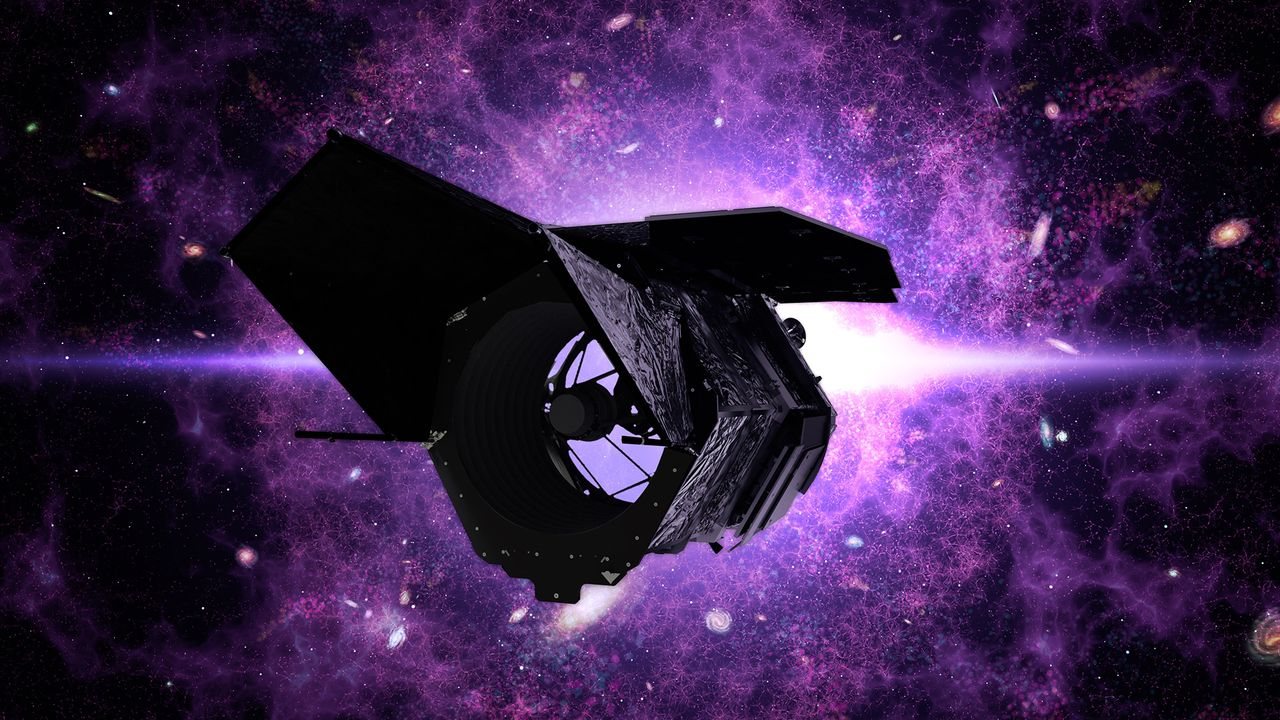
NASA has successfully launched its $4.3bn Nancy Grace Roman Space Telescope, a flagship observatory designed to investigate the dark universe and survey the cosmos on an unprecedented scale. The spacecraft lifted off atop a SpaceX Falcon Heavy rocket from Florida's Kennedy Space Center at 7:26 am local time on 30 August, beginning a mission that scientists say will transform understanding of dark energy, dark matter, exoplanets, and black holes.
The observatory will spend three months traveling to the second Sun-Earth Lagrange point, known as L2, a gravitationally stable location about 1.6 million kilometers from Earth. From that vantage point, Roman will survey space with a field of view at least 100 times greater than that of the Hubble Space Telescope, allowing it to map billions of galaxies and capture data at a rate higher than any previous NASA astrophysics mission.
Roman carries a 2.4-meter primary mirror and two scientific instruments. A wide-field instrument will capture images in visible and near-infrared light, while an experimental coronagraph will use masks, prisms, and mirrors to block starlight and directly detect exoplanets. The combination is expected to yield insights into the nature of dark energy and dark matter, two of the most persistent mysteries in modern physics.
Nicola Fox, associate director for NASA's Science Mission Directorate, described the telescope as a discovery machine. She said Roman will bring researchers closer than ever to answering fundamental questions about cosmic history. NASA administrator Jared Isaacman praised the mission as a success story, noting that it was completed ahead of schedule and on budget, and said it demonstrates what is possible when the space program combines ambition with disciplined execution.
NASA intends the observatory to operate for at least a decade, with three major surveys planned for its first five years. The first survey will identify tens of thousands of distant supernovae, far more than the roughly 2,000 currently known. The second will observe more than a billion galaxies. Together, these measurements will be combined with data from other survey telescopes to improve understanding of dark energy and its possible role in the accelerating expansion of the universe. Observations of gravitational lensing will also allow astronomers to map the distribution of dark matter.
A third survey will focus on the center of the Milky Way, searching for signs of gravitational microlensing that could reveal more than 2,000 otherwise invisible exoplanets. The telescope's wide-field capabilities will allow it to scan large regions of the sky quickly, providing targets that other instruments, such as the James Webb Space Telescope, can then examine in greater detail.
The observatory was originally known as the Wide-Field Infrared Survey Telescope before undergoing several design changes due to cost pressures. In 2020, it was renamed in honor of Nancy Grace Roman, who served as NASA's first chief astronomer in the early 1960s and is widely known as the mother of the Hubble Space Telescope. Roman will not replace Hubble or Webb but will complement them, offering broad surveys that those instruments can follow up with high-resolution observations.
Roman is expected to survey the universe about one thousand times faster than Hubble, generating roughly 1.4 billion terabytes of information daily. NASA says machine learning, artificial intelligence, and citizen science will be used to help sift through the massive data stream and flag findings for astronomers to study.
117