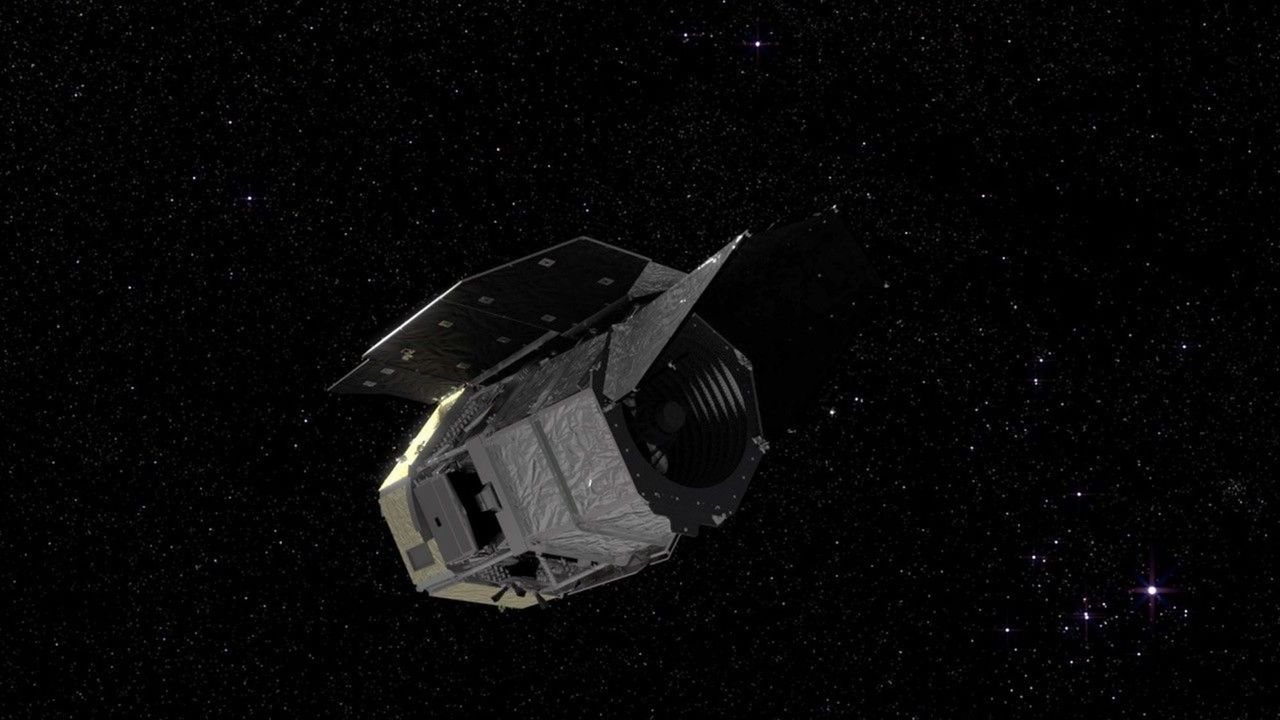
NASA's Nancy Grace Roman Space Telescope will operate for roughly 22 years instead of the 11 years originally planned, after engineers executed a highly precise engine burn that conserved propellant and doubled the mission's scientific lifetime. The adjustment means the observatory, designed to investigate dark energy, dark matter, and exoplanets, can continue collecting data well into the 2040s.
The burn was carried out with such accuracy that it used far less fuel than mission planners had budgeted for the maneuver. That surplus propellant is what allows the telescope to remain operational for an additional decade. The Roman team confirmed the result, describing the outcome as a major gain for the mission's science return.
The Roman Space Telescope is built to survey the universe with a field of view roughly 100 times larger than that of the Hubble Space Telescope, while matching Hubble's sharpness. Its wide-angle infrared vision is intended to tackle some of the biggest open questions in astrophysics, including the nature of dark energy, the acceleration of the universe's expansion, and the distribution of dark matter.
Beyond cosmology, the observatory will search for and characterize exoplanets using a technique called gravitational microlensing, which can detect worlds at greater distances from their stars than other methods. It will also test new technologies, including a coronagraph instrument designed to block starlight and directly image planets around other stars.
The extended lifetime matters because Roman is a survey mission. More years in orbit translate directly into more sky observed, more data collected, and a larger legacy archive for the global astronomy community. Missions of this scale are planned around finite fuel budgets, and any propellant saved early can be spent later on orbit maintenance and pointing adjustments.
The engine burn was not a routine maneuver. It required extreme precision to place the spacecraft on the correct trajectory while avoiding waste. By executing the burn so efficiently, the mission effectively bought itself a second decade of operations at no additional hardware cost.
NASA has not announced a new launch date in connection with the lifetime extension, but the mission remains on track for launch in the coming years. Once in space, Roman will operate at the second Sun-Earth Lagrange point, a gravitationally stable region about 1.5 million kilometers from Earth, where it can maintain a clear view of the cosmos with minimal fuel expenditure.
The doubled lifetime also has implications for how astronomers plan future surveys. A longer mission allows for repeated observations of the same regions, which can reveal changes over time, such as supernovae brightening and fading or stars shifting position. Those time-domain measurements are central to understanding cosmic expansion.
For the scientists and engineers who designed the mission, the result is a reminder that careful navigation and propellant management can reshape what a telescope can achieve. Roman was already expected to deliver transformative data. With 22 years instead of 11, its contribution to astronomy could be far larger than originally envisioned.