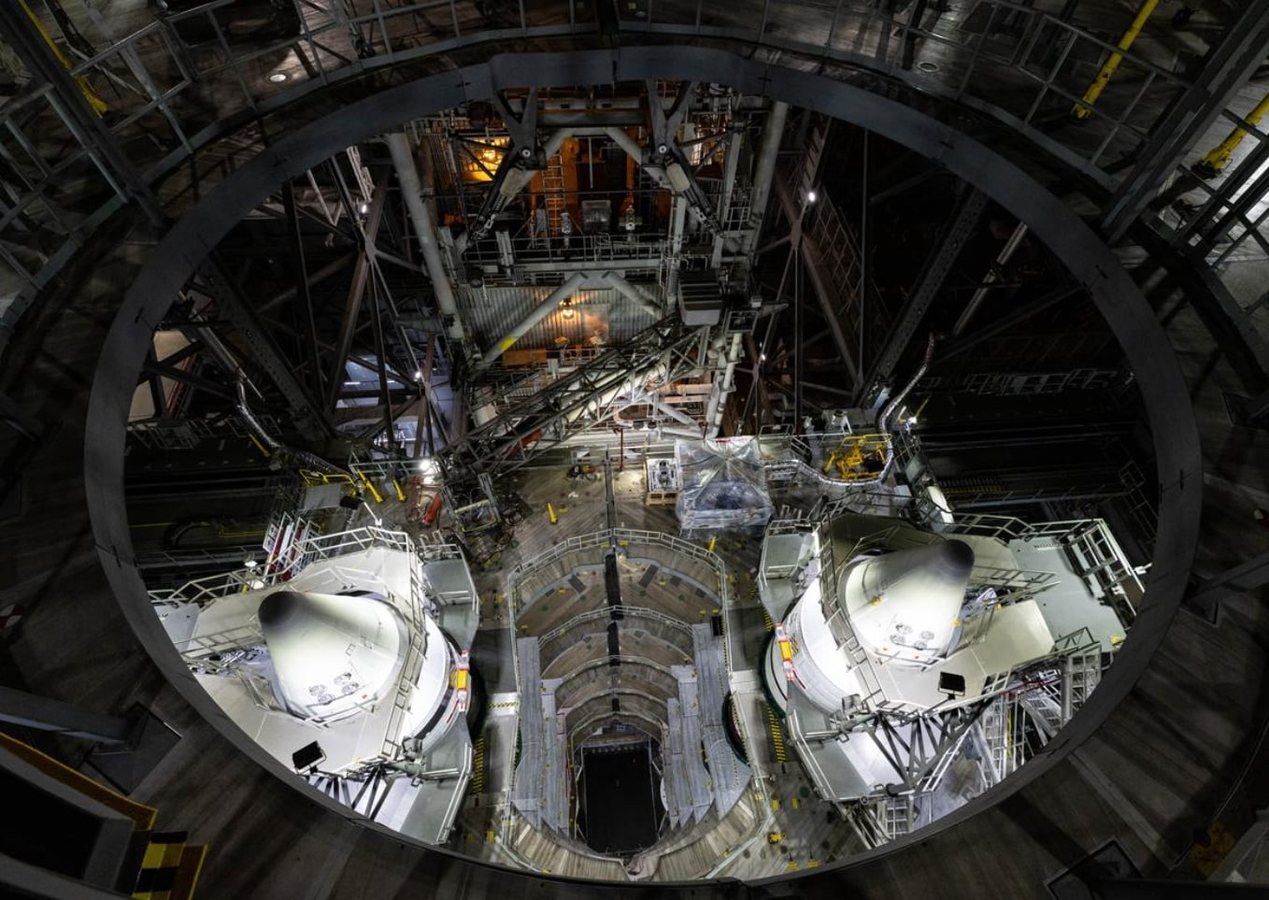
NASA has stacked the center segments of both Artemis III solid rocket boosters on Mobile Launcher 1 at Kennedy Space Center, moving the Space Launch System closer to mating with its Core Stage. The twin five-segment boosters are being assembled inside the Vehicle Assembly Building, where the first pair of aft segments was placed on the launcher on July 13.
The right aft-center segment followed on August 12, directly above the aft segments, and the center segments were lifted and stacked on August 20, right booster first and left booster second. Two motor segments remain on each booster and will be capped by the nose cones and forward skirts, which are already inside the Vehicle Assembly Building awaiting installation.
Artemis III is currently targeted for no earlier than June 2027. Although it will not go to the Moon, the mission will carry an Orion spacecraft and a crew of four to test the lunar modules alongside the spacecraft in low Earth orbit.
Booster stacking continues in High Bay 3, while in High Bay 2 teams are preparing the Core Stage. Its tank section arrived from New Orleans in the spring and was mated to the engine section shortly afterward, and engine installation is now underway. NASA images have periodically provided updates on the installation of the RS-25 engines into the Core Stage ahead of mating with the two solid rocket boosters on Mobile Launcher 1.
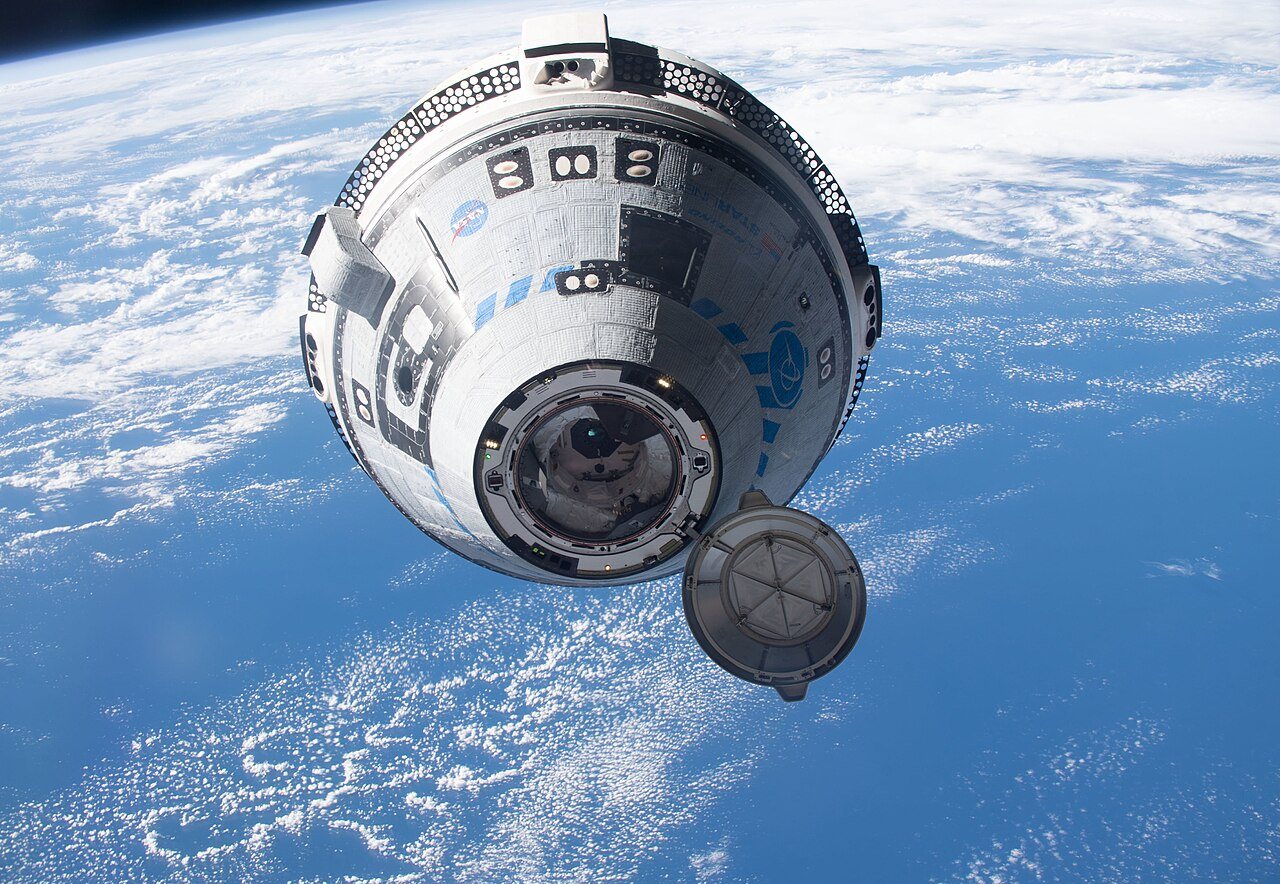
At the Operations and Checkout Building at Kennedy Space Center, engineers have completed umbilical connections between the Artemis III Orion crew module and its European Service Module. The crew module was powered through those umbilicals for the first time, confirming the electrical connection between the two modules before further integrated testing.
Teams at Marshall Space Flight Center are preparing the spacer that will fly in place of the Interim Cryogenic Propulsion Stage, which is not required on this mission. Welding of the spacer barrel finished several weeks ago, and teams have since added the forward ring that will join the spacer to the Launch Vehicle Stage Adapter, the conical interstage. A second ring will be welded to the opposite end for the connection to the Orion Stage Adapter, which is also in work at Marshall.
For Artemis III, NASA plans to fly the structural test articles of the Launch Vehicle Stage Adapter and the Orion Stage Adapter, keeping the flight units for Artemis IV. The test articles have been in storage for years and require additional work before launch. Images released with the early October update show teams working on the Orion Stage Adapter, which will receive paint and insulation before installation on SLS next year.
Work is also visible on later Core Stages. NASA released images and video of the liquid hydrogen tank for Core Stage 4 after proof testing at the Michoud Assembly Facility in New Orleans, a test that ended in September. The tank will now be cleaned and prepared for further outfitting. Core Stage 4 is assigned to Artemis IV, currently planned for 2028, with Artemis V the next mission in the sequence.
For Artemis V, NASA recently showed the engine section barrel being moved into the Vertical Assembly Center at Michoud, where it will receive the ring used to mate it to the liquid hydrogen tank. The engine section is the most complex part of the Core Stage and remains the furthest along in production.
Hardware production has also started for the Core Stage associated with Artemis VI, even though NASA's stated plan is to transition to commercial vehicles for crew flights to lunar orbit after Artemis V. The part now in work is a connecting ring of the type used to join major stage elements. Once finished, it would be welded to the engine section of Core Stage 6 if that stage continues through assembly. The work is consistent with long-lead manufacturing started as a contingency if commercial alternatives are not ready after Artemis V, and whether the hardware proceeds to a completed stage is not yet clear.
12