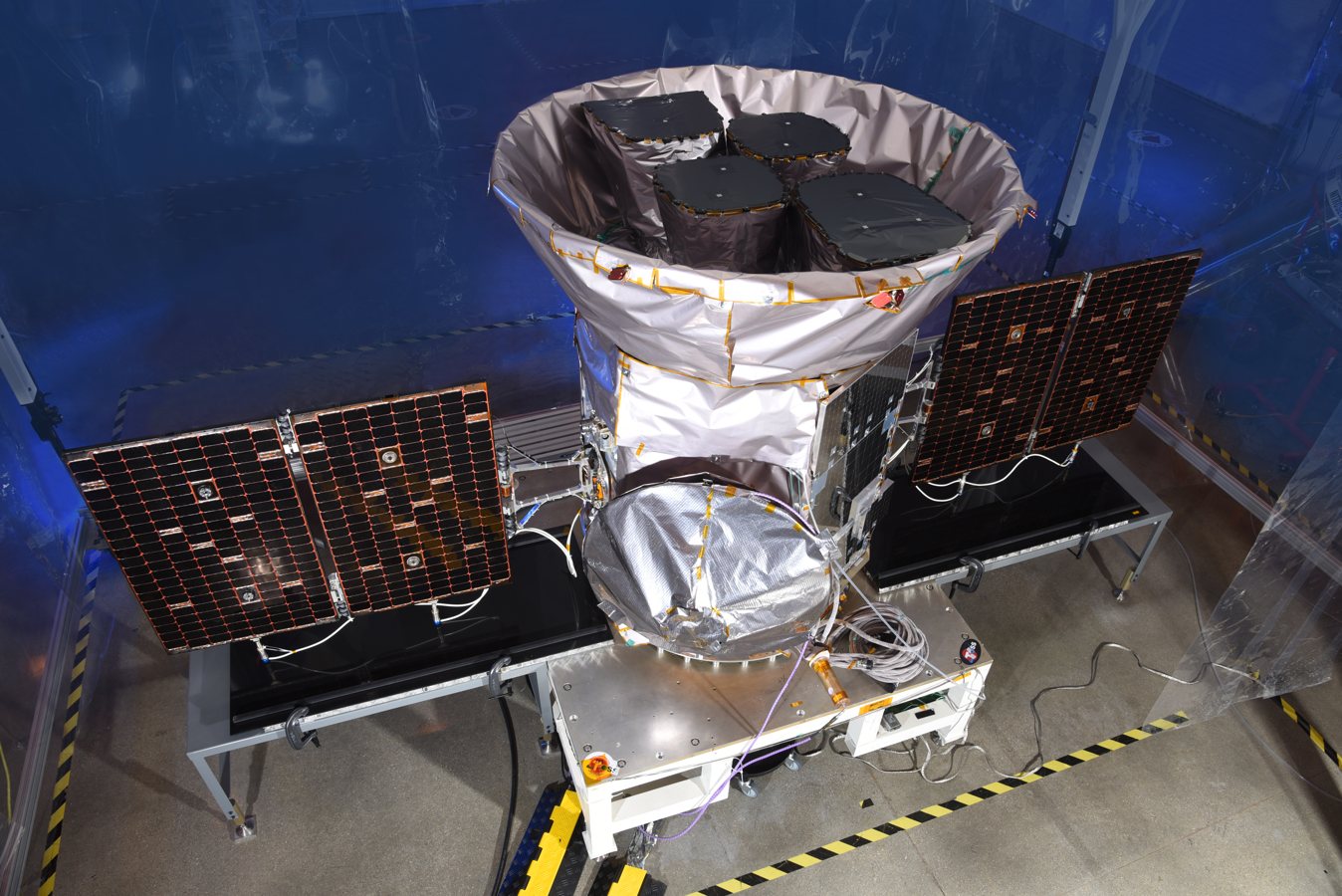
For the first time in its mission, NASA’s Transiting Exoplanet Survey Satellite (TESS) has identified a planet using gravitational microlensing, a technique that exploits the distortion of light caused by the planet and its star. The discovery, reported in a paper published this month in The Astrophysical Journal Letters, marks a significant milestone for the space telescope, which was originally designed to detect exoplanets through the transit method.
The planet, designated Gaia23bra b, was initially detected in 2023 by the European Space Agency’s Gaia satellite and classified as a microlensing event. TESS’s subsequent observations confirmed the planetary nature of the object. “When the TESS mission launched, no one expected it would ever be able to find a planet of this type,” said Diana Dragomir, a professor at the University of New Mexico and co-author of the study. “The discovery implies that there are likely other such planets hidden in TESS data that we had never thought to look for before.”
Gaia23bra b is a super-Jupiter exoplanet that orbits its host star, an orange dwarf, at a distance roughly equivalent to that between Jupiter and the Sun. The system acted as a gravitational lens, amplifying the light from a more distant background star during a brief alignment. This microlensing event allowed TESS to detect the planet’s signature in the light curve, even though Gaia’s measurements alone were insufficient to confirm its presence.
“Gaia’s measurements were not enough to detect the planet, but TESS was monitoring the same area of the sky at the time of the event, and its more frequent observations over time allowed us to notice certain details in the light curve caused by Gaia23bra b,” explained Mallory Harris, a doctoral student at the University of New Mexico and lead author of the paper.
Of the more than six thousand exoplanets known to date, about three-quarters have been discovered through the transit method, which TESS typically uses. That technique is most sensitive to objects close to their stars, as they are more likely to cross in front of them. Microlensing, by contrast, is more effective at finding planets with orbits similar to Earth’s or larger, making it a valuable tool for studying star systems analogous to our own solar system.
In microlensing, light from a background source is bent as it passes through the distorted spacetime caused by the mass of a foreground star. When the alignment is particularly tight, the foreground star acts as a lens, focusing and amplifying the light from the source. Planets orbiting the lens star can contribute to the effect by acting as smaller lenses themselves, producing a distinct peak in the brightness of the source star.
“The main advantage of microlensing lies in the type of planets it is sensitive to. Those in very tight orbits essentially behave as if they were part of the star’s mass and do not produce a distinct signal,” Harris noted. “With this technique, we can find smaller planets with wider orbits, including worlds that lie in the habitable zone of their star and even farther out.”
The two detection methods also provide different types of information. “Transit reveals the size of a planet, from which we can then estimate its mass and density,” Dragomir said. “Microlensing, on the other hand, gives us the masses and orbital distances of planets that we would never have seen without this technique.”
However, microlensing has a major drawback: the observations represent time-limited opportunities. “Microlensing events happen once and do not repeat,” Harris said. “I like to joke that we will probably find the first Earth-like planet and be forced to wave goodbye because we will never see it again.” This makes detailed follow-up observations difficult, but the sample of planets discovered through this method continues to grow. Over time, it is becoming possible to study not only the formation and evolution of planetary systems but also how common exoplanets in wide orbits are throughout the galaxy.
119