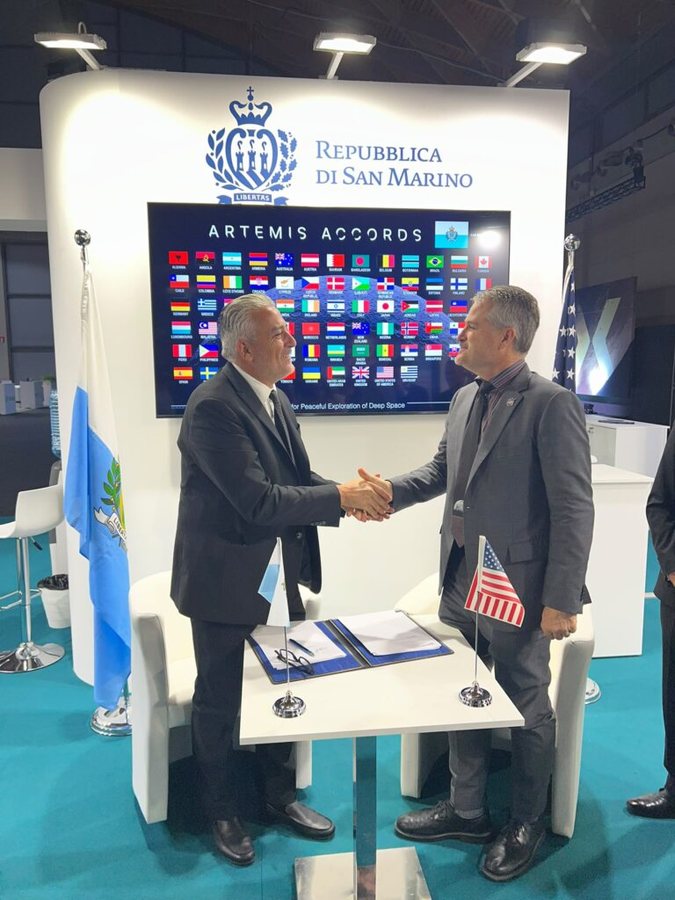
San Marino has formally signed the Artemis Accords, becoming the 74th country to join the international framework governing cooperation in space exploration. The signing was carried out by Secretary of State for Industry Rossano Fabbri in the presence of U.S. Consul General Joe Tordella and NASA's Europe lead Gregory Mann, closing San Marino's participation in the Beyond Exploration Expo in Rimini.
The accords commit signatories to principles of transparency, data sharing, and responsible behavior in space. Mann emphasized that contemporary exploration programs rest on transparency and the sharing of scientific data, describing the agreements as the ideal framework for countries now entering space to benefit from discoveries and develop advanced technological skills. The signing marks San Marino's most visible step yet toward integrating itself into international space governance.
Beyond the formal signature, San Marino used the three-day expo to lay out the industrial and legal architecture it hopes will secure a position in the New Space Economy. The strategy combines a lean sovereign state with a new regulatory framework designed to offer predictable timelines and rapid responses to private operators. The approach was promoted by the Congress of State in implementation of directives from the «Next Economy» Forum, and brought together institutions, universities, and corporate finance.
The cornerstone of the plan is a framework law on the Space Economy drafted by legal scholar Anna Masutti, a professor at the University of Bologna. The law harmonizes United Nations treaties and the European Space Act with the needs of free economic initiative. It establishes a fast authorization regime, transparent registration of space objects, and strict rules on civil liability and safety — measures Masutti described as indispensable for attracting foreign capital.
Fabbri framed the accords as part of a broader industrial strategy rather than a symbolic gesture. «We are here to structure a reactive and competitive ecosystem», he said. «We are not seeking a facade presence. We want to offer foreign investors a unique regulatory and operational framework, capable of integrating our companies into international aerospace value chains. Dialoguing on equal terms with the world's leading agencies and signing agreements of global relevance demonstrates that the Republic possesses the logical tools and the determination to act as a catalyst for innovation».
Interest in San Marino's path was underscored by a meeting at the Republic's stand between Fabbri and Colonel Walter Villadei, an Italian Air Force astronaut who piloted the Axiom-3 mission to the International Space Station and was named a Knight of the Order of Sant'Agata during San Marino Aerospace. Villadei met with the San Marino delegation to discuss the sector's prospects.
European integration was also on the agenda. Alexander Soucek, head of international relations at the European Space Agency, stressed the importance of continental technological sovereignty and identified ESA as the natural reference point to guide San Marino toward inclusion in European research programs.
The closing session of the Stati Generali della New Space Economy returned to themes of innovation ecosystems and technology transfer. Secretary of State for Labor and Technological Innovation Alessandro Bevitori called for a permanent link between basic research and enterprise, arguing that innovation requires stable infrastructure and dedicated financial instruments to position the Republic as an agile hub capable of hosting startups and supporting local companies through industrial reconversion.
Operational models and innovation services were detailed by John Mazza, sole administrator of San Marino Enterprise, who presented an action plan to connect the San Marino economic fabric with international buyers. Nicolas Rossini, head of innovation at San Marino Innovation, confirmed that the New Space Economy will serve as the pilot worksite for refining business support infrastructure, with strategic input from Denis Cecchetti, director general of the Economic Development Agency and Chamber of Commerce, on investment attraction and internationalization.
International perspectives enriched the discussion. Wil Benton, founder of Metta Partners, highlighted how rigorous mentorship and targeted advisory networks are essential to reduce the mortality of young companies in their first months. From India, Amit Sachdeva of the INSPACE agency described the support architecture built by ISRO to orient private actors. The contacts made at the expo are now underway, with San Marino aiming to convert its regulatory framework and sovereign agility into durable aerospace partnerships.
14