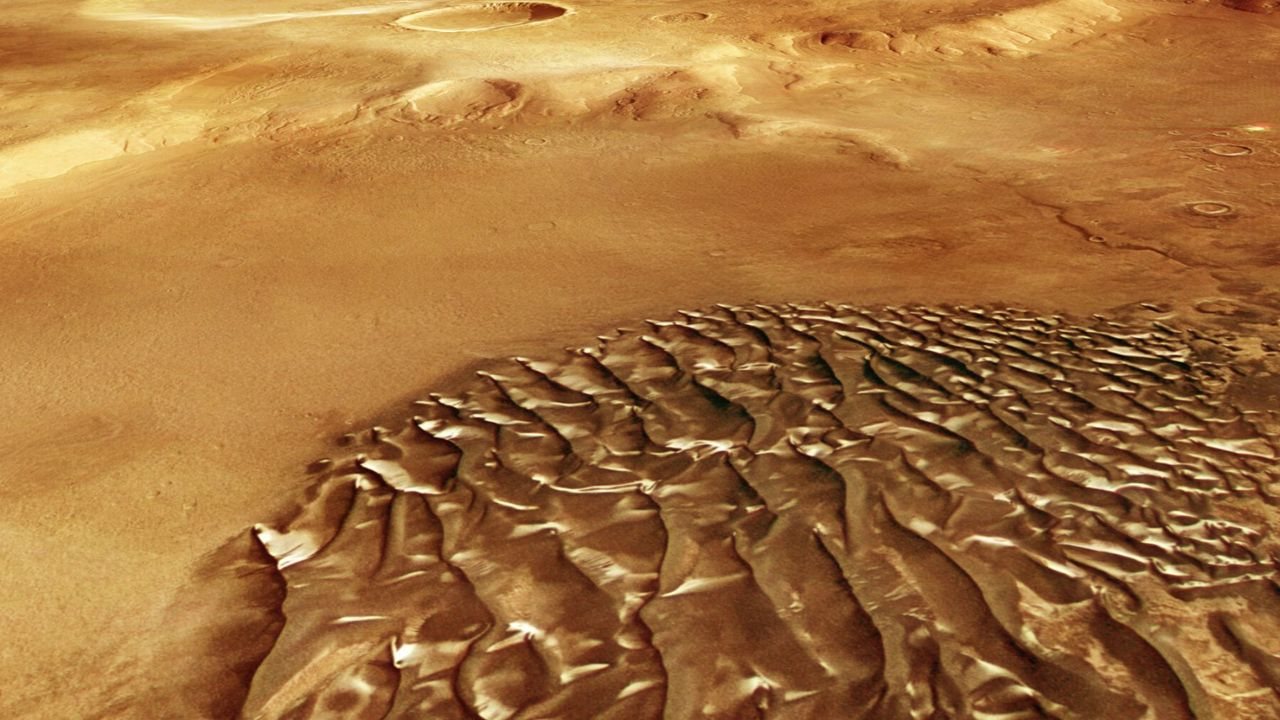
Strange, metallic-looking dunes on the surface of Mars have long intrigued scientists and the public alike, often evoking comparisons to science fiction landscapes. Now, researchers have provided a clear explanation for these unusual features, confirming they are not made of metal but are instead composed of volcanic glass and minerals shaped by eons of wind erosion and geological processes.
The dunes, located in the northern lowlands of Mars near the planet's north polar ice cap, appear in high-resolution images from NASA's Mars Reconnaissance Orbiter as dark, shiny patches that stand out against the surrounding reddish terrain. Their reflective quality led to early speculation that they might contain metallic elements, but a new study published in the Journal of Geophysical Research: Planets has settled the question.
Led by scientists at the Planetary Science Institute in Tucson, Arizona, the research team analyzed spectral data from the orbiter's Compact Reconnaissance Imaging Spectrometer for Mars (CRISM) instrument. They found that the dunes are rich in volcanic glass, also known as obsidian, along with minerals such as pyroxene and feldspar. These materials, when ground into fine particles by persistent Martian winds, produce a smooth, reflective surface that mimics the appearance of polished metal under certain lighting conditions.
«The dunes are not metallic in the sense of containing native metals like iron or copper,» said Dr. Mary Bourke, a planetary geomorphologist at Trinity College Dublin and co-author of the study. «What we are seeing is the result of volcanic activity billions of years ago, followed by extensive wind erosion that has rounded and polished the grains until they reflect light in a way that looks metallic to our instruments.»
The process begins with ancient volcanic eruptions that deposited layers of ash and lava across the Martian surface. Over time, these deposits cooled into glass-rich rocks. Wind, which is a dominant force on Mars due to its thin atmosphere, then transported and abraded the material, creating dunes composed of smooth, dark particles. The lack of liquid water and vegetation on Mars means these dunes remain largely undisturbed, preserving their unusual appearance.
Understanding the composition of these dunes is important for several reasons. It provides clues about the volcanic history of Mars, which remains poorly understood compared to Earth. The presence of volcanic glass also suggests that explosive eruptions occurred on Mars, a finding that has implications for the planet's past climate and potential habitability. Volcanic glass can trap gases and organic compounds, offering a possible archive of ancient Martian environments.
The study also has practical implications for future Mars exploration. The dark dunes could be a hazard for landing spacecraft, as their low albedo means they absorb more heat, potentially affecting thermal conditions. Conversely, they might serve as a resource for future human missions, as volcanic glass can be processed to produce building materials or even water if heated.
«These dunes are a window into Mars' volcanic past,» said Dr. Bourke. «They also remind us that even familiar-looking features on other planets can have surprising origins. What looks like metal is actually a story of fire and wind written in sand.»
The findings add to a growing body of research that uses orbital data to decode the geological history of Mars. As NASA's Perseverance rover continues to explore Jezero Crater and prepare samples for return to Earth, studies like this help scientists build a more complete picture of the Red Planet's evolution.
For now, the metallic dunes remain one of Mars' most visually striking features, a reminder that the solar system is full of landscapes that challenge our Earth-bound expectations. With each new analysis, scientists are slowly unraveling the processes that shaped them, turning science fiction into science fact.
107