Six missions are set to lift off from launch sites across the globe this week, highlighting the growing diversity of commercial and national space programs. The schedule includes the debut of a new Chinese medium-lift rocket, a Japanese Earth-observation satellite launch from New Zealand, a SpaceX Starlink mission from California, an Indian geostationary satellite, and the long-awaited first flight of a German-built small launcher from Norway.
The week begins with the demonstration flight of Pallas-1, a partially reusable rocket developed by Galactic Energy. The launch is scheduled for Tuesday, Sept. 1, at 02:00 UTC from the Jiuquan Satellite Launch Center in China. Pallas-1, also known as Zhishenxing-1, stands over 49 meters tall and is powered by seven company-developed Welkin engines in its first stage. Like the Falcon 9, it uses kerosene and liquid oxygen and features grid fins and landing legs for recovery, though no landing is planned for this initial mission. The rocket can carry up to 5,000 kg to low-Earth orbit or 3,000 kg to a 700 km Sun-synchronous orbit. Galactic Energy is also developing the larger Pallas-1B, which will use three cores to deploy up to 17,500 kg to low-Earth orbit.
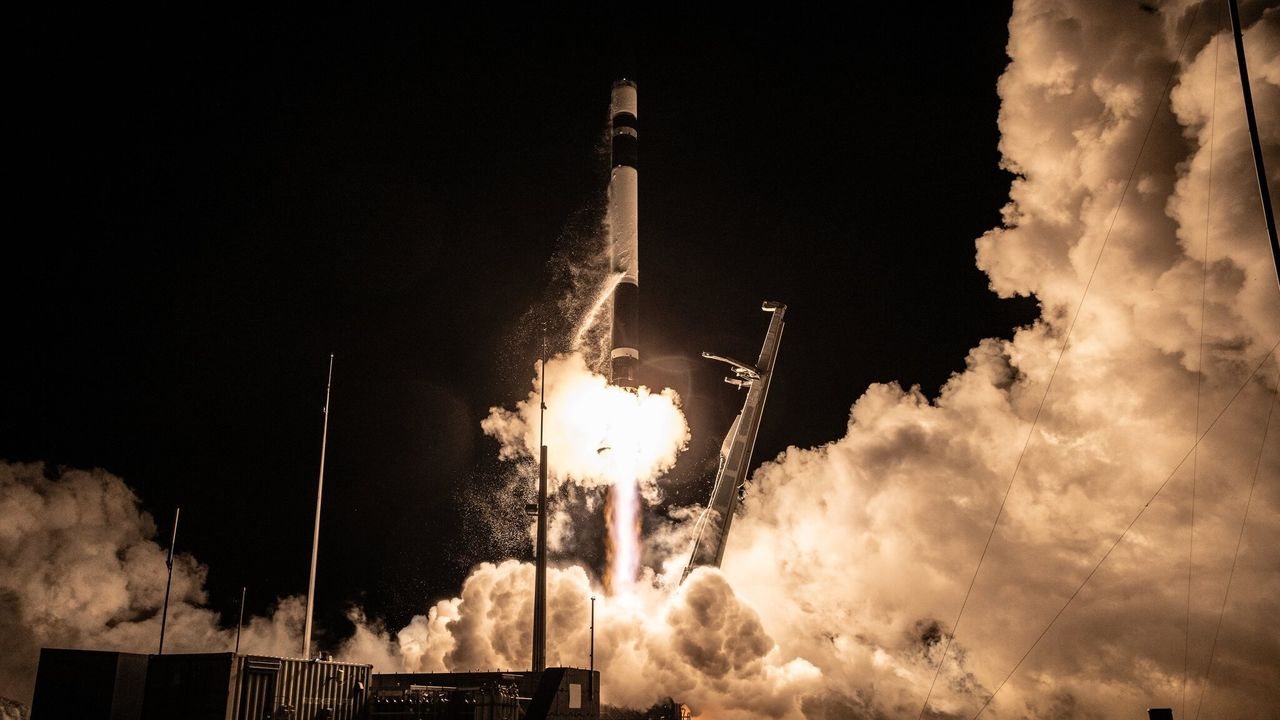
Later that day, Rocket Lab will launch its “Owl Around The World” mission for the Japanese company Synspective. The Electron rocket will lift off from the Mahia Peninsula in New Zealand at 11:30 UTC, with backup opportunities extending to Sept. 14. The mission will deploy StriX-9, a 100 kg synthetic aperture radar satellite capable of imaging at one to three meters resolution with a swath width of 10 to 30 km. This will be the 11th StriX satellite launched by Rocket Lab, and Synspective has booked an additional 16 flights with the company through 2030. The mission is the 15th Electron launch of 2026, putting Rocket Lab on pace to exceed 20 flights this year.
SpaceX continues its Starlink deployment with the first of several planned missions this week, all now launching from Vandenberg Space Force Base in California. The Falcon 9 flight, designated Starlink Group 15-23, is scheduled for Wednesday, Sept. 2, at 07:46 UTC. Booster B1063, on its 35th mission, will carry 27 Starlink v2 Mini satellites to a low-Earth orbit inclined 70 degrees. The booster will land on the droneship “Of Course I Still Love You” in the Pacific, marking the 675th Falcon 9 recovery attempt. This will be the 102nd Falcon 9 mission of 2026 if schedules hold. SpaceX has shifted all future Starlink v2 Mini launches to the West Coast, reducing Florida launch activity.
India’s space agency ISRO returns to flight with the GSLV Mk II F17 mission, carrying the EOS-05 (GISAT-1A) imaging satellite. The launch is set for Thursday, Sept. 3, at 21:25 UTC from the Satish Dhawan Space Centre. The 2,367 kg satellite will be placed into geostationary transfer orbit. EOS-05 is designed to observe the entire Indian landmass every 30 minutes at 42 meters resolution in visible and near-infrared light, providing rapid imagery for disaster response, such as the recent glacier-collapse-induced flash flood in the Himalayas. The satellite replaces EOS-03, lost in a GSLV failure in August 2021. This is the 19th flight of the GSLV Mk I and II series.
The week concludes with the maiden flight of Isar Aerospace’s Spectrum rocket, named “Onward and Upward,” scheduled for Friday, Sept. 4, at 20:00 UTC from the Andøya Rocket Range in Norway. The launch window lasts 60 minutes. Spectrum is a small satellite launcher designed to carry payloads of up to one ton to low-Earth orbit. The flight has faced multiple delays, and its success would mark a significant milestone for European commercial spaceflight, offering an independent access to orbit for small satellites.
These launches reflect a broader trend of increasing launch cadence and international collaboration, with new players like Galactic Energy and Isar Aerospace joining established providers such as SpaceX and Rocket Lab. The diversity of missions, from Earth observation to broadband internet, underscores the expanding role of space in everyday life, from disaster monitoring to global connectivity.
166