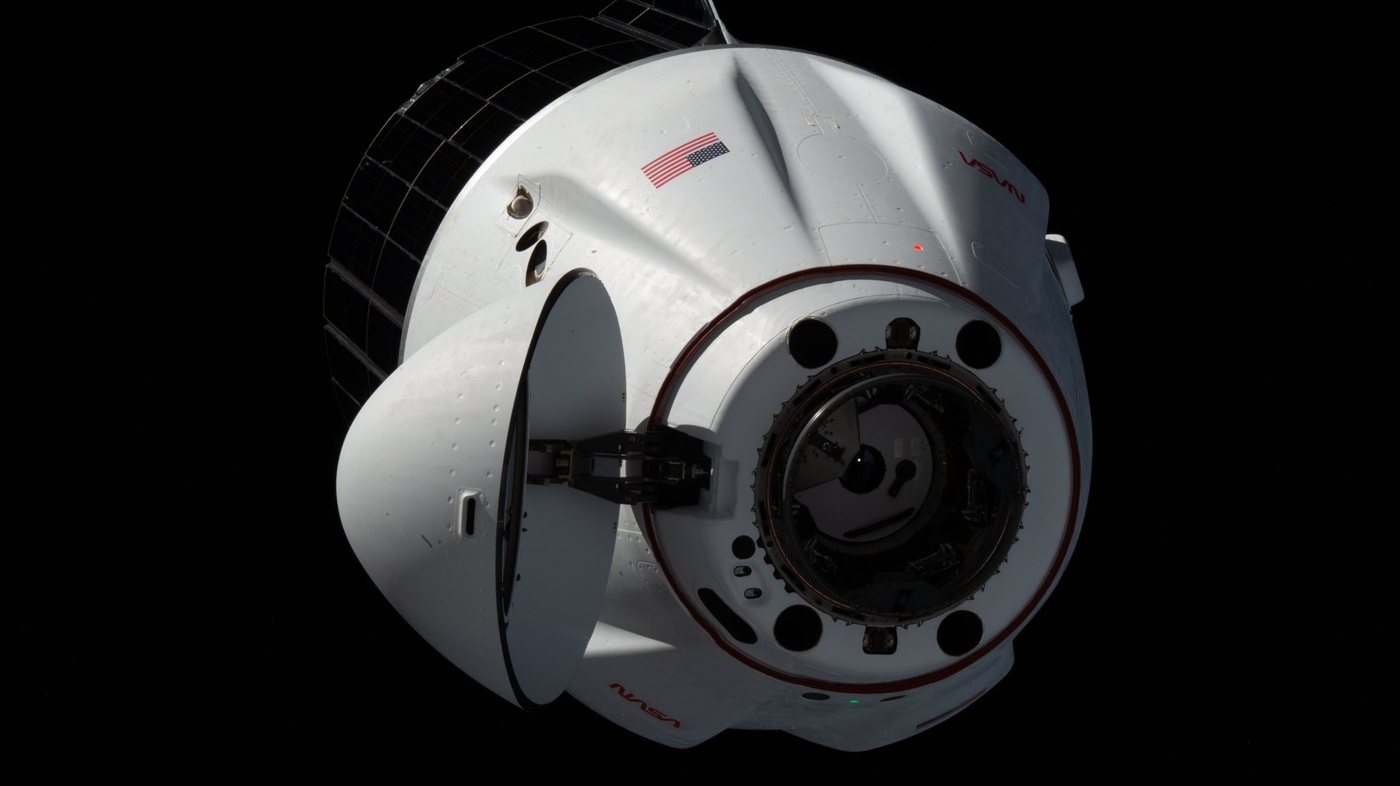
A SpaceX Cargo Dragon docked with the International Space Station on Oct. 15, delivering 1,671 kilograms of pressurized cargo and 1,195 kilograms of unpressurized cargo to the Expedition 75 crew, along with a new ISS Roll Out Solar Array. The CRS-35 mission launched two days earlier from Space Launch Complex 40 at Cape Canaveral Space Force Station in Florida and attached to the Harmony module's zenith port.
The delivery came during a crowded stretch of traffic at the orbiting laboratory. Crew-13 arrived at the start of October after launching from Florida on Oct. 1 aboard a Falcon 9 rocket, with the Crew Dragon Grace capsule docking to the Harmony forward port just under eight hours later — the fastest arrival at the station by a U.S. spacecraft. The four new Expedition 75 members are NASA astronauts Jessica Watkins and Luke Delaney, Canadian Space Agency astronaut Joshua Kutryk, and Roscosmos cosmonaut Sergey Teteryatnikov. They are scheduled to remain aboard for roughly six months, undocking in March 2027.
Before Crew-12 departed, command of the station passed from NASA's Jessica Meir to Roscosmos's Pyotr Dubrov, who arrived on Soyuz MS-29. Crew-12 undocked on Oct. 7 and its Dragon Freedom capsule splashed down in the Pacific Ocean the following day, where a SpaceX recovery vessel retrieved it. Crew-12 had launched to the station in February and docked to the Harmony module's zenith port.
Two days after the crew rotation, the Cygnus XL spacecraft from the NG-24 mission departed the station. Ground controllers used the Canadarm2 robotic arm to unberth the freighter from the Unity nadir port on Oct. 9. Before release, the crew loaded it with several thousand kilograms of waste and unneeded cargo that will burn up harmlessly in Earth's atmosphere. Cygnus had launched in April and delivered 5,000 kilograms of cargo for Expeditions 74 and 75.
The newly arrived solar array is to be installed during two U.S. spacewalks. NASA astronaut Anil Menon and Kutryk are scheduled to conduct the work on Oct. 29 and Nov. 5. The Cargo Dragon is expected to remain at the station until no earlier than November 2026.
Science work continued alongside the logistics. On Sept. 28, Meir used an ultrasound device to scan Menon's jugular vein and measure his blood pressure for the Venous Flow investigation, which examines space-caused blood conditions such as clots or changes in blood chemistry. The European Space Agency's Fluid Science Laboratory, which had operated in the Columbus module since 2008, was decommissioned before the Crew-12 astronauts returned to Earth. On Oct. 16, cosmonauts Dubrov and Anna Kikina completed a week of studies in which they wore an exoskeleton suit, virtual reality goggles and hand controls to operate tools remotely, work that may inform crew training for future long-duration missions.
NASA is also preparing for the station's planned decommissioning by the end of 2030. On Oct. 9, the agency released its final Request for Proposals for the Commercial Low Earth Orbit Destinations program, inviting industry to submit plans for a successor station. Proposals are due Dec. 8, and NASA expects to announce about two companies in spring 2027 that will receive funding to develop, build and operate the new outpost.
12