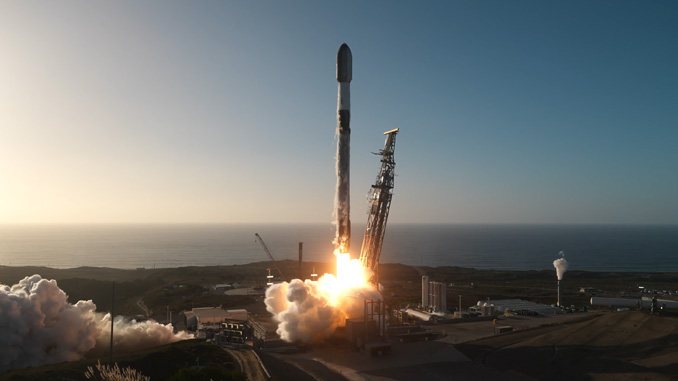
SpaceX launched a Falcon 9 rocket on Monday from Vandenberg Space Force Base in California, carrying 27 Starlink V2 Mini Optimized satellites into orbit. The mission, designated Starlink 15-25, lifted off from Space Launch Complex 4 East at 5:28 p.m. Pacific Time, which is 8:28 p.m. Eastern Time or 0028 UTC on October 13.
The rocket headed on a southerly trajectory along the California coast as it targeted an orbit inclined 70 degrees to the Equator. If the flight proceeds as planned, the satellites will be released into an orbit about 266 kilometers high a little more than an hour after liftoff, the company's standard approach for deploying its broadband constellation in low Earth orbit.
The first-stage booster, serial number B1088, was flying for the 20th time. It landed on the drone ship Of Course I Still Love You about 8.5 minutes into the flight, allowing the vehicle to be reused again. The booster has a varied record: it previously supported the NROL-126, Transporter-12, SPHEREx, NROL-57 and USSF-366 missions, in addition to 14 earlier Starlink deliveries. The mix of national security, commercial rideshare, science and broadband flights illustrates how the same reusable hardware is being applied across very different customers.
Reports on the launch also noted that the pace of Falcon 9 launches has slowed compared with earlier periods, a shift that coverage of a recent Starlink mission from the same coast has highlighted. The Monday flight, however, continued the steady rhythm of Starlink deployments from Vandenberg, which remains one of the main launch sites for the constellation on the West Coast.
18