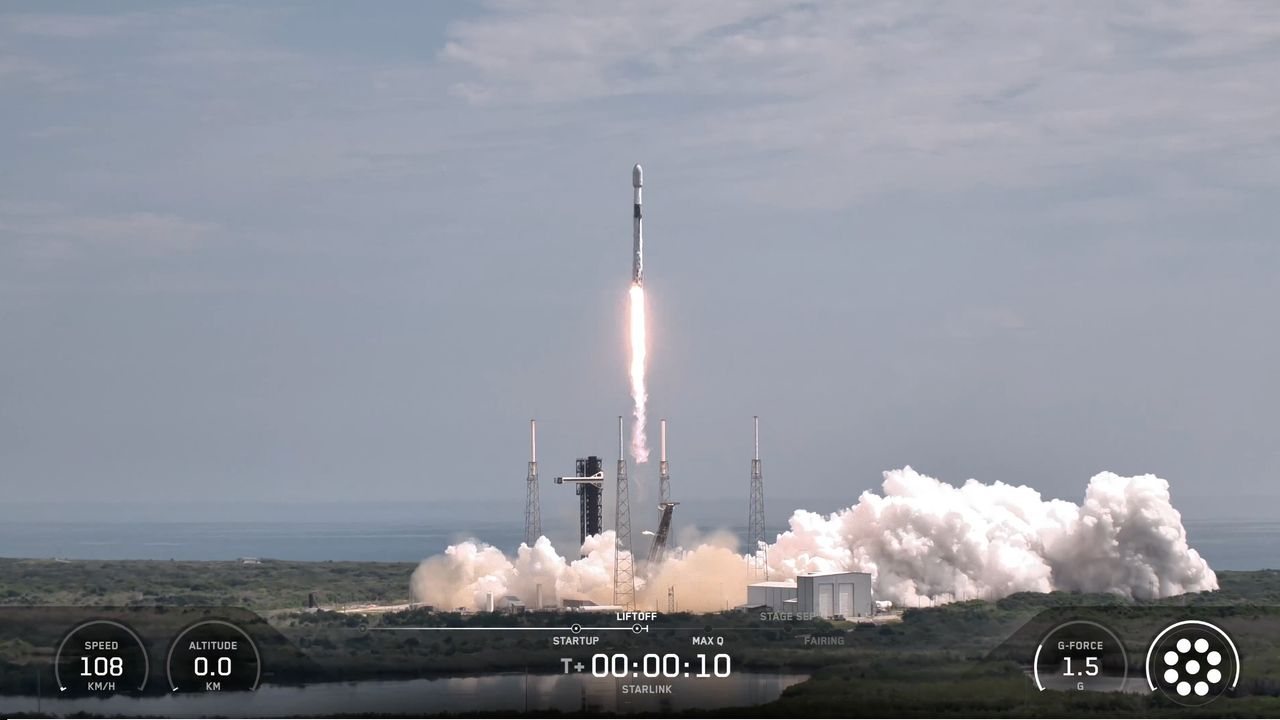
SpaceX launched 29 Starlink satellites into low Earth orbit on a Falcon 9 rocket, then landed the booster on a droneship stationed in the Atlantic Ocean. The mission, designated Starlink Group 10-39, lifted off from Cape Canaveral Space Force Station in Florida, continuing the company’s rapid deployment of its broadband internet constellation.
The Falcon 9’s first stage separated from the upper stage about two and a half minutes after liftoff and descended to a precise landing on the autonomous droneship Just Read the Instructions. This marked the booster’s 14th flight, according to SpaceX. The upper stage continued to orbit, deploying the 29 satellites about 65 minutes after launch, as confirmed by the company’s live webcast.
This mission is part of SpaceX’s broader effort to expand the Starlink network, which now includes thousands of operational satellites. The constellation provides high-speed internet to users in remote and underserved regions, as well as to maritime, aviation, and government customers. Each launch adds more capacity and coverage, helping to reduce latency and improve service reliability.
The successful landing underscores SpaceX’s commitment to rocket reusability, a key factor in lowering the cost of space access. The company has now landed Falcon 9 boosters more than 300 times, with many rockets flying 15 or more missions. Reusing hardware allows SpaceX to maintain a rapid launch cadence, which is essential for building out the Starlink constellation and supporting other commercial and government missions.
SpaceX has conducted dozens of Starlink launches this year alone, with the pace expected to continue as the company works toward global service. The Federal Communications Commission has authorized SpaceX to deploy up to 12,000 Starlink satellites, with plans for a second-generation constellation of up to 30,000 satellites. The current network already serves millions of customers worldwide, and the company is testing direct-to-cell capabilities that could provide connectivity to standard smartphones in dead zones.
Beyond Starlink, the Falcon 9 rocket is a workhorse for NASA, the Department of Defense, and commercial customers, delivering cargo and crew to the International Space Station, as well as launching scientific and national security payloads. The success of this mission adds to SpaceX’s record of reliable launches, which has made it a dominant player in the global launch industry.
The next Starlink launch is already scheduled, reflecting the company’s streamlined operations and the growing demand for satellite internet. As the constellation expands, SpaceX continues to refine its technology, including laser inter-satellite links that enable high-speed data transfer between satellites without relying on ground stations.
This launch also highlights the increasing role of private companies in space exploration and infrastructure. SpaceX’s achievements have inspired a new wave of commercial space activity, from satellite manufacturing to space tourism, and have prompted other nations and companies to accelerate their own space programs.
With each successful mission, SpaceX moves closer to its goal of providing global internet coverage and enabling a multi-planetary future. The company’s Starship program, currently in development, aims to carry larger payloads and eventually humans to the Moon and Mars, building on the lessons learned from Falcon 9’s reliability and reusability.
139