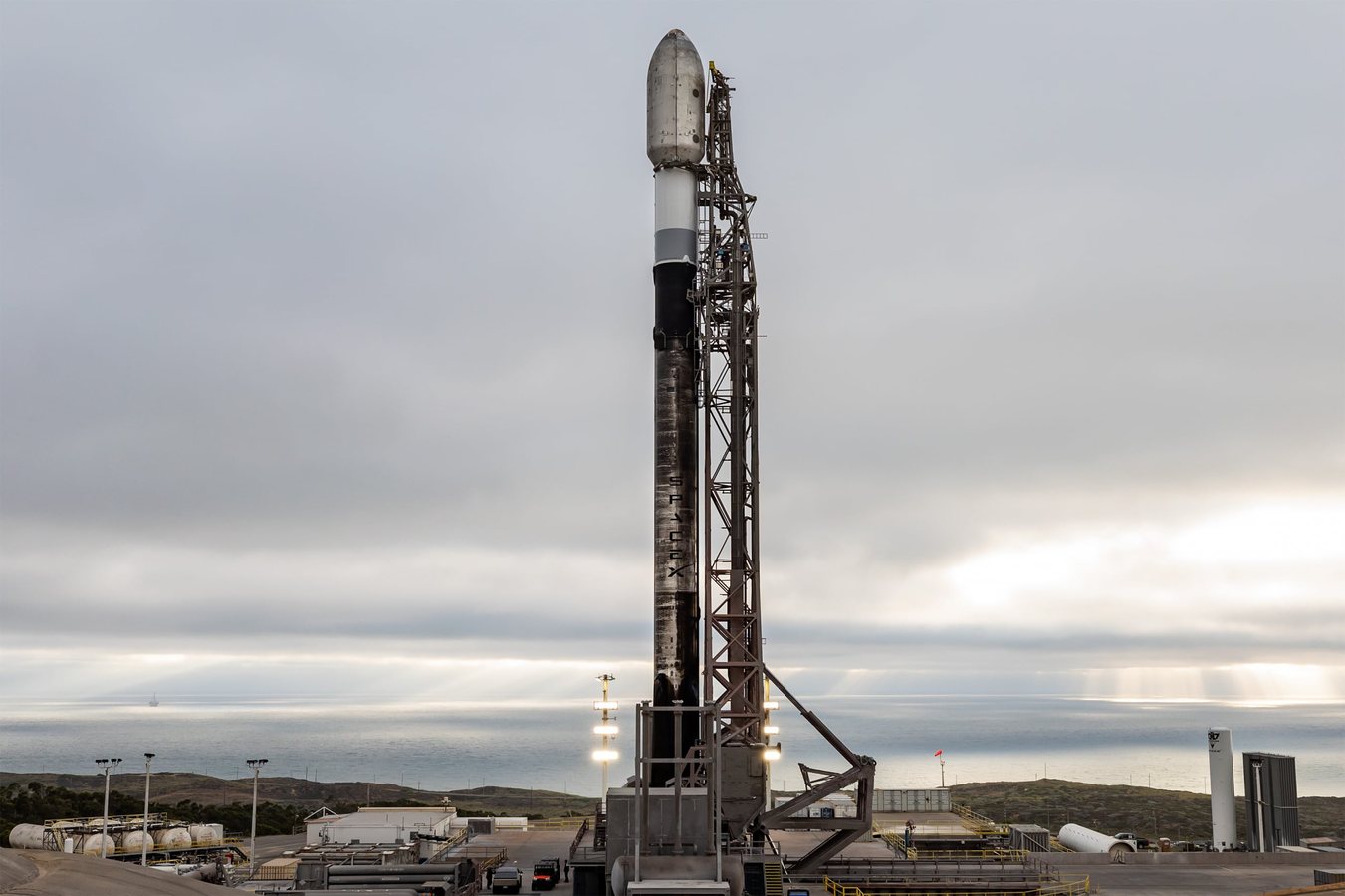
SpaceX is preparing to launch its Transporter 18 rideshare mission, carrying 130 payloads to sun-synchronous orbit, from Space Launch Complex 4E at Vandenberg Space Force Base in California. The Falcon 9 rocket is scheduled to lift off on Thursday, Oct. 1 at 11:18 a.m. PDT, with a 58-minute launch window closing at 12:16 p.m. PDT. If successful, this will mark the 110th Falcon 9 mission of 2026.
The mission's diverse payload manifest includes a prototype AI satellite for Google, the NASA-funded SPRITE telescope, and Starfish Space's first Otter satellite servicing vehicle. Google's Project Suncatcher M1 prototype is an experimental satellite designed to test data processing hardware in orbit for future space-based AI data centers. The satellite will evaluate how Google's Tensor Processing Units handle launch vibrations and space radiation, as well as approaches to cooling the chips. Google plans to test a laser link between two Suncatcher prototypes in 2027.
NASA's SPRITE payload, also known as the Supernova Remnants and Proxies for Reionization Testbed Experiment, is a 12U CubeSat that will study shock waves in supernova remnants and ionizing radiation from low-redshift star-forming galaxies. SPRITE will be the first payload deployed, starting at T+54:22. Another NASA payload, the Green Propulsion Dual Mode (GPDM) experiment, will test a low-toxicity green propellant for a dual-mode system supporting high-impulse and high-efficiency spacecraft maneuvers.
Starfish Space's Otter satellite servicing vehicle, a 335-kilogram spacecraft, is contracted by NASA for the Small Spacecraft Propulsion and Inspection Capability (SSPICY) mission. Over up to two years, Otter will autonomously inspect multiple dead US-owned satellites, gathering data on spin rate, spin-axis, and surface condition after approaching within hundreds of meters. SSPICY is a precursor to future life extension and satellite deorbiting missions, for which Starfish Space holds contracts from Intelsat and the US military.
The mission will also deploy Varda Space's W-8 and W-9 satellites, which host small factories capable of producing pharmaceuticals or other materials in orbit. These products will then transfer into a reentry capsule that returns safely to Earth. Exolaunch will deploy 45 satellites as part of its rideshare program, including four spacecraft for Finnish intelligence company ICEYE. Other payloads are booked by D-Orbit, Planet Labs, OHB Italia, Satellogic, and SEOPS.
Following stage separation, the first stage booster B1082-25 will perform a return-to-launch-site maneuver, touching down at Landing Zone 4 near the launch pad. The booster has previously supported 20 Starlink missions, as well as USSF-62, OneWeb #20, and NROL-145. After the second stage completes its second burn at T+51:07, payload deployment will occur over an 11-minute period from T+54:22 to T+1:05:15.
This launch is part of a busy period for SpaceX, with Transporter 18 flying on the same day as the Crew-13 and NROL-97 Falcon Heavy missions from Florida. It marks the first time in a while that the company is using all three Falcon-capable launch pads in the same general time period. Rideshare missions like Transporter 18 have been instrumental in building up constellations, offering countries the ability to launch their first satellite, and flying experiments that might not have been feasible to fund and fly before.
However, the future of such missions is uncertain. SpaceX may wind down Falcon 9 rideshare operations past 2028 in favor of Starship. Three more Transporter missions remain on the Falcon 9 manifest: Transporter 19 is scheduled for no earlier than February 2027, Transporter 20 for no earlier than June, and Transporter 21 for no earlier than October 2027. The launch site for these future missions has not been determined, as sun-synchronous orbit missions can fly from either the West Coast or Florida.
9