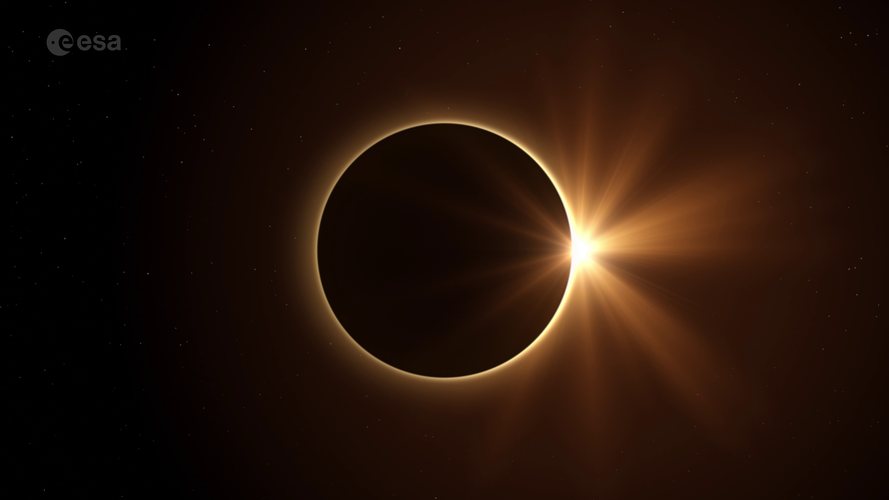
The European Space Agency has released a video featuring its reserve astronaut Sara García Alonso and astronaut candidate Pablo Álvarez Fernández, outlining eight key facts about the total solar eclipse set to occur on August 12, 2026. The eclipse promises to be a spectacular celestial event, with a path of totality crossing parts of the Arctic, Greenland, Iceland, and Spain, offering millions of observers a rare chance to witness the Moon completely block the Sun.
One of the most striking features of this eclipse will be the appearance of Baily's beads, a phenomenon that occurs just before and after totality. As sunlight streams through the rugged lunar valleys, it creates a string of bright points along the Moon's edge, resembling a necklace of pearls. The ESA video explains that this effect is particularly dramatic during total solar eclipses and adds to the visual splendor of the event.
The 2026 eclipse is also notable for its timing near sunset for observers in western Europe and parts of the Atlantic. As the Sun approaches the horizon, the eclipse will take on a deep red or orange hue due to atmospheric scattering, making it an especially beautiful sight. This sunset alignment means that viewers in Spain, for example, will see the eclipsed Sun low in the sky, potentially creating a stunning backdrop for photography and observation.
Totality—the brief period when the Moon fully covers the Sun—will last up to about two minutes and 18 seconds in the most favorable locations along the path. The ESA emphasizes that safety remains paramount: viewers must use certified solar eclipse glasses or indirect viewing methods to protect their eyes, except during the brief moments of totality when the Sun's corona becomes visible to the naked eye.
The path of totality for the August 12 eclipse begins in the Russian Arctic, crosses the North Pole region, then sweeps over Greenland, Iceland, and finally reaches northern Spain. Major cities such as Reykjavik, Iceland, and several Spanish cities including Valencia and Zaragoza lie within or near the path, offering accessible viewing opportunities. Outside the path, a partial eclipse will be visible across much of Europe, northern Africa, and parts of North America.
Weather conditions will play a crucial role in visibility. The ESA notes that cloud cover is a common challenge in the Arctic and North Atlantic regions, so eclipse chasers should monitor forecasts closely and consider traveling to areas with historically clearer skies. Spain's Mediterranean coast, for instance, often offers better chances of clear weather in August compared to Iceland or Greenland.
The ESA video also highlights the scientific value of total solar eclipses. They provide a unique opportunity to study the Sun's corona—the outer atmosphere—which is normally obscured by the Sun's bright light. During totality, researchers can observe coronal mass ejections, solar flares, and other solar activity, contributing to our understanding of space weather and its potential impacts on Earth's technology and communications.
For those planning to observe the eclipse, the ESA recommends arriving at the viewing location well in advance, as crowds are expected along the path of totality. Travelers should also prepare for variable weather and bring appropriate gear, including warm clothing for Arctic or Icelandic sites. The agency underscores that this will be the last total solar eclipse visible from Europe until 2027, making it a particularly significant event for European skywatchers.
In addition to the visual spectacle, the eclipse offers a moment of shared human experience. Communities along the path are organizing public viewing events, and many astronomy clubs and scientific institutions will host live streams and educational activities. The ESA's involvement, featuring its astronauts, underscores the agency's commitment to engaging the public with space science and the wonders of the universe.
As the countdown to August 12 continues, the ESA encourages everyone within the visibility zone to plan their observation safely and to take advantage of this rare alignment of Sun, Moon, and Earth. Whether witnessing the diamond ring effect, Baily's beads, or the ethereal glow of the corona, the 2026 total solar eclipse promises to be an unforgettable event for all who experience it.
208