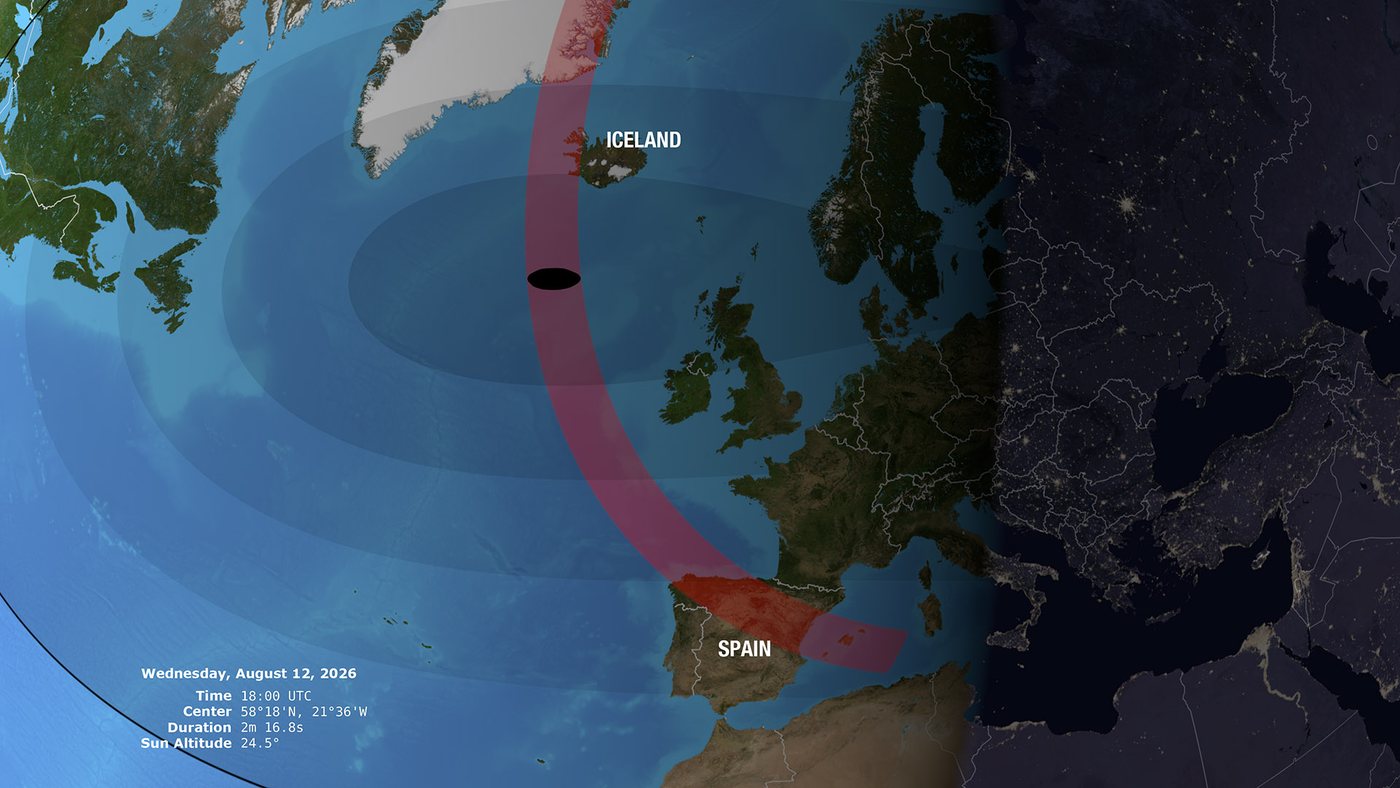
On Wednesday evening, the Moon’s shadow will sweep from the high Arctic across Iceland and into Spain, producing the first total solar eclipse visible from mainland Europe in years. For most of Europe, the spectacle will be partial and low in the western sky. For a narrow corridor through Iceland and Spain, daylight will collapse into totality.
A new Ukrainian project is using that moment to make an unusually large piece of eclipse mathematics public.
Ukrainian Private Space Agency, or UPSA, has opened its Eclipse Almanac, an interactive database that calculates solar and lunar eclipses from 2026 through 2126 and lets a user replay them from a selected city. The Almanac is the agency’s newest public service. It is free, has no advertising or registration, and is available in Ukrainian, English, German and French.
The database contains 457 eclipses over the century: 227 solar and 230 lunar. The solar set consists of 72 total, 73 annular and 82 partial eclipses. The lunar set contains 81 total, 63 partial and 86 penumbral events. Visibility calculations cover 284 cities on every continent.
That catalog is more than a list of dates. Its central idea is to turn celestial mechanics into a view from a real place.
One calculation, three ways to see it
Open an eclipse in the Almanac and the same geometry can be viewed in three modes.
The wide view places the observer above a cloud layer under a sky whose Sun, Moon, stars and bright planets are positioned for that time and location. The close view moves in on the solar disk, where the rendering can show features associated with the final moments before totality, including Baily’s beads, the diamond-ring effect and the corona. A third mode strips the scene down to an astronomical diagram with numerical data: apparent radii in arcminutes, angular separation, position angle, right ascension and declination, altitude and azimuth, and the times of eclipse contacts.
The result is deliberately halfway between a planetarium and a technical ephemeris. A person planning an observation can ask a simple question — what will I see from this city? — and then move directly into the underlying geometry.
A timeline marks the key phases and lets the user scrub through the event or run it from real time up to 3,600 times faster. During an actual eclipse, a “Now” control can synchronize the simulation with the current moment. Changing the city moves the virtual observer and forces the geometry to be calculated for the new coordinates rather than simply switching to another prerecorded animation.
For each event, the service also suggests several useful observing cities. A separate “visible from” filter reverses the process: choose a city first, and the catalog reduces itself to eclipses visible from that location, including whether a solar eclipse is total, annular or partial there.
The visuals do not pretend to forecast everything nature will do. The project labels its modeled corona and lunar-eclipse colors as typical rather than predictive. The exact shape of the solar corona depends on solar activity, while the color of the Moon inside Earth’s shadow depends on the state of the atmosphere at the time. Clouds in the wide view are scenery, not a weather forecast, and can be switched off.
A century is much less generous than it sounds
One of the stranger lessons in the database is how rare totality remains even over 100 years.
Among the 284 catalog cities, only 70 receive at least one total solar eclipse between 2026 and 2126. In other words, roughly three quarters never fall inside the path of totality during the entire century. Eleven solar eclipses in the catalog miss every one of those cities, with their observable paths concentrated over ocean or polar regions.
The average catalog city can see about 145 solar and lunar eclipses of all types during the century, but most of those are lunar events or partial solar eclipses. A large number of eclipses does not translate into a large number of moments when the daytime sky goes dark.
Reykjavik offers a striking example. According to the Almanac, 156 eclipses are visible there through 2126, yet only one is a total solar eclipse: the one arriving on Aug. 12. The service calculates about 65 seconds of totality from Reykjavik.
Its Spanish city list puts A Coruña, Bilbao, Zaragoza, Valencia and Palma in the totality corridor as well. The Almanac gives roughly 81 seconds in A Coruña, 87 seconds in Zaragoza and 99 seconds in Palma. Published eclipse references can differ by several seconds for the same general location because the answer depends on exact coordinates and on how the apparent edge of the Moon is modeled.
That distinction also appears at the eclipse’s global maximum. The Almanac places greatest eclipse at 17:45:46 UTC near 65.22° N, 25.25° W in the North Atlantic near Iceland. NASA’s published eclipse elements put the same point near 65.2° N, 25.2° W and the maximum only a few seconds later. NASA’s canonical central duration is about 2 minutes 18 seconds, while the Almanac calculates about 2 minutes 21 seconds under its lunar-disk convention.
Those are not different eclipses. They are small modeling differences around the limb of the Moon, where a few seconds matter.
Ukraine gets a sunset bite, but no totality for a century
For Ukrainian readers, the database produces a more sobering result.
The project ran all 72 total solar eclipses in its 2026–2126 set against 515 points distributed across Ukraine and found no observable total phase anywhere in the country during the century. The only geometric touch it found, on April 20, 2061 over Crimea, occurs with the Sun about 4.8 degrees below the horizon. There is therefore nothing to observe from the ground at that moment.
Ukraine does get deep partial eclipses. The Almanac calculates 87% of the solar disk covered from Odesa on Sept. 3, 2081, 89% from Lviv and Odesa on July 23, 2093, and 88% from Kyiv on July 13, 2075. But none crosses the line into totality.
Tomorrow’s eclipse will be much more modest from Ukraine, and timing matters because the Sun is setting as the eclipse develops. The service calculates roughly 47% obscuration in Uzhhorod and 43% in Lviv before sunset. Chernivtsi reaches about 16%. Kyiv gets only about 6% at the horizon. In Odesa, Kharkiv and Dnipro, the Sun sets before the eclipse begins locally.
For Kyiv, the next easier solar eclipse comes much sooner: Aug. 2, 2027, when the Almanac puts the Sun about 57 degrees above the horizon with roughly 27% of its disk covered.
Wherever the Aug. 12 eclipse is partial, proper solar protection is essential. Ordinary sunglasses are not safe for direct viewing. Eclipse glasses or another appropriate solar-viewing method are required, and binoculars, cameras and telescopes need solar filters designed to sit in front of the optics. Only observers actually inside totality may look without a solar filter during the brief interval when the Sun is completely covered.
The calculation runs in the browser
The project says the positions of the Sun and Moon are calculated with Astronomy Engine, an open-source library released under the MIT license. Astronomy Engine’s own documentation describes tests against established professional references including NOVAS and JPL Horizons.
UPSA says its 457-event catalog was calculated for the service rather than copied from an existing eclipse table. The same computational engine runs in the browser, so dragging the time slider changes the celestial positions dynamically instead of stepping through a pre-rendered video.
The presentation layer is a WebGL rendering system. The project describes the solar surface as a procedural shader using fractal noise and domain distortion, while the corona’s overall character is varied with the phase of the roughly 11-year solar cycle. Lunar detail uses NASA Lunar Reconnaissance Orbiter material; stars are based on the Yale Bright Star Catalog; land outlines come from Natural Earth. Optional music is credited to Kevin MacLeod under CC BY 4.0.
The service says its core calculated dataset is compact: 457 event files plus a visibility index of roughly 560 kilobytes. That contrast is part of what makes the project interesting. A visually elaborate sky can be driven by a relatively small numerical description when the browser is doing the geometry and rendering itself.
UPSA keeps its public profile deliberately narrow. It does not publish a staffing figure, a founding date, a partner roster or a budget, and it does not ask to be judged on any of them. What it publishes is working software. Alongside the Almanac, the agency runs UPSA Radar, a live map of tracked objects in Earth orbit that propagates satellite positions in the browser from public CelesTrak element sets. Two free services, both open to being checked, are the artifacts by which the organization proposes to be measured.
And an eclipse is a particularly unforgiving first demonstration. The shadow either crosses a city or it does not. The Sun is either above the horizon or below it. Contact times, angular sizes and coordinates can be compared against established eclipse calculations.
On Aug. 12, observers in Iceland and Spain will have only seconds of darkness. Most other users will see a partial Sun, or nothing at all from their location. The Almanac’s larger proposition is that the same question can be asked for any one of 457 events long after tomorrow’s shadow has left Earth: choose a city, choose a time, and let the geometry show what the sky permits.
144