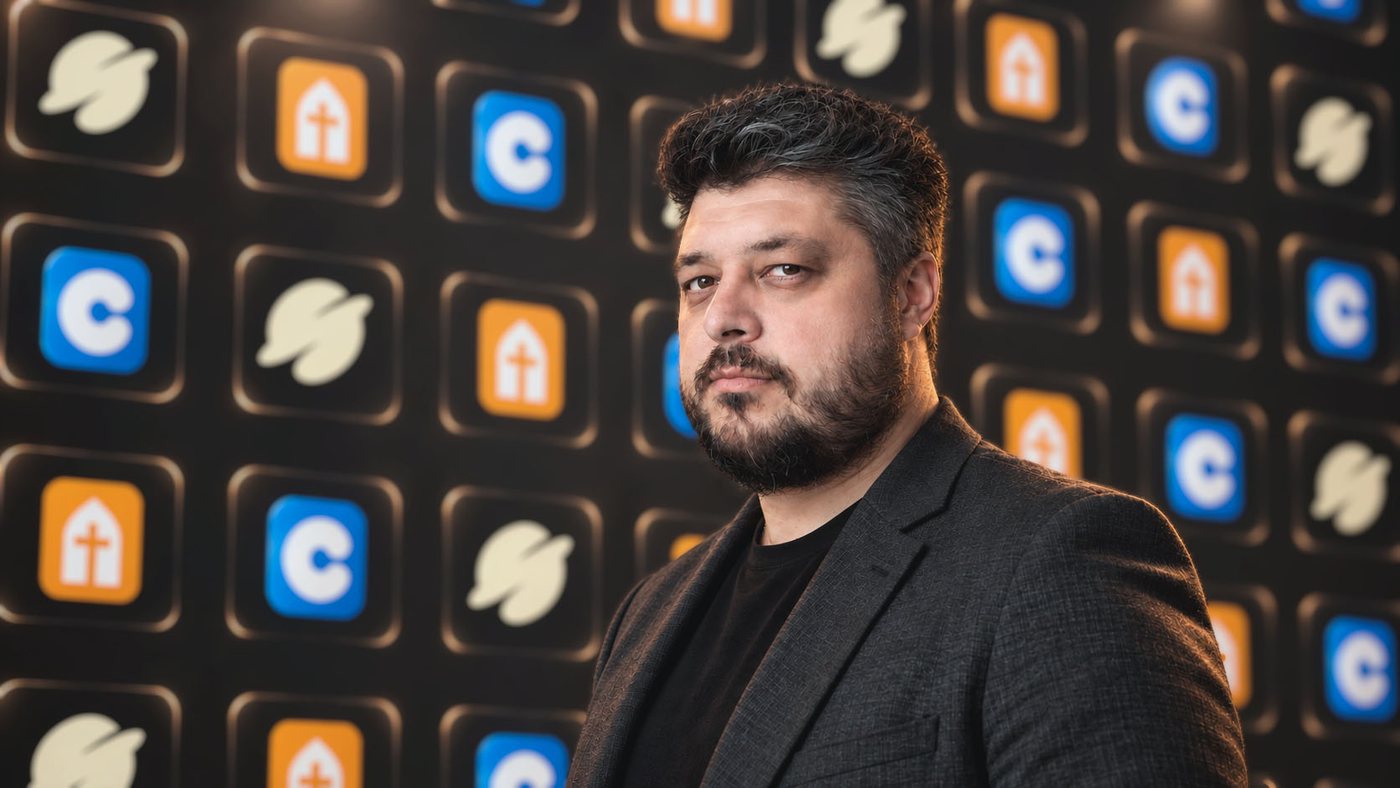
The argument for slowing artificial intelligence usually gets compressed into a false choice: race ahead or ban the technology. Father Bohdan, an Orthodox priest and technology entrepreneur, is proposing something narrower. In a statement published on September 8, he called for a temporary pause in training new, ever more powerful AI models while leaving existing systems in use.
His wording is deliberately specific. He is not calling for artificial intelligence to be outlawed, for useful services to be switched off, or for technological progress to be rejected. His question is whether ordinary life would actually become worse if the frontier stopped moving for a while. His answer is no — and from that he argues that slowing the present pace is the sensible course.
That distinction matters scientifically because AI development is not one single activity. Existing models can continue to answer questions, assist programmers, translate text, analyze documents and support research even if laboratories delay the next major capability jump. A pause in frontier training would therefore be closer to a safety hold on a new generation of systems than a ban on a mature technology already in circulation.
The timing of Father Bohdan’s intervention is notable. Two days earlier, OpenAI Chief Scientist Jakub Pachocki published a detailed essay arguing that the ability to monitor and align increasingly capable systems has not advanced far enough to justify maximum-speed scaling indefinitely. Pachocki wrote that no laboratory has solved those problems sufficiently to keep scaling responsibly at maximum speed for much longer, and said he expects voluntary slowdowns to become common until shared safety thresholds exist.
OpenAI has already described what a targeted slowdown can look like in practice. In August, the company said it had paused reinforcement-learning training on its latest deployment models for two weeks while it strengthened monitoring, security and red-team testing. Its largest planned frontier reinforcement-learning run remained on hold while smaller evaluations continued. The useful distinction is the same one Father Bohdan is now emphasizing: slowing development is not the same as shutting down deployed AI.
At the same time, the pressure to move faster is increasing. Fortune reported on September 8 that OpenAI’s research organization was already using 3.1 days of AI-agent effort for every day of human researcher work. That means artificial intelligence is beginning to accelerate the work used to create better artificial intelligence. Researchers call the more advanced version of that process recursive self-improvement, and it is one reason the debate about pacing has become more urgent.
The concern is no longer limited to outside critics. On September 9, Anthropic researcher Jacob Coxon was reported to have left both the company and the AI industry, warning that frontier development was moving too quickly and that no single firm could manage the risks alone. Reports of his resignation said he favored government rules or a coordinated industry slowdown. Axios separately reported that several Anthropic researchers had gone public with severe concerns about out-of-control AI.
None of these positions is identical. Pachocki still sees enormous value in more capable AI and argues that advanced systems may themselves be needed to build defenses. Anthropic continues developing frontier models. Father Bohdan’s statement is broader and more intuitive: if society already possesses powerful tools, why assume the next capability jump must happen immediately?
That question shifts the burden of proof. Instead of asking skeptics to prove that a future model will be dangerous, it asks developers to show why waiting would be more harmful than proceeding. In fields where experiments can be repeated safely, speed is often a virtue. At the frontier of AI, however, each generation can expand what software can do autonomously, including in cyber systems and scientific research.
A temporary pause would not solve alignment, governance or international competition by itself. It would create time in which safety evaluations, monitoring systems, legal rules and coordination mechanisms could catch up. Whether leading laboratories could sustain such a pause without common rules remains the practical obstacle. That is why the newest calls from inside the industry increasingly pair voluntary restraint with shared standards.
Father Bohdan’s formulation enters that debate from outside the laboratory but lands on the same unresolved issue. The question is no longer whether AI should exist. It is whether every available increase in capability has to be pursued immediately, before institutions can demonstrate that they can keep the next generation under meaningful human control.
104