Physicists in Germany have developed a new way to read out the spin states of nitrogen–vacancy (NV) centres in diamond, a method that offers vastly higher contrast than the fluorescence-based techniques used in earlier studies. The team, led by Florian Schall at the Fraunhofer Institute for Applied Solid State Physics, reports that the approach could make NV centres a far more competitive option for sensing subtle magnetic fields.
Instead of measuring fluorescence, the researchers place NV-doped diamond inside the cavity of a near-infrared laser, alongside its semiconductor gain medium. The laser bounces light between opposite-facing mirrors, amplifying the intensity each time it passes through the gain medium and producing an intense, coherent beam at a wavelength of 1042 nm. NV centres in an intermediate singlet state absorb light at this wavelength, so changes in magnetic field alter how many centres are in that state and, in turn, how much infrared light the diamond absorbs. This creates a direct link between laser intensity and the strength of an external magnetic field.
The difference in performance is striking. Schall's team reports that when the microwave frequency matches the spin resonance of the NV centres, the laser is shut down entirely, delivering a 100% optical contrast. When the microwave frequency is mismatched, the laser produces a strong beam of more than 50 mW. Across this broad intensity range, the system shows a roughly 500-fold improvement in the ratio between its fundamental sensitivity limit and its dynamic range, compared with the most advanced fluorescence-based sensors available to date. The researchers say the method also enables vector magnetometry, the determination of all three components of a magnetic-field vector rather than only its magnitude or a single component.
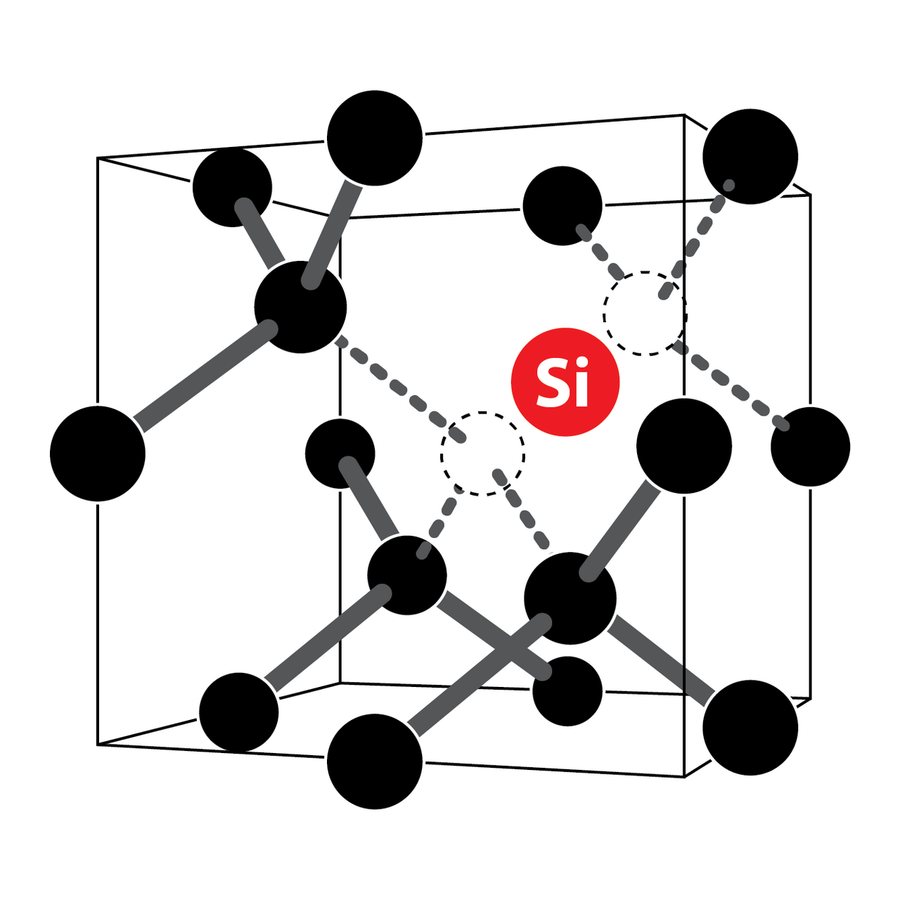
The background to the work lies in the unusual physics of NV centres. These defects form where two adjacent carbon atoms in the diamond lattice are replaced by a nitrogen atom and an empty lattice site. The unpaired electrons they contain form spin states that the diamond lattice stabilises, which makes the centres highly sensitive to temperature, magnetic and electric fields, and mechanical strain, all of which shift the energy gaps between spin states. Conventionally, a green laser excites the electrons so the diamond fluoresces, and microwaves tuned to the right frequency flip the electrons into higher-energy spin states, changing the fluorescence. Sweeping microwave frequencies reveals the resonance dip from which the energy gap, and so the sensed quantity, can be inferred.
Schall notes that NV-based magnetic sensors have lagged behind other cutting-edge techniques, largely because fluorescence signals are weak and their optical contrast is typically only a few percent. The new approach sidesteps that limitation by replacing the fluorescence measurement altogether. Schall says the work demonstrates an entirely new way of probing NV spin states that the team hopes can be applied more widely.
"This could form the basis for a new generation of room-temperature magnetic field sensors with a unique combination of sensitivity and dynamic range, which is particularly interesting for applications in medical diagnostics, magnetic navigation, and resource exploration," Schall says. The research is described in Nature Communications.
Source: physicsworld.com
11