Physicists in Austria and the United States have created a hybrid optical device that dramatically improves the efficiency of nonlinear frequency conversion, a process central to telecommunications, quantum information transfer, and ultrafast signal processing. By stacking a nanostructured metasurface atop a specially engineered semiconductor heterostructure, the team achieved a thousandfold increase in second-harmonic generation compared with an unpatterned material, according to a study published in Nature Nanotechnology.
Nonlinear frequency conversion allows light of one frequency to be transformed into another. It underpins technologies such as frequency mixing, broadband light sources, high-speed modulation, and the generation of entangled photon pairs for quantum communication. One common form, second-harmonic generation, combines two photons into a single photon with twice the energy. Efficient nonlinear devices require intense electric fields and materials whose polarization responds disproportionately to those fields, but only a handful of such crystals exist, and their fixed structures limit which wavelengths they can handle and how well they perform.
To overcome these constraints, researchers led by Marcus Ossiander at TU Graz and Federico Capasso at Harvard's John A. Paulson School of Engineering and Applied Sciences turned to a semiconductor metamaterial developed by Seth Bank's group at the University of Texas at Austin. This material consists of nanoscale layers of gallium arsenide and aluminium gallium arsenide containing asymmetrically coupled quantum wells. The asymmetry forces electrons to move predominantly in one direction when illuminated, creating a «one-way street» that amplifies nonlinear electron oscillations and exceeds natural nonlinearities.
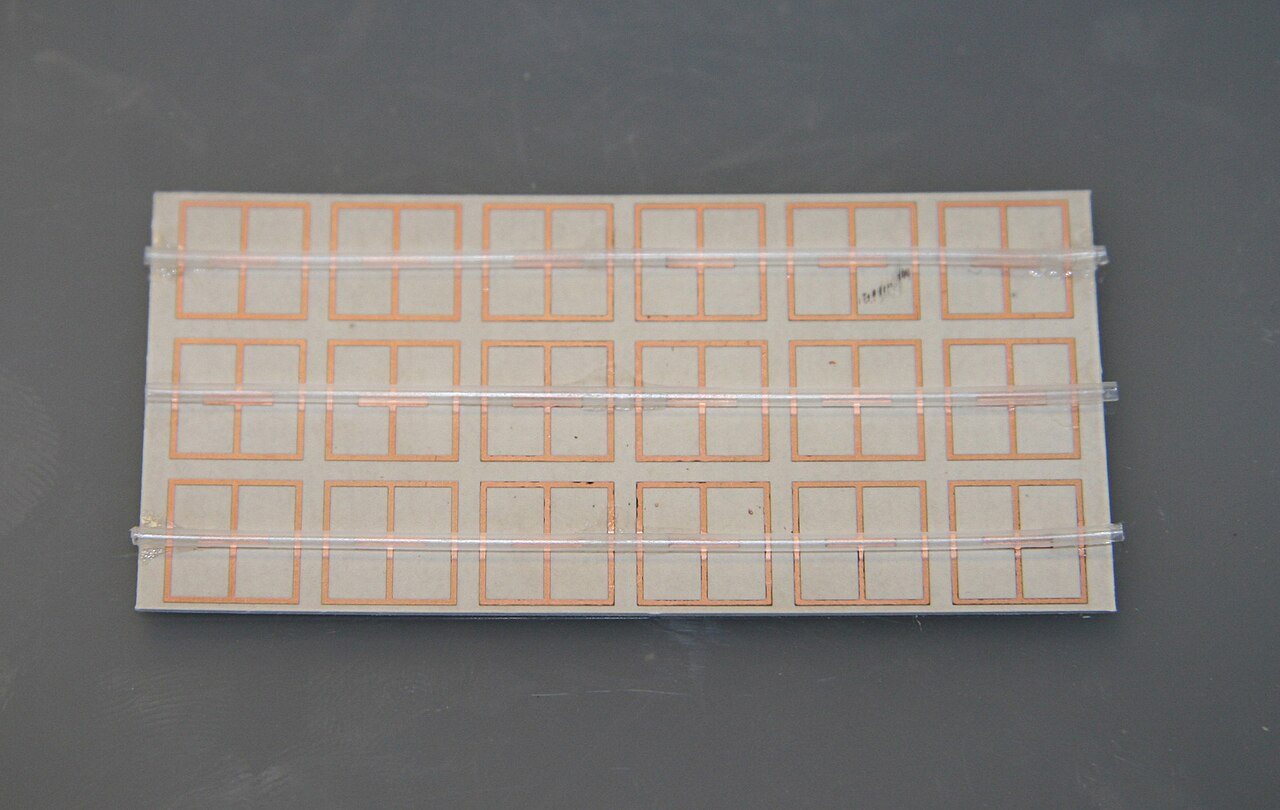
The team then added a second, two-dimensional metamaterial — a metasurface made of titanium dioxide pillars, each several hundred nanometres in size — on top of the first. This metasurface precisely controls the polarization of incoming light, deflecting it so that it scatters along the one-way street and further intensifies the interactions between light waves.
During experiments, the researchers encountered an unexpected challenge. The designable second-order nonlinear susceptibility tensor element required a different incident polarization than conventional materials. As a result, when light struck the sample at exactly normal incidence, the generated waves cancelled each other out, annihilating any enhancement. Tilting the sample by just 0.3 degrees broke the symmetry and resolved the issue.
With this small adjustment, the effective nonlinear conversion increased by three orders of magnitude compared with a non-patterned heterostructure. The effect also surpassed previously reported values for comparable devices operating at near-infrared wavelengths, which are important for optical communications.
«Nonlinear optics are ubiquitous in modern science and technology, with examples including the generation of light at new frequencies, all-optical signal processing and the generation of entangled photon pairs for quantum communication,» Ossiander said. «Enhancing the fundamental processes enabling this technology will allow for much more efficient, compact devices and enable new measurements that would previously be impossible.»
First author Pernille Undrum Fathi, who works in Capasso's group, noted that working with new materials brought additional uncertainty. «We spent a lot of time learning about and understanding the mechanisms of these new structures and how the particular nonlinear tensor elements of this material interact with the resonant modes introduced by the metasurface,» she said.
The advance could lead to smaller, more efficient components for telecommunications, quantum information systems, and other photonics applications, where compact and powerful light sources are increasingly in demand. By combining band-structure engineering with metasurface design, the approach offers a tunable platform for enhancing nonlinear optical processes that were previously limited by the intrinsic properties of natural crystals.