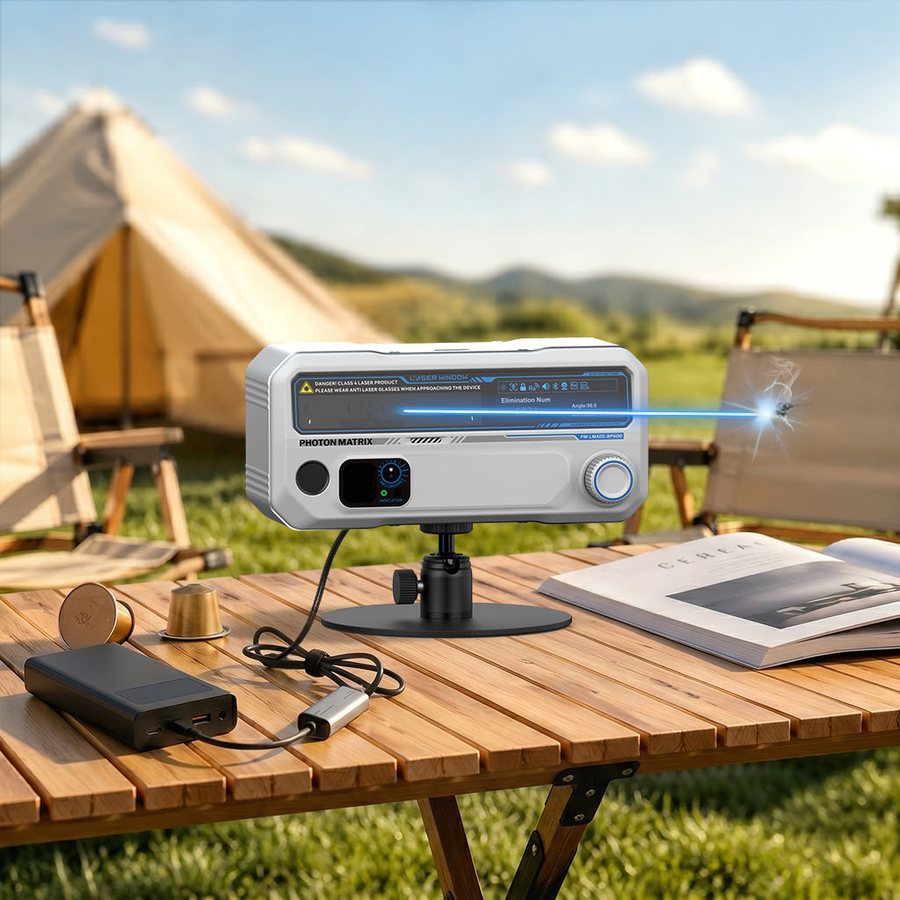
A portable device developed by Chinese startup Photon Matrix Intelligent Technology is bringing an unusual engineering approach to mosquito control: detect a flying insect with optical ranging and computer vision, calculate its position, and steer a laser pulse towards it in real time.
Photon Matrix combines several sensing technologies rather than relying on a camera alone. The company says LiDAR continuously scans a plane and measures the distance to the background. When a small object enters that space, the change in distance provides a candidate target. A vision module and other logic then help determine whether the object fits the expected characteristics of a mosquito or another small flying insect. Millimetre-wave radar is also part of the system and is described as one layer of its safety architecture.
Once a target is accepted, a galvanometer system steers the laser. Galvanometer mirrors are useful in applications that require a beam to change direction rapidly because the optical path can be redirected without physically rotating a heavy housing. The manufacturer says its short laser pulse disables the insect’s wings, causing it to fall.
The published operating envelope is unusually specific. Photon Matrix says it can identify and strike flying insects between 2 and 20 millimetres in size at speeds up to one metre per second. The Pro model is advertised for an effective distance of up to six metres and a 90-degree scanning sector. These specifications are consistent with a system designed for a constrained zone rather than unrestricted 360-degree coverage.
A much more dramatic set of numbers has driven online attention: a targeting response of around three milliseconds and capacity of up to 30 mosquitoes per second. Technology publications reported those figures from the crowdfunding campaign, but independent scientific or comparative testing confirming such peak throughput under ordinary conditions has not yet become a substantial part of the public evidence. That distinction is important. Demonstrating that a system can detect and strike an insect is different from proving a sustained elimination rate across variable backgrounds, lighting, wind, insect species and trajectories.
The concept itself has scientific precedent. A 2021 paper available through arXiv described experiments in mosquito neutralisation using machine vision, a power laser and galvanometer steering, and considered neural networks and other machine-learning methods for recognition. Earlier and parallel research into automated mosquito detection has also shown why classification matters: mosquitoes are small, fast and difficult to distinguish reliably from other objects in uncontrolled environments.
Photon Matrix therefore appears less like an invention of an entirely new physical principle and more like an effort to integrate known sensing, targeting and machine-learning techniques into a compact consumer product. That integration challenge is substantial. Optical alignment, latency, false-positive control, environmental robustness and safe laser operation all have to work together.
Safety deserves particular scrutiny. The manufacturer says the device checks the distance to a solid background and disables the laser when conditions are unsuitable. It also advertises radar-based protections. For any automated laser system intended for homes or outdoor living spaces, independent assessment of these safeguards will be essential, especially around people, animals and reflective materials.
The device has nevertheless attracted considerable market interest. By late May 2026, the company said its crowdfunding campaign had exceeded US$2.5 million, with more than 3,500 backers and over 3,000 orders. That response suggests there is consumer demand for mosquito-control technologies that avoid chemical sprays and passive traps.
Whether Photon Matrix becomes a practical pest-control tool will depend less on its most viral demonstrations than on repeatable testing. The key scientific and engineering questions are now measurable ones: detection sensitivity, classification error rates, effective kill probability at different distances, performance in cluttered environments and the reliability of safety interlocks over long periods of operation.
Image source: Photon Matrix.
99