Sophia Space announced on July 30 that it has been granted a patent, co-owned with the California Institute of Technology, covering large, modular data centers designed to operate in space. The patent, issued by the U.S. Patent and Trademark Office, outlines a concept for scalable orbital facilities that could process and store data directly in orbit, reducing the need to transmit large volumes of information back to Earth.
The invention addresses a growing bottleneck in satellite communications and Earth observation. As constellations of small satellites generate ever-larger streams of imagery, telemetry, and sensor data, downlinking everything to ground stations becomes increasingly impractical. A space-based data center would allow raw data to be processed, filtered, and analyzed in orbit, so only the most relevant results need to be sent to the ground. This could slash latency for applications such as disaster response, environmental monitoring, and real-time navigation.
Sophia Space, a startup focused on space infrastructure, partnered with Caltech, a leading research institution with deep expertise in aerospace and computing, to develop the patent. The collaboration combines Caltech's theoretical and experimental work on space-based systems with Sophia Space's engineering and commercialization efforts. The companies have not disclosed specific timelines for building or launching a prototype, but the patent provides a critical intellectual-property foundation for attracting investment and partners.
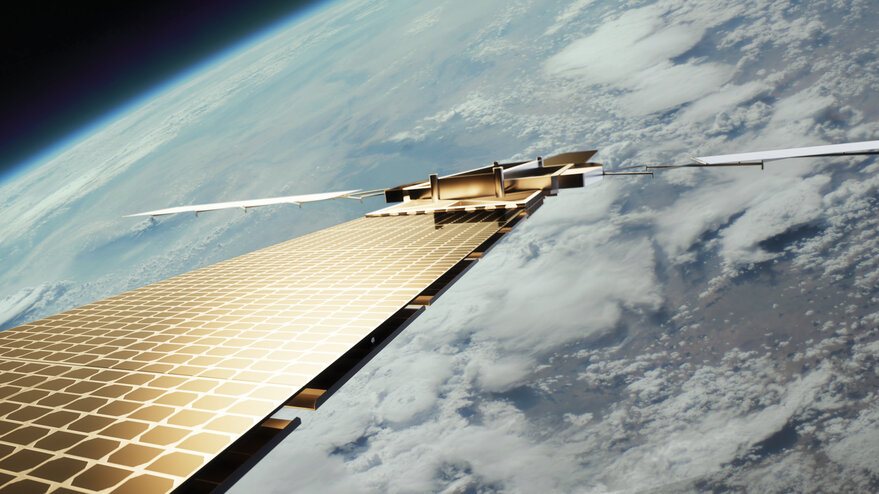
The modular design is a key feature. Instead of launching a single monolithic structure, the patent describes a system of interconnected modules that can be assembled incrementally in orbit. Each module would contain computing hardware, power systems, thermal management, and radiation shielding. This approach allows the data center to be expanded over time as demand grows, similar to how terrestrial data centers add server racks. The modules could be delivered by existing commercial launch vehicles and assembled robotically or by astronauts.
Space-based data centers face unique engineering challenges. Orbital environments subject electronics to intense radiation, extreme temperature swings, and micrometeoroid impacts. Power is another constraint: solar arrays must provide enough energy for both computing and cooling, while heat rejection in a vacuum requires specialized radiators. The patent is expected to address these challenges through novel shielding techniques, efficient thermal control, and redundant system architectures.
The concept of orbital data processing has attracted interest from several companies and space agencies. Amazon Web Services, Microsoft, and IBM have experimented with edge computing in orbit, and the European Space Agency has studied in-space data centers. Sophia Space's patent could position it as a key player in this emerging market, particularly for government and commercial clients seeking secure, low-latency data handling for national security, climate science, or telecommunications.
Financial terms of the patent award were not disclosed, but the intellectual property is likely to be leveraged in future funding rounds or licensing agreements. The news comes as the space economy continues to expand, with global investment in space infrastructure reaching billions of dollars annually. Data processing is seen as a critical enabler for next-generation services, from autonomous satellite operations to in-orbit manufacturing.
Caltech's involvement lends academic credibility and access to ongoing research in space systems. The institution operates the Jet Propulsion Laboratory for NASA, giving it hands-on experience with deep-space communications and planetary missions. That expertise could accelerate the development of reliable, long-lived data centers that operate far from Earth.
Sophia Space has not yet published technical specifications or a roadmap for its orbital data center. However, the patent filing indicates that the company is thinking beyond simple satellite buses and into dedicated computing platforms that could fundamentally change how data is handled in orbit. If realized, such facilities might one day host cloud services for satellite operators, support autonomous spacecraft, or even bridge communication gaps between Earth and lunar or Martian outposts.