Researchers working in eastern Mongolia have excavated a monumental tomb left by the Xiongnu, a nomadic people who dominated the steppe more than two thousand years ago. The burial, found at the Duurlig Nars cemetery, is roughly 240 feet long and stands out for its scale and for the goods buried with its occupant. The work was carried out by a team from the National Museum of Korea, the Mongolian Academy of Sciences and the National Museum of Mongolia.
The tomb is built around a small burial chamber set inside two nested wooden structures. Above the central grave, the excavators found a lacquered carriage. The whole complex was covered by nine stacked layers of stone, reaching more than 45 feet deep, a sign of the effort invested in marking and protecting the burial.
Among the most striking finds is a glass vessel with a handle that may have originated in the Roman Empire, which would point to long-distance trade reaching the Mongolian steppe. Scientists have not yet confirmed its origin, and chemical analysis of the glass is expected to settle the question. Until then, the attribution remains a working hypothesis.
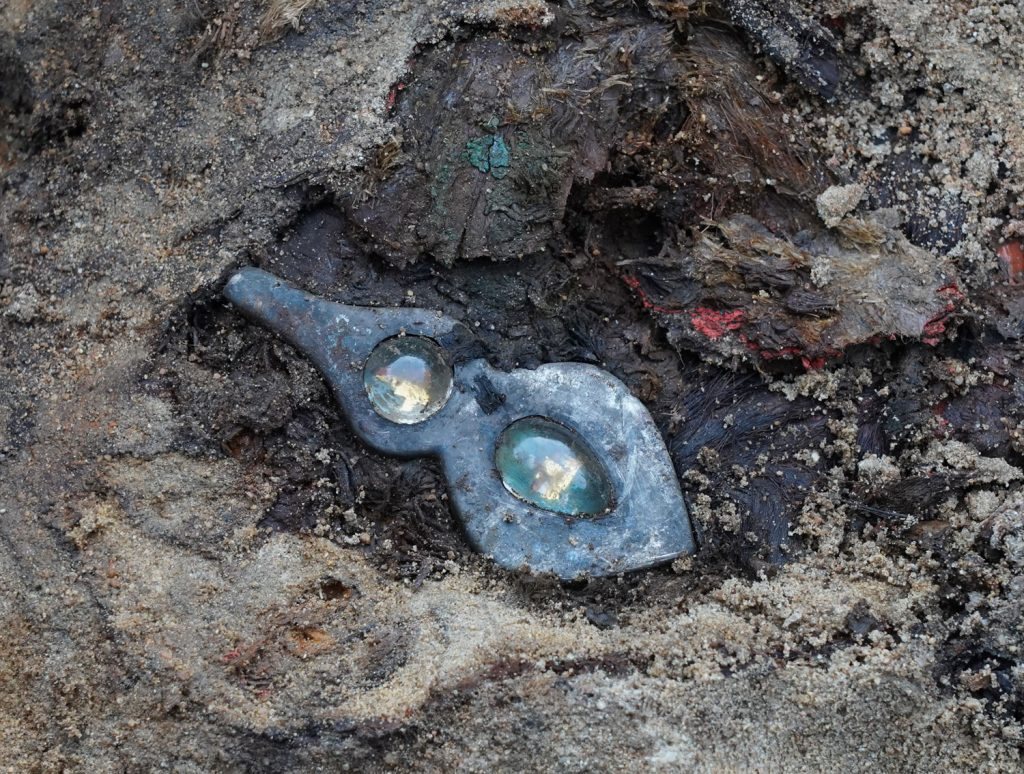
The grave also held fifteen jade objects inside a wooden coffin. They resemble the disks associated with the Han Dynasty of China, but their irregular shapes and detailed decoration suggest that Xiongnu craftsmen adapted Chinese funerary customs to their own tastes rather than simply copying them. A silver gourd-shaped pendant set with rock crystal, probably a horse harness ornament, is similar to pendants found in ancient tombs in what is now North Korea, another sign of the wide network of contacts the Xiongnu maintained.
A round gold ornament with red and blue inlay beneath a crystal cover may be the first object of its kind recovered from a Xiongnu tomb. Taken together, the finds show a nomadic elite whose burial practices drew on influences from China, the steppe and beyond.
Credit. Based on reporting by Jessica Esther Saraceni for Archaeology Magazine. Is this your work? Write to us.
52