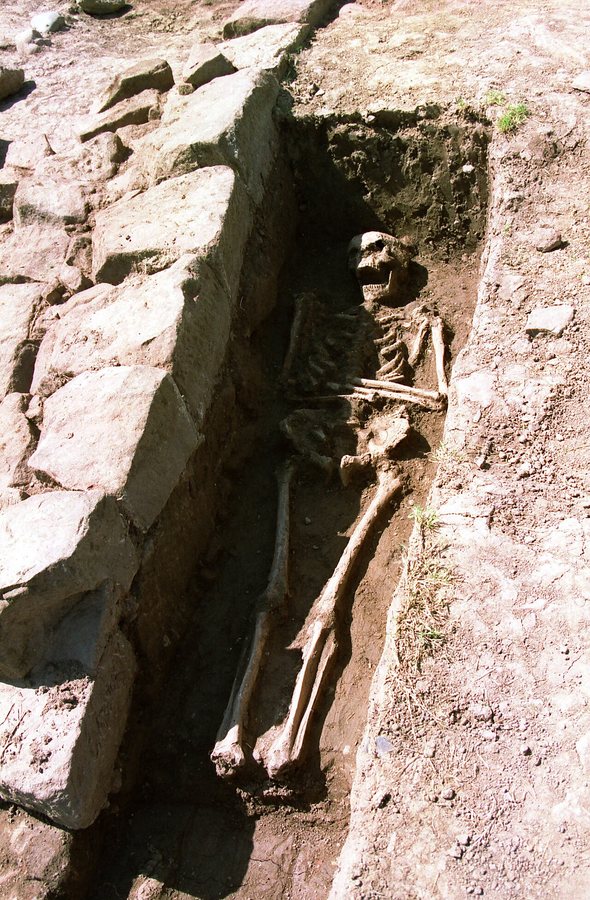
A landslide in central Italy has exposed a pre-Roman burial belonging to the Picene culture, a civilization that flourished along the Adriatic coast before the rise of Rome. The burial is estimated to date to the sixth century B.C., according to researchers who inspected the site near Sant'Elpidio a Mare.
The discovery occurred when heavy rains triggered a landslide that cut into a hillside, revealing a ceramic vessel. A team from the Superintendency of Archaeology, Fine Arts, and Landscape for the Provinces of Ascoli Piceno, Fermo, and Macerata examined the area and recovered several additional vessels from the exposed context.
The Picenes are known to have lived near the Adriatic Sea and to have been active participants in Mediterranean trade networks. They imported pottery, bronzes, and other goods from Greece, and some of the merchandise that passed through their ports was carried onward to other parts of Europe. Previous genetic studies have shown that the Picenes were related to other pre-Roman Italic groups, making the burial a potential source of information about the population's origins and cultural connections.
The ceramic vessels recovered from the hillside are consistent with Picene funerary practices, though researchers have not yet determined whether the burial belonged to a single individual or contained multiple interments. Further investigation of the site may reveal additional burials and possible links to other Picene sites in the region, which could help clarify settlement patterns and trade routes during the sixth century B.C.
The accidental nature of the discovery highlights how erosion and extreme weather can both threaten and reveal archaeological heritage. Landslides and heavy rains in Italy's central regions have previously exposed ancient structures and artifacts, sometimes leading to rescue excavations. In this case, the Superintendency team acted quickly to document and recover the vessels before the site could deteriorate further.
The Picene culture is named after Picenum, the ancient region that roughly corresponds to modern-day Marche and parts of Abruzzo. Its people were known for their distinctive material culture, including decorated pottery and metalwork, and they maintained contacts with Greek colonies in southern Italy. The sixth century B.C. was a period of significant cultural exchange in the Adriatic, with goods and ideas moving between Italic groups, Greeks, and other Mediterranean peoples.
Archaeologists plan to continue studying the recovered vessels and the surrounding hillside. If additional burials are found, the site could provide a broader view of Picene funerary customs and social organization. The Superintendency has not announced a timeline for further excavation, but the initial recovery suggests the area holds more than a single isolated grave.
The discovery adds to a growing body of research on pre-Roman Italy, where genetic and archaeological studies have increasingly illuminated the relationships among Italic populations. The Picenes, like other groups in the region, were eventually absorbed into the Roman state, but their material remains offer clues about the cultural landscape that preceded Roman expansion.