Archaeologists have reexamined the remains of a man found in a well at the Roman fort of Velsen on the North Holland coast, and their findings suggest he was brutally murdered rather than dying in a single episode of unrest. Mark Driessen and Carol van Driel-Murray of Leiden University led the work, which revisits skeletal material first recovered in 1977.
Previous research had linked the death to a rebellion by local Frisians against Roman taxes in A.D. 28, an event recorded by the Roman historian Tacitus in his Annals. The new study builds on that account but proposes several additional possibilities for how the man died, drawing on fresh analysis of the bones and the objects found with them.
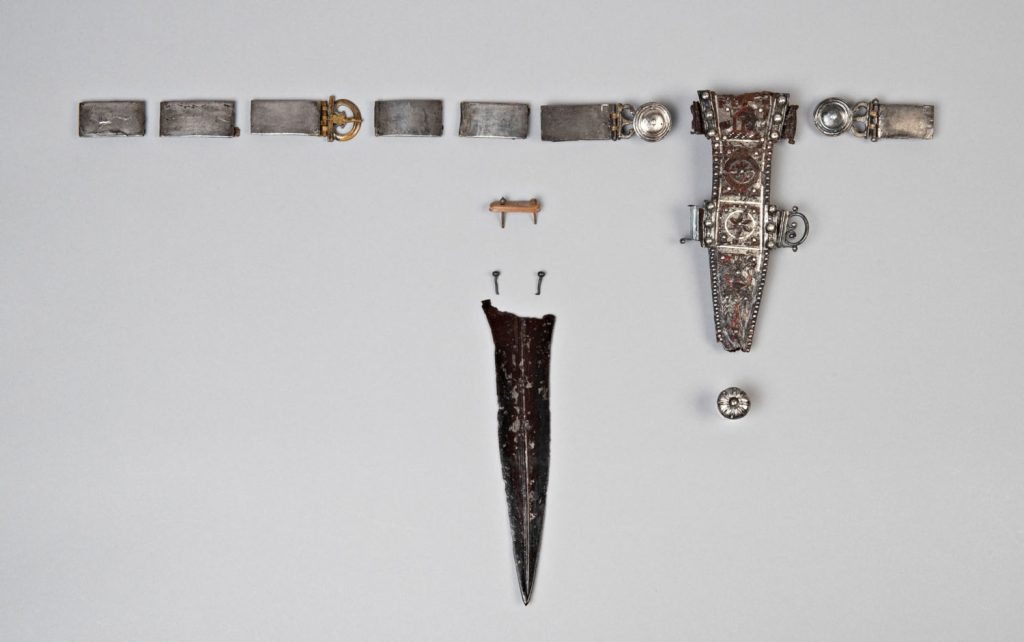
Examination of the skeleton identified multiple stab wounds, including on the inside of the ribcage and the pelvis, indicating a violent and deliberate attack. Three-dimensional models of the wounds indicate they were probably inflicted with a Roman military dagger, or pugio. A pugio of this kind was recovered from the well beside the remains. The blade measured nine inches long and the iron sheath was decorated with silver and red and yellow enamel.
The study also offers a profile of the man himself. He is estimated to have stood more than six feet tall and to have been very muscular. Researchers believe he was a soldier rather than an officer, because the dagger showed signs of wear and his belt had been assembled from mismatched pieces. He wore an iron ring set with a glass-paste stone that depicts either the god Mars or possibly Alexander the Great.
The 1970s study of the bones had suggested the man may have been a local Frisian. An isotope analysis of his tooth enamel has now revised that view, showing that he spent his childhood in southern Europe. The finding points to a life that began far from the Dutch coast and raises questions about how he came to serve at the fort.
Driessen and van Driel-Murray concluded that the man may have been killed by Frisians during an attack on the fort, as Tacitus described. They also consider other scenarios. He could have been a deserter executed by Roman military officials, or he might have been murdered by locals seeking revenge. The researchers present these as possibilities that the evidence allows, rather than settled conclusions.
The well also yielded a military belt, a ring, a fibula and a sandal with a studded sole, objects that together help place the man within the fort's garrison. The reexamination shows how modern analytical methods, including 3D modelling and isotope study, can add detail to material excavated decades ago.
20