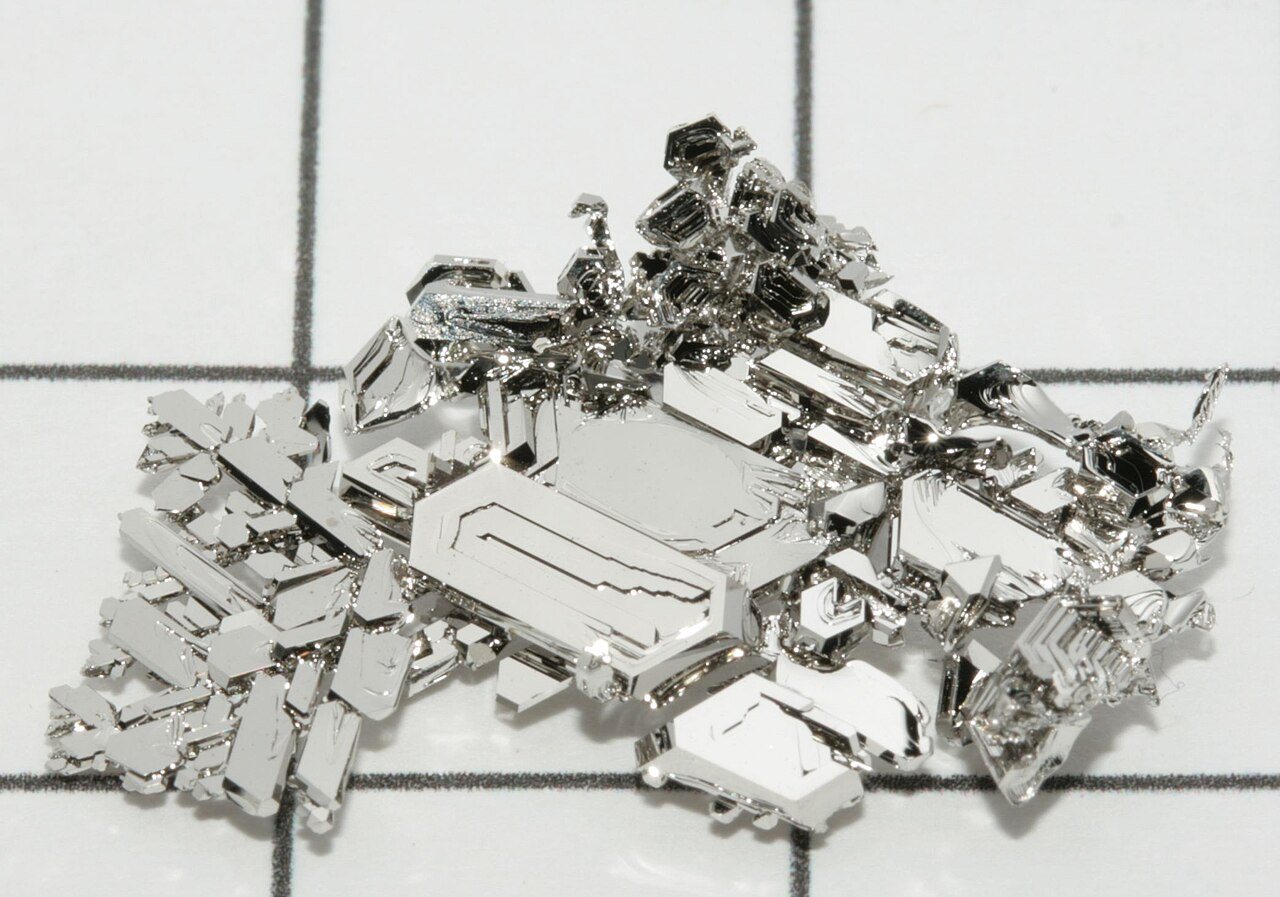
Platinum group metals, or PGMs, play a role in everyday industry that many people never see. In a recent episode of the Physics World Weekly podcast, chemical engineer Marge Ryan of the UK firm Johnson Matthey described how these rare and expensive materials are used in manufacturing, vehicle pollution control and a growing range of physics research.
The six metals in the group are platinum, palladium, ruthenium, rhodium, osmium and iridium. All of them are relatively rare and expensive, which is one reason their use is closely managed by manufacturers and researchers alike. Ryan, who has more than 25 years of experience working with the metals, explained that their catalytic properties are central to two very different fields. In the chemical industry they help produce pharmaceuticals, while in cars they are used in catalytic converters that reduce harmful exhaust emissions.
The metals also have physical properties that suit demanding environments. Their high melting points and resistance to corrosion make some PGMs useful in jet engines and in glass production, where materials must withstand extreme heat and aggressive conditions. These same qualities explain why engineers have relied on the group for decades in sectors where failure is costly.
Looking ahead, Ryan said the gradual move away from internal combustion engines is expected to free up some platinum group metals for other applications. Demand for catalytic converters has long been the largest single driver of PGM consumption, so a shift in the vehicle market could change how the metals are allocated. The podcast explored several newer areas in which these materials are being investigated, including plasmonics, quantum materials and spintronics. These fields rely on unusual electronic and optical behaviour that certain metals can display at the nanoscale, and they sit at the boundary between fundamental physics and applied technology.
Johnson Matthey was founded in 1817 as an assayer and refiner of precious metals and has since grown into a leading supplier and recycler of PGMs. Its long history in refining gives it an unusual position in the supply chain, since recovering metals from spent materials can keep valuable supplies in circulation. To encourage new uses, the company and its mining partners have set up the PGM Award Scheme, which supplies materials free of charge to selected researchers. The programme gives academic and independent scientists access to metals that would otherwise be costly to obtain for exploratory work. The arrangement shows how industry and research communities are working together to test whether PGMs can support the next generation of devices.
Ryan also pointed to career opportunities for physicists in the PGM sector. She described roles spanning fundamental materials science, research and development, and commercial functions, suggesting that the industry needs people trained in both theory and practical application. Listeners who wish to contact her can do so through a link provided on the Physics World page for the episode.
15