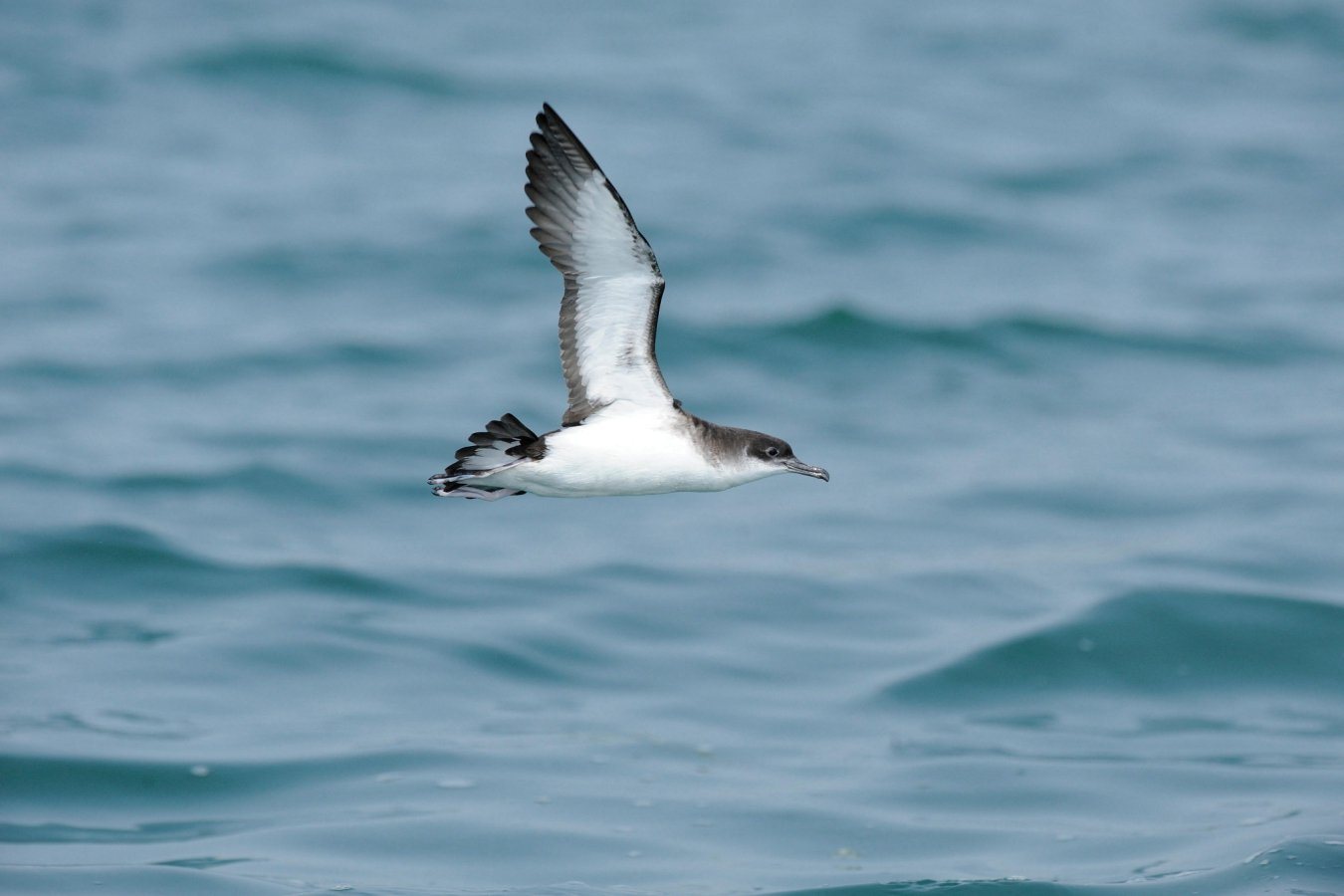
Manx shearwaters, small seabirds that nest on islands around the United Kingdom and Ireland, can suffer something very much like jet lag. A study of their foraging trips suggests that when the birds make fast eastward flights, their internal sense of time falls out of step with local daylight, and the return journeys can drift off course.
Each breeding season, the shearwaters fly more than 1,000 kilometres west to fishing grounds in the mid-Atlantic to find food for their chicks. They travel largely by exploiting wind gradients over the sea, a technique known as dynamic soaring. The researchers analysed nearly 4,000 trips tracked by GPS, and focused on the fast, rapid return flights that carry the birds back toward their nests.
When the birds were out of sight of land, their homeward flights deviated clockwise. The team found that the pattern was best explained by a sun compass tied to the birds' internal clock. Experiments in which small magnets were attached to the birds had no effect on their navigation, which suggests the shearwaters do not rely on the geomagnetic field to orient themselves. Clock-reset experiments in many other animals support the idea that a sun compass is used.
The deviation is small, roughly 5 kilometres over a 1,000-kilometre journey, and the researchers think it is probably too minor to have shaped the evolution of jet-lag avoidance. Still, the findings suggest that other long-distance migrants, including insects and bats, may also experience clock shifts. The effects on animals living near the poles remain unclear and may be stronger there.
We rewrote this story on 4 November 2026 after an editorial review.
Credit. Based on reporting by Michael Le Page for New Scientist. Is this your work? Write to us.
97