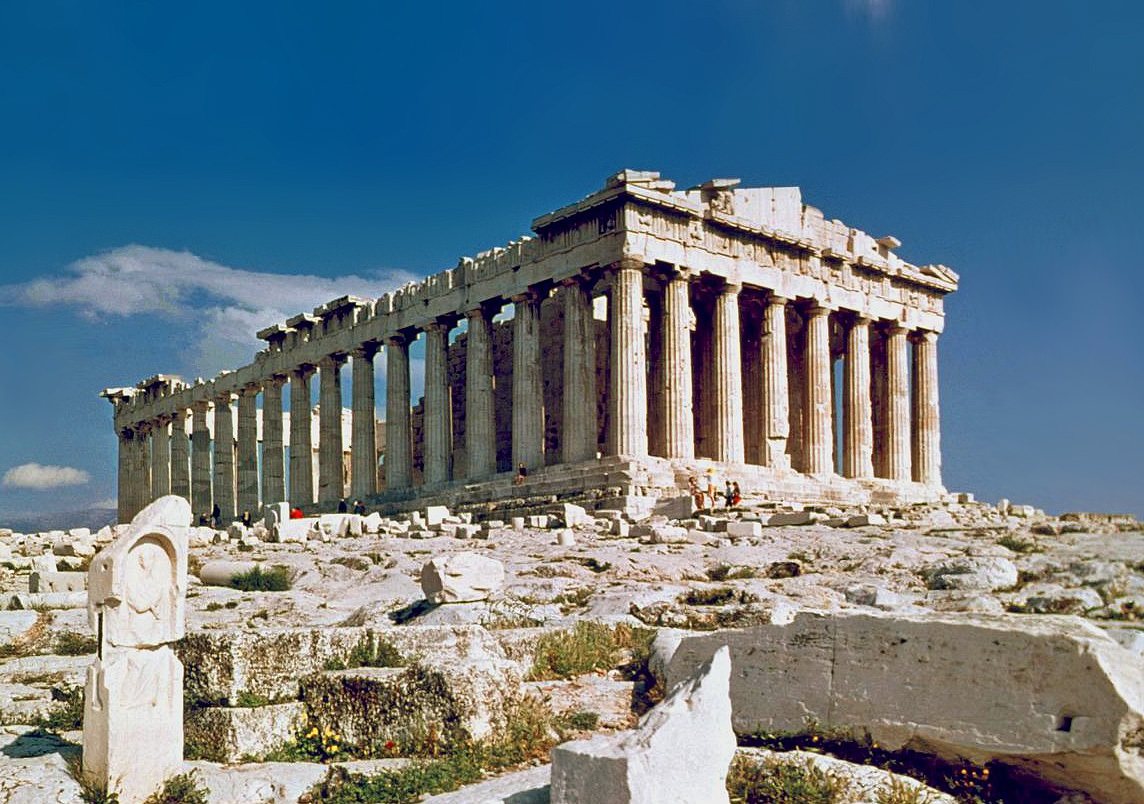
The Parthenon's celebrated architectural refinements were not designed to correct optical illusions, according to a mathematical analysis that challenges a belief long presented as fact in art and archaeology textbooks. Alain Goriely, a mathematician at the University of Oxford, examined twelve proposed optical corrections in the 2,500-year-old temple and found that they are either unsupported by evidence or too small to have any perceptible effect under normal viewing conditions.
The Parthenon, built in the 5th century BC in Athens, is considered the high point of the Doric style of classical Greek architecture. It measures 69.5 metres long and 30.9 metres wide and, although it appears straight, famously contains almost no straight lines or right angles. The enduring hypothesis holds that Greek architects deliberately introduced curves to counteract visual distortions, on the theory that perfectly straight lines would appear to bend and that curved lines would therefore look straight.
«It's widely accepted that it was made this way on purpose,» Goriely said. «But there is strictly no evidence that the refinements in the Parthenon actually produce the proposed visual illusions.»
The most prominent claim concerns the upward curve at the middle of many horizontal elements, including the stepped base on which the columns stand, known as the stylobate, and the horizontal entablature across the tops of the columns. According to the traditional explanation, this curvature prevents the elements from appearing to sag. Goriely's calculations show that viewers would not perceive any sagging in the first place, so the correction would be unnecessary.
«There are certain effects such as the Hering illusion that, on paper, would give qualitatively the same direction of effect, but if you actually do the computation, you realise that the effect does not appear,» he said. «And although it might work on paper, the effect in the real 3D building with an observer is completely different.»
A more likely explanation for the curve, proposed before but dismissed in the 1800s, is that the slight gradients help water drain away and prevent puddles from forming. Goriely acknowledged that the builders' actual reasoning cannot be known definitively.
Marge Livingstone, a neuroscientist at Harvard Medical School who studies visual perception, also rejects the illusion explanation for the floor. «I think it must have been for drainage, just like on roads,» she said.
John Senseney of the University of Arizona in Tucson attributes the curvature throughout the building to the curve of the platform on which it was constructed. He described the refinement as the product of skilled, often enslaved labourers working collaboratively on site rather than the abstract mathematical vision of an elite architect. In his view, the curvature was not an intended optical correction at all.
Other proposed illusions fare no better under scrutiny. One holds that the columns have a slight bulge in their middles to keep them from appearing pinched. Another suggests the corner columns were made thicker than the interior ones to offset the stronger light around the edges, which would otherwise make them look thinner. Goriely said no such pinching illusion has ever been scientifically demonstrated, even in controlled tests using three-dimensional reconstructions of temples.
Simpler explanations are available, he argued. The builders may have shaped curved columns because they found them more pleasing than straight ones, or because the profile improves resistance to buckling. The corner columns could be larger because they carry a slightly heavier load. Livingstone offered another possibility: if the columns narrow toward the top, it could be to make them appear taller, or simply because stability favours a thicker base.
Ancient Greeks were aware of visual illusions, but there is no evidence they designed the Parthenon to counteract the ones commonly cited, Goriely said. The first suggestion that the temple incorporated optical corrections appears in Vitruvius's De architectura, written roughly 400 years after construction. The idea took hold, he argues, because it captures the imagination, much as the now-disproven notion that the Parthenon was built to fit the golden ratio.
«Myths that are so powerful are very hard to change,» Goriely said. «Look at religion, right?»
The findings are published in Royal Society Open Science.