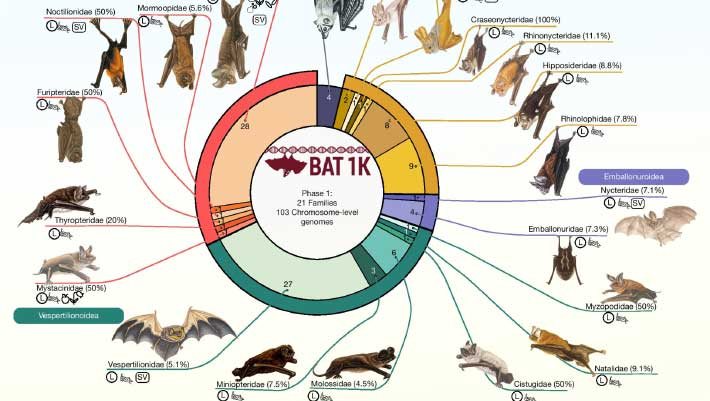
Bats, which account for more than one fifth of all living mammal species, may have first taken to the air in Europe rather than in the tropics or the Southern Hemisphere, according to a landmark genetic and fossil analysis. The finding challenges decades of debate over where and when the ancestors of modern bats evolved and could have significant implications for research into viruses and cancer in humans.
The study, described as the biggest of its kind, brought together thousands of DNA samples and tissue specimens collected from bat populations around the world. Among the most demanding fieldwork was the collection of samples from hammer-headed fruit bats in the northern forests of the Congo-Brazzaville, where scientists worked deep into the night in protective gear to swab and sample the animals along the Congo River. Those hard-won specimens, combined with fossils, helped reconstruct a new family tree for bats.
The results point to a European origin for the group, a conclusion that contradicts earlier assumptions that bats arose in warmer regions. Because bats make up such a large share of mammal diversity, their evolutionary history is central to understanding how mammals as a whole diversified. The revised family tree also provides a clearer timeline for when bats first appeared and how they spread across the globe.
Beyond rewriting the mammal family tree, the research is being described as a potential gamechanger for biomedical science. Bats are known reservoirs for a range of viruses, and they possess unusual immune and cancer-resistance traits. A more accurate evolutionary framework could help scientists trace how those traits arose and how they might be applied to human health, including the treatment of viral diseases and cancer.
The study relied on genetic data from modern bats as well as fossil evidence, allowing researchers to cross-check their conclusions against the physical record. The combination of molecular and paleontological approaches is what makes the new origin story particularly robust, according to the researchers. The work also highlights how much remains to be learned from museum collections and field samples gathered over years of difficult expeditions.
For now, the European origin hypothesis offers a new starting point for investigations into bat evolution, disease ecology, and the broader history of mammals. Further sampling and analysis will be needed to refine the timing and routes of the group's early dispersal, but the study already marks a major shift in how scientists understand the deep history of one of the most diverse and ecologically important groups of mammals.
12