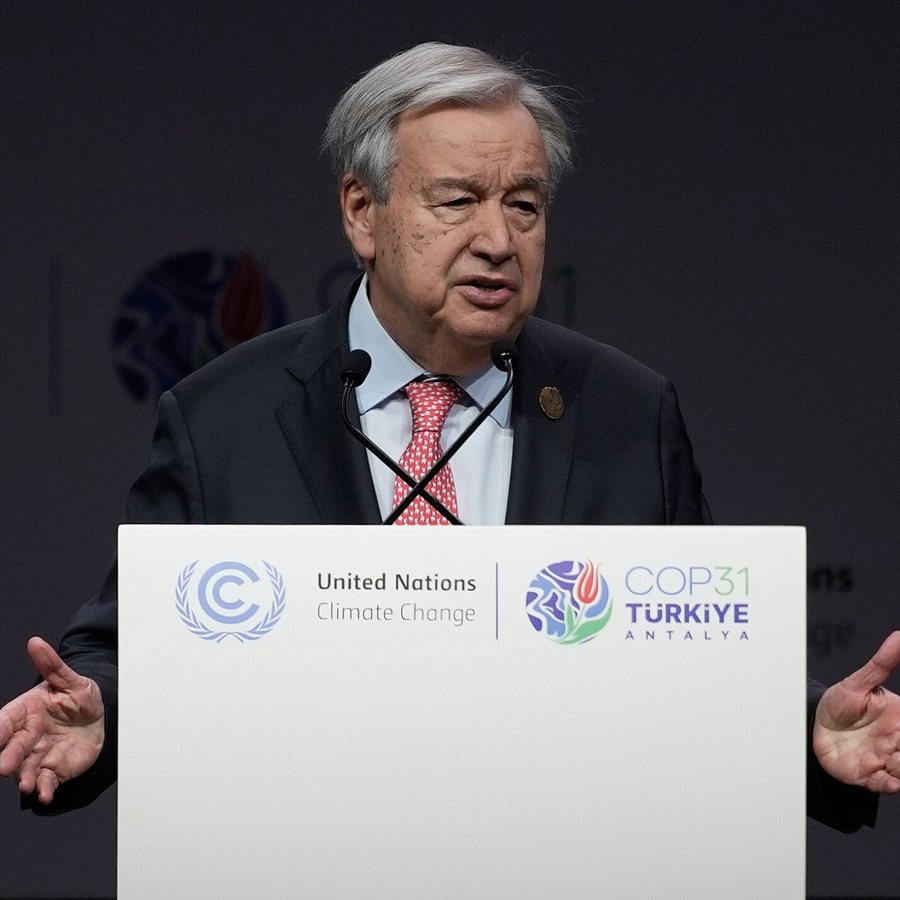
UN Secretary General António Guterres used his speech at the COP31 climate summit in Antalya, Turkey, on Wednesday to accuse fossil fuel interests of profiting while damaging the planet. He urged climate negotiators and advocates to keep fighting, even as the talks run into familiar disagreements over money and ambition.
Guterres, who is leaving his post, praised Turkey for hosting the gathering despite logistical problems that left delegates waiting long periods for buses and accreditation badges after the summit opened on 9 November. His tone was pointed rather than celebratory, and he framed the coming weeks as a test of whether governments will act on promises already made.
One of the central proposals on the table is Turkey's call for electricity to reach 35 percent of global final energy use by 2035, a goal referred to as "35×35". Australia, Ethiopia, Germany and Norway have explicitly backed it, while the European Union and the United Kingdom have expressed partial support. The idea would push the shift toward electrified power as a major part of cutting emissions.
The most contentious issue is adaptation finance, the money needed to help developing countries cope with climate impacts they did not cause. A 2026 report from the UN Environment Programme estimates that developing nations will need about $305 billion a year by 2035 for adaptation. Projected funding of $85 to $120 billion would cover only 20 to 29 percent of that need. African states pressed for an agenda item to triple aid for adaptation, but the proposal was left out.
Developing countries and the Group of 77 have invoked Article 9.1 of the Paris Agreement, which holds that wealthy countries should provide finance to support the transition. Critics note that the United Kingdom and Germany have reduced their climate finance while backing fossil fuel expansion, a tension that observers say will shape the negotiations. Hosts are also preparing a cover text that may acknowledge the world could temporarily exceed the 1.5°C warming threshold.
The open question for the summit is who will pay for adaptation, and whether the pledges made in the halls of Antalya will turn into money that actually reaches the countries that need it.
Credit. Based on reporting for NYT > Climate and Environment. Is this your work? Write to us.
37