A Kentucky family's refusal to sell 534 acres for more than $26 million has become a vivid symbol of anxiety about the physical footprint of artificial-intelligence infrastructure. The scientific question beneath the symbolism is narrower: what impacts can actually be measured, and which remain concerns until the proposed data center is designed and operating?
Ida Huddleston, 82, was offered $60,000 per acre for 71 acres in Mason County. Her daughter, Delsia Bare, was offered $48,000 per acre for 463 acres. They ultimately rejected the sale. The broader family farm is about 1,200 acres and has deep generational ties, according to PEOPLE.
The family has publicly raised concerns about water, electricity, pollution and the conversion of agricultural land. Huddleston summarized the land-use issue with the line, “You can't get food out of a data center.” That statement is straightforward as a comparison of land functions: a field can produce agricultural output, while an industrial computing site serves a different purpose.
Water is more technically conditional. The U.S. Department of Energy explains that data centers using cooling towers consume water through evaporation and require makeup water. But cooling architecture matters. Air-side economizing, different thermal designs and operating improvements can reduce water use. It is therefore not scientifically sound to infer a fixed water burden from facility size alone without knowing the cooling system, climate, workload and operating conditions.
Electricity demand is easier to establish as a national trend, though not as a site-specific number here. Lawrence Berkeley National Laboratory's June 2026 update estimates that U.S. data centers could use between 521 and 843 terawatt-hours of electricity in 2030, equivalent to roughly 9.5% to 15.3% of national electricity consumption. The report's reference case is 649 TWh, or 11.8%. That growth is driven in part by expanding AI hardware deployments and the power required by high-density computing.
Those national figures do not tell us the exact load of the Mason County project. They do explain why large data-center proposals increasingly trigger grid-planning debates and why communities ask who pays for substations, transmission and other infrastructure. Local officials in Mason County say the developer would cover the roads, water, sewer and electrical infrastructure required for the project.
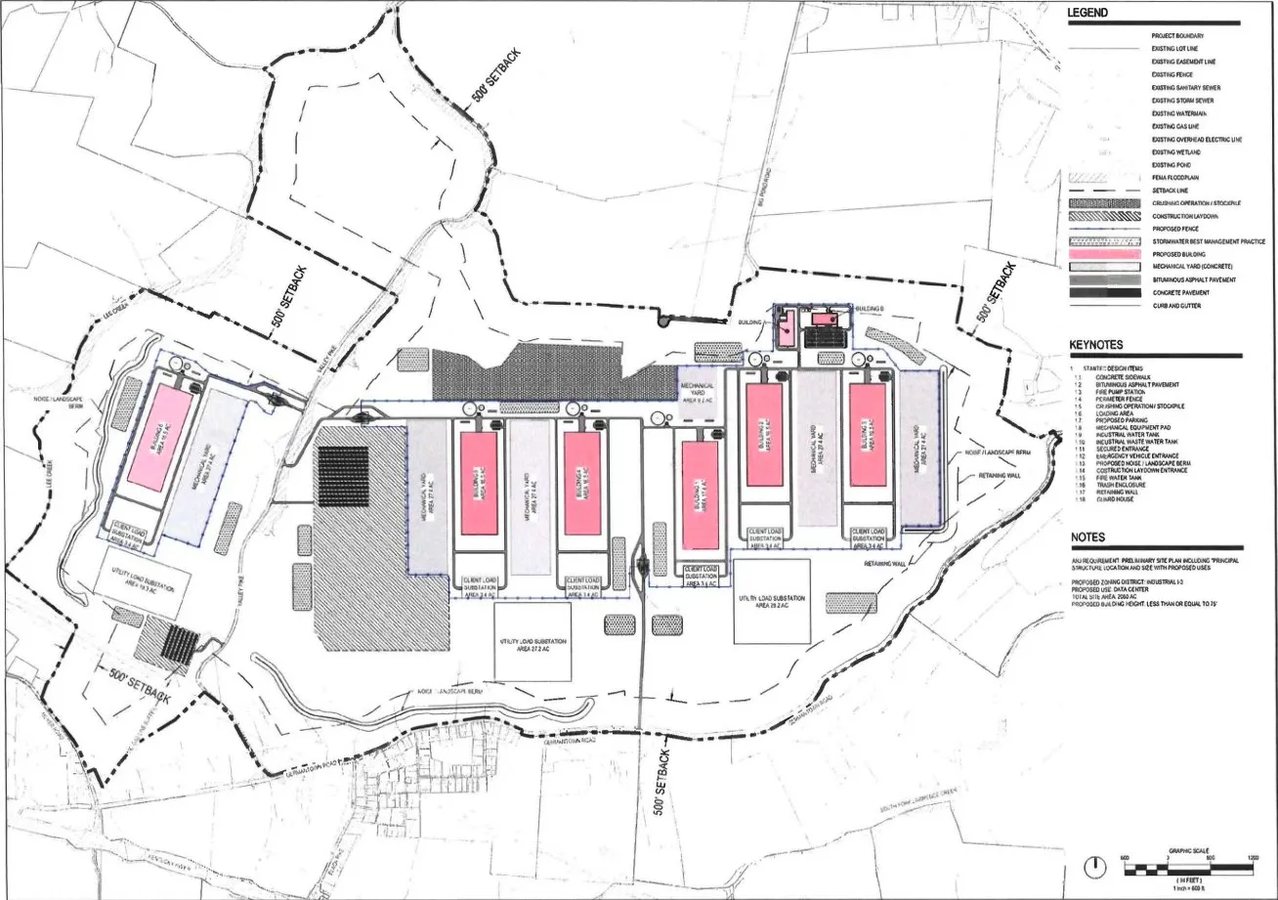
Land conversion, by contrast, is already measurable. On May 22, county officials approved rezoning 28 properties totaling roughly 2,080 acres from agricultural to rural industrial use for the proposed hyperscale campus. That zoning action does not prove all 2,080 acres will be covered by buildings, but it does change what uses are legally contemplated for the land.
The ultimate technology company remained undisclosed in July, and a residents' group is pursuing legal challenges. The developer still must decide whether to build.
The dispute illustrates why environmental evaluation benefits from separating categories. The loss of agricultural zoning is a documented planning decision. The family's concerns about water and pollution are documented public concerns. National growth in data-center electricity demand is measured and modeled by federal researchers. The actual water and energy performance of this specific project, however, will depend on engineering details that must be disclosed and monitored if construction proceeds.
That distinction does not make the family's choice less significant. It makes the debate more useful: communities can argue about values while still demanding quantitative answers about cooling, power, land and infrastructure before assumptions harden into facts.
90