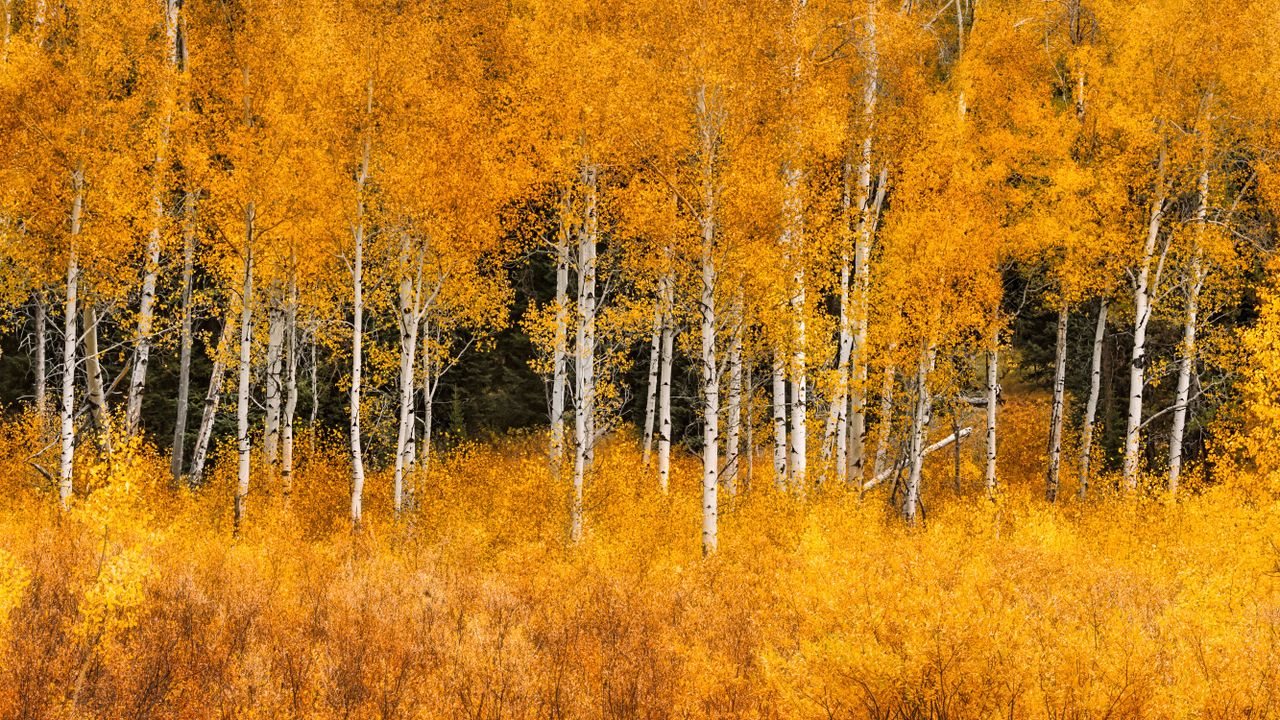
As wildfire seasons grow longer and more destructive across the American West, researchers are highlighting an unlikely natural ally in the fight against flames: the aspen tree. A new study shows that groves of aspen can act as natural firebreaks, slowing the advance of wildfires and giving firefighters a crucial advantage, even under the increasingly severe conditions fueled by climate change.
The findings offer a counterpoint to the prevailing narrative that Western forests are uniformly primed to burn. While dense conifer stands and drought-stressed timber have contributed to catastrophic megafires, aspen stands appear to resist ignition and suppress fire spread, according to the study. The quaking leaves and pale bark that make aspens iconic across mountain landscapes may also make them a quiet line of defense against one of the region’s most destructive natural hazards.
Fire scientists have long observed that certain forest types burn less readily than others, but the new research provides a systematic look at how aspen’s physical traits translate into fire behavior. Aspen leaves contain high levels of moisture, and the trees tend to leaf out earlier in the spring and hold their foliage later into the fall, keeping the immediate environment cooler and more humid than surrounding conifer forests. Their thin, smooth bark is less flammable than the thick, resinous bark of many evergreens, and the sparse, shaded understory beneath an aspen canopy supports fewer ladder fuels that can carry fire into the crowns of taller trees.
These characteristics, the researchers say, create conditions that are inhospitable to fast-moving crown fires. When a wildfire reaches an aspen stand, it may drop from the treetops to the forest floor, slow its rate of spread, or in some cases stop altogether. That behavior gives firefighters a natural containment line, a tool that could become increasingly valuable as climate change lengthens fire seasons and pushes blazes into higher elevations where aspens are common.
The study’s authors note that aspen’s firebreak effect is not absolute. Under extreme conditions, such as during a prolonged drought or when winds are exceptionally strong, aspens can burn like any other tree. But the research suggests that aspen groves are more resilient and more likely to survive a fire than surrounding conifer forests, and that they may recover more quickly after a blaze passes. In the aftermath of a fire, aspen’s roots can sprout new stems, allowing a burned grove to regenerate vigorously while slower-growing conifers take decades to re-establish.
The findings have practical implications for land managers. Rather than viewing the landscape as a binary choice between clearing forests and leaving them untouched, the study points to a middle path: maintaining and even expanding aspen stands in fire-prone areas could create a patchwork of natural firebreaks. This approach aligns with a broader shift in wildfire management away from total suppression and toward working with natural processes, using vegetation patterns to reduce the severity of fires.
Aspen’s reputation as a single organism, connected by a shared root system, adds another layer of interest to the findings. Some of the largest aspen groves in the world are believed to be among the oldest living organisms on Earth, and their ability to resprout after disturbance has long fascinated ecologists. The new study ties that ecological resilience to fire management, suggesting that nurturing aspen could yield benefits that extend well beyond their beauty.
The research arrives as federal and state agencies grapple with ballooning firefighting budgets and the growing threat of megafires. In recent years, blazes have consumed millions of acres annually, destroyed thousands of homes, and blanketed cities across North America in hazardous smoke. Climate scientists expect the trend to continue, with warmer temperatures drying out vegetation earlier in the season and extending the window in which large fires can ignite and spread.
While the study does not suggest that aspens alone can solve the wildfire crisis, it adds to a growing body of evidence that forest composition matters. Landscapes with a diversity of tree species, including fire-resistant hardwoods mixed among more flammable conifers, are better equipped to withstand extreme fire weather. The researchers argue that promoting aspen stands could be a low-cost, ecologically sound complement to mechanical thinning and prescribed burning.
As with any scientific finding, the study’s authors call for further research to refine their results. Questions remain about how aspen groves interact with different fire intensities, how climate change will affect aspen health itself, and how large a grove must be to meaningfully slow a blaze. But for communities on the front lines of fire season, the message is clear: the humble aspen is more than a scenic landmark, it is a natural buffer that deserves a place in the broader strategy for living with fire.