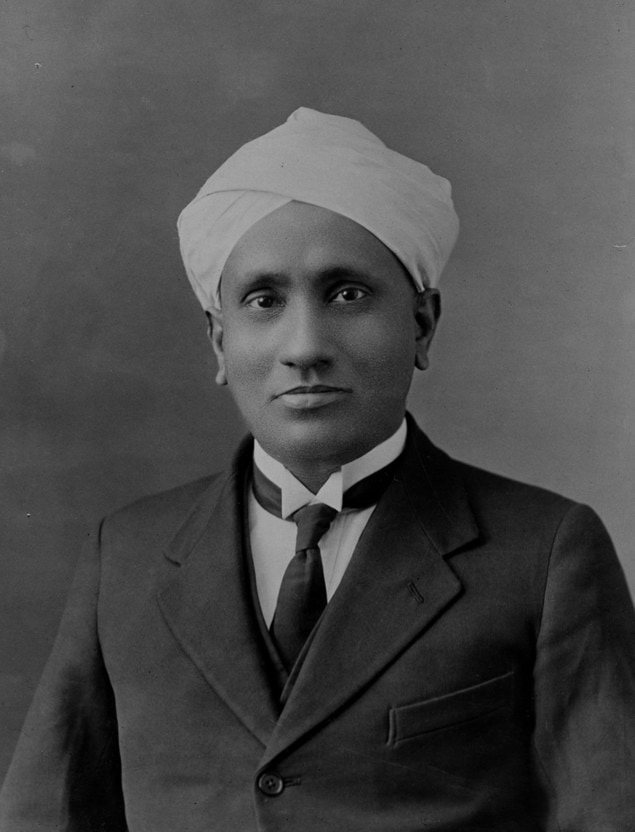
Indian physicist Chandrasekhara Venkata Raman was so certain he would win the 1930 Nobel Prize in Physics that he booked passage for himself and his wife from India to Stockholm months before the award was announced. The two-month sea journey was necessary because the prize winner would not be revealed until mid-November, leaving too little time to travel from India to Sweden for the ceremony on 10 December. Raman set sail in July 1930 and arrived in Stockholm on 9 December. The gamble paid off: he was awarded the prize for his work on the scattering of light and for the discovery of the effect that now bears his name.
The recognition made Raman the first person from India to win a scientific Nobel Prize. The poet and musician Rabindranath Tagore had previously won the 1913 Nobel Prize in Literature. Raman also became the first physicist from outside Western Europe or the United States to receive the physics award. His achievement came less than two years after the Indian National Congress declared Purna Swaraj, or complete independence, in January 1929. For a country under colonial rule and fighting for its identity, the prize carried significance beyond the laboratory, offering hope and aspiration to millions.
Born on 7 November 1888 in Thiruchchirappalli, Tamil Nadu, Raman was a child prodigy who at 16 came top in physics at the University of Madras and published his first research paper at 18. Appointed professor of physics at the University of Calcutta in 1913, he had a long obsession with winning a Nobel Prize. When elected a fellow of the Royal Society in 1924, he was asked during the award ceremony what was next for him. «The Nobel prize of course!» he replied.
The discovery that earned him the prize began on another sea voyage. In 1921, returning from Southampton to Bombay on the SS Narkunda after attending the Second Congress of the Universities of the Empire in Oxford, Raman spent the 15-day journey examining the deep blue colours of the Mediterranean, Red and Arabian seas with pocket Nicol prisms, a small telescope and a diffraction grating. He wrote up his findings in a short letter mailed to the journal Nature while the ship was docked at Aden in Yemen. Published on 20 October 1921, it listed his address as «SS Narkunda, near Aden». A follow-up paper, titled «The colour of the sea», carried the byline «SS Narkunda, Bombay Harbour».
The spectrum of blue fascinated Raman and led him to question the prevailing belief, based largely on the work of Lord Rayleigh, that the colour of the sea was simply a reflection of the sky and had nothing to do with the water itself. In his second Nature paper, published on 17 November 1921, Raman challenged that notion. «It was abundantly clear from the observations,» he wrote, «that the blue colour of the deep sea is a distinct phenomenon in itself.» He believed light diffracts as it passes through water and suggested that the diffracting particles might, at least in part, be the molecules of the water themselves.
That curiosity drove a series of experiments over the following years, carried out primarily by his students at Calcutta University. The work culminated in the discovery that light changes its wavelength and energy when it passes through any material, a change that acts as a fingerprint of the material itself. The phenomenon became known as Raman scattering, or the Raman effect. It later gave rise to Raman spectroscopy, which uses the scattering of laser light to establish the chemical make-up of a material and forms the basis of airport security scanners.
Raman's audacity, self-belief and the arduous journey to Stockholm in 1930 secured him the recognition he had long pursued. His story remains a landmark in the history of science, linking a simple observation of the sea to a discovery that continues to shape chemical analysis and security technology today.
10