The Royal Swedish Academy of Sciences awarded the 2026 Nobel Prize in Physics to Belgian physicist Francis Halzen, 82, for his decisive contributions to the IceCube Neutrino Observatory and the discovery of high-energy neutrinos of astrophysical origin. The prize recognizes work that opened a new window for studying the universe through subatomic particles capable of traveling vast distances without deviating or losing energy.
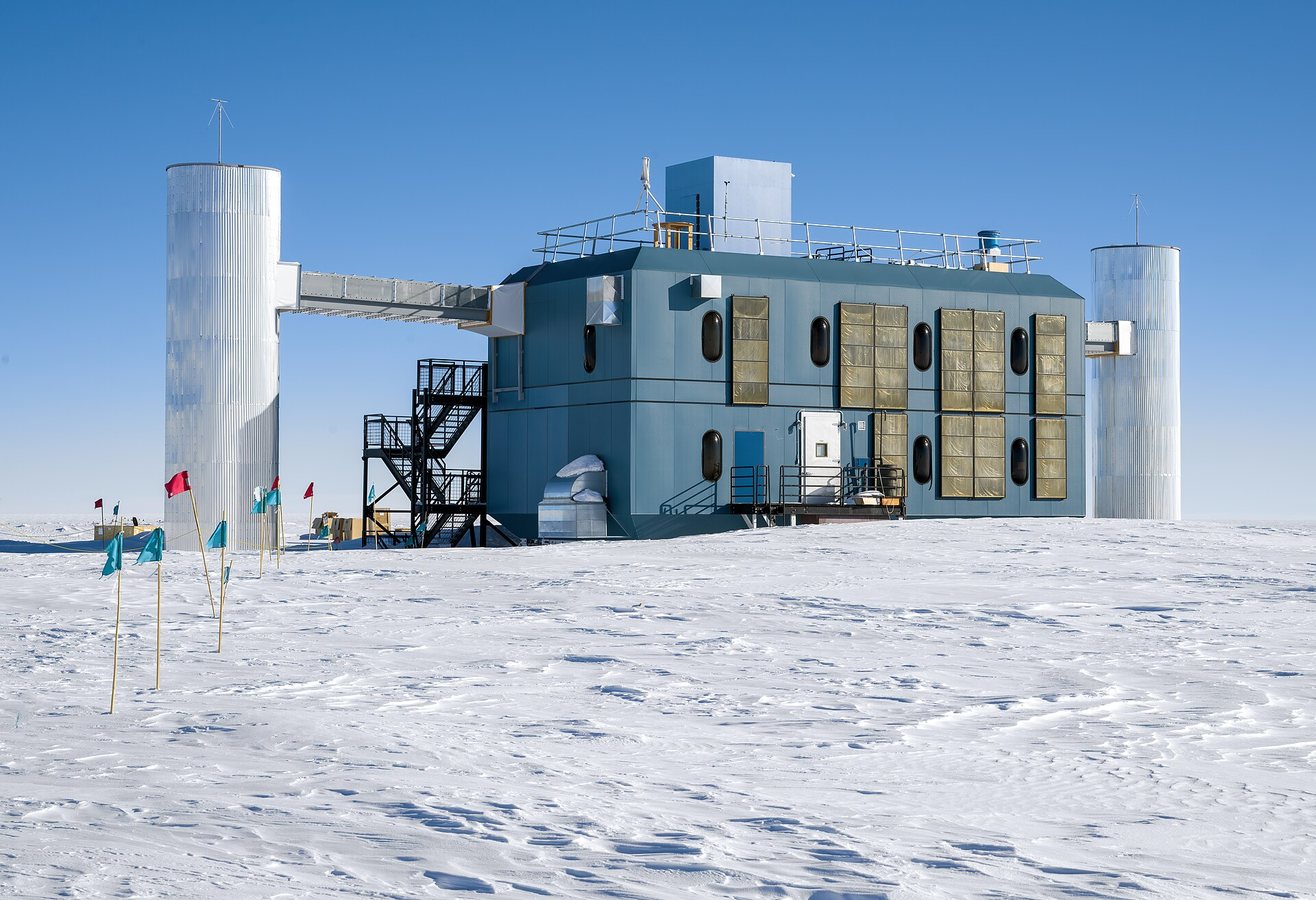
Halzen, a professor at the University of Wisconsin-Madison, first proposed in 1988 the possibility of building an observatory capable of detecting cosmic neutrinos. That idea became IceCube, a massive detector installed about two kilometers beneath the ice of Antarctica. The structure spans roughly one cubic kilometer and contains more than 5,000 light sensors. Between 2004 and 2010, researchers melted ice with pressurized hot water to place detectors at various depths.
«This Nobel Prize has to do with a giant ice cube located at the South Pole of our planet. The ice cube allows the detection of neutrinos,» said Eva Olsson, a member of the Nobel Committee for Physics. The sensors identify tiny flashes of light produced when neutrinos pass through the ice, a phenomenon known as Cherenkov radiation.
Most neutrinos reaching Earth are produced by the Sun. However, in 2013 IceCube detected 28 neutrinos of cosmic origin, coming from outside the Solar System. The finding allowed researchers to reconstruct their trajectories and study the phenomena that produce them, including extreme environments related to supermassive black holes and other cosmic events. «The vision and scientific leadership» of Halzen were fundamental to the observatory's development, the Swedish Academy noted. «Cosmic neutrinos with extremely high energies are very rare, so an enormous volume of ice is needed to observe a suitable number of collisions,» the jury explained.
Unlike other particles, neutrinos can travel great distances without significantly changing direction or losing energy, making them messengers of phenomena occurring in distant regions of the universe. Halzen said the announcement was a surprise. «It has been a great surprise and obviously I did not expect it,» he said during the press conference after the announcement. «But it is a great pleasure to know that I have been awarded this prize,» he added. He also highlighted the researchers who trusted the project when doubts existed about whether the observatory could be built. «What makes me happiest, besides winning the Nobel Prize, is that I hope this serves to recognize the truly brave people who joined me at the beginning of this project,» he said.
Spanish researcher Enrique Zas, who worked with Halzen in the late 1980s on calculations for the detector's design, recalled that the project represented an innovation compared to early attempts to build neutrino observatories in the sea. Another former student, researcher Juande Zornoza, noted that the finding «opened a new window to the universe» and allowed the study of phenomena such as stellar collapse and supermassive black holes.
IceCube cost approximately $279 million and involved international participation. The United States provided a major portion of the funding, while Germany, Belgium, and Sweden also contributed. Currently, scientists from 14 countries participate in the collaboration. The observatory will continue operating with financial support until 2031, and a new generation of detectors is planned that will be about eight times larger than the current one. Similar developments are underway elsewhere, including KM3NET, a neutrino observatory being built about 3,500 meters deep in the Mediterranean Sea.
Belgian Prime Minister Bart De Wever congratulated Halzen and called the prize a recognition of a life dedicated to studying the mysteries of the universe. «An impressive recognition of a life dedicated to unraveling the greatest secrets of the cosmos through its most minuscule manifestations,» he wrote on X. During the press conference, Halzen was also asked about the possibility that neutrinos could be used to transmit messages from extraterrestrial civilizations. «It has been speculated that (...) this would be an ideal way to communicate with extraterrestrials,» he responded. However, he added: «I think we already have enough real problems to deal with right now.»
The 2026 Nobel Prize in Physics is the second prize announced this week. On Monday, the prize in Physiology or Medicine was awarded to scientists Karl Deisseroth, Peter Hegemann, and Georg Nagel for their discoveries concerning light-activated ion channels and the development of optogenetics. Each award is worth 11 million Swedish kronor, equivalent to approximately one million euros.
10