The National Security Research Center at Los Alamos National Laboratory has released a photographic history of the Trinity test, the world's first atomic explosion, drawing on more than 200 images from the test's official archive and other sources. The book, titled «Trinity: an Illustrated History of the World's First Atomic Test», was written by Emily Seyl and her colleagues at the NSRC and is designed to serve as a public record of a period that is receding from living memory.
The Trinity site, located in a remote corner of New Mexico, remains strictly off-limits to the public. Although most of the radioactivity from the 1945 explosion has dissipated, military police still guard the gates, and the US Army continues to use the area as a missile range. Members of the public are allowed in only once a year, on the third Saturday in October, between 8 a.m. and 3:30 p.m. For those unable to visit during that narrow window, the book offers what may be a superior alternative: a visual reconstruction of a place that today contains little more than a few dilapidated buildings, a commemorative obelisk, and a fragment of a half-million-pound steel tank.
That steel tank, known as Jumbo, receives significant attention in the book. Costing $12 million in 1940s money, it was originally designed to contain the conventional explosives that would implode the Gadget's plutonium core. If the explosives worked but the chain reaction did not, Jumbo was meant to prevent plutonium from scattering across the site. The Ohio-based manufacturer Babcock & Wilcox built the vessel without being told its purpose. By the time Jumbo arrived in New Mexico in spring 1945, scientists at Los Alamos had grown confident enough in the Gadget's design that the containment vessel was deemed surplus to requirements. Technicians had spent days hauling it across the desert, an episode the book documents with numerous black-and-white photographs.
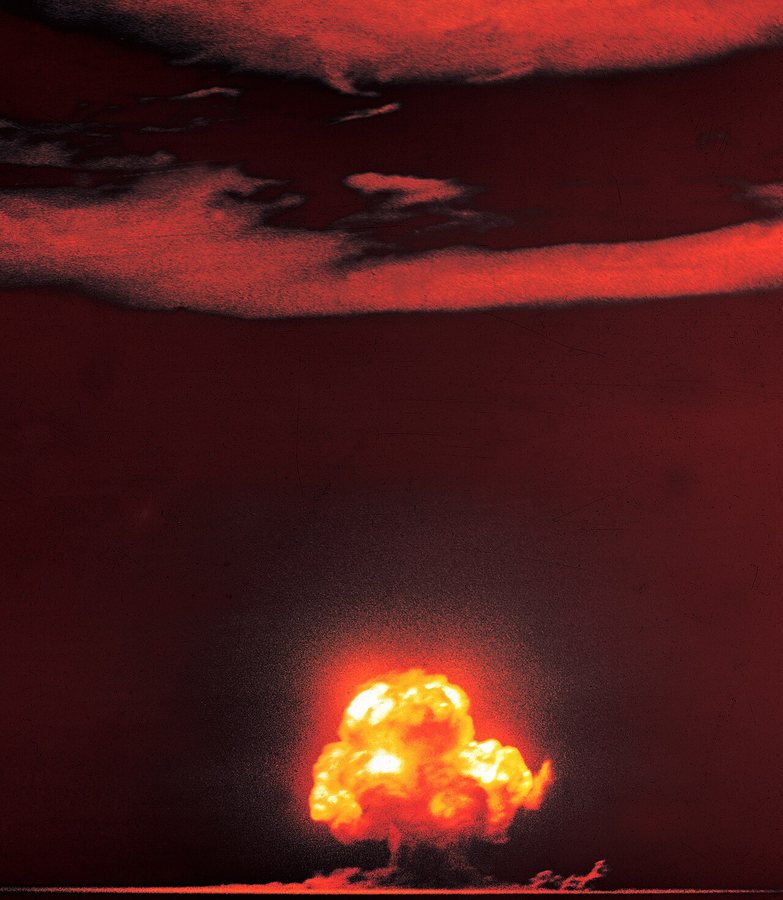
Beyond the machinery, the book devotes considerable space to the individuals who worked at Trinity, including relatively unknown figures. Among them is Jack Aeby, a technician in the Army's Special Engineer Detachment, an organization that diverted soldiers with technical training into atomic support work. An amateur photographer, Aeby asked his group leader, the physicist Emilio Segrè, for permission to document the explosion with his personal camera. Because of technical problems with the official Kodak cameras, Aeby's snapshot is now the only decent color image of the Trinity test in existence.
The book also covers the scientific and historical background leading to the test. Its introduction summarizes Lise Meitner and Otto Frisch's 1938 insights into nuclear fission, the start of the Second World War, Enrico Fermi's demonstration of the first nuclear chain reaction, and the launch of the Manhattan Project to weaponize those discoveries. The test itself took place on 16 July 1945, when Manhattan Project participants gathered to witness the dawn of the nuclear age.
According to the book, the Trinity site today offers little physical evidence of the bustling installation where the Gadget was assembled and tested. The photographic record is therefore intended to make both the site and the people who worked there come alive for readers who cannot visit. The result, as the book's own material suggests, is a volume that is by turns illuminating, beautiful, and disturbing — an important public record of a place still veiled in secrecy.