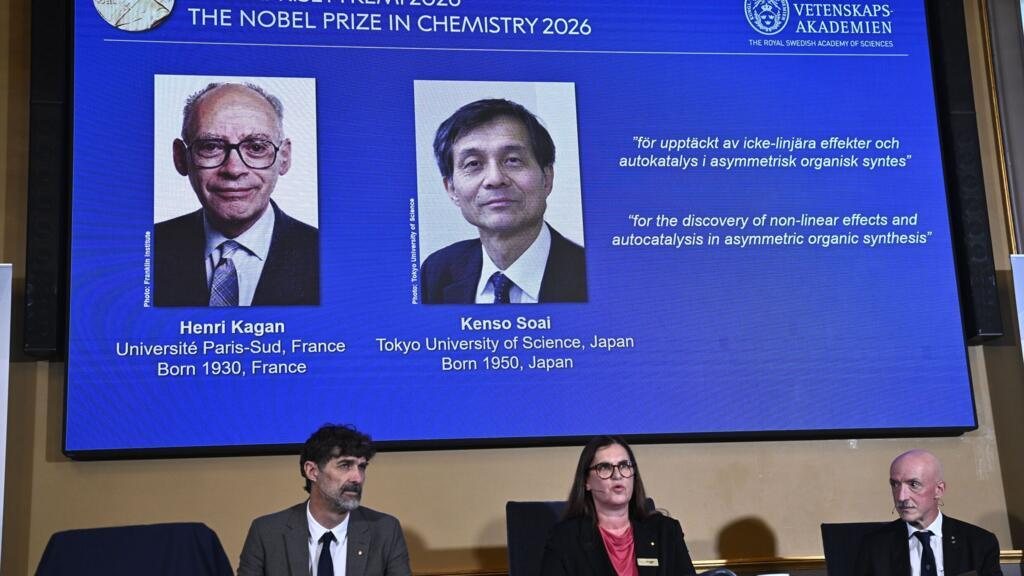
The 2026 Nobel Prize in Chemistry has been awarded to Frenchman Henri Kagan and Japanese chemist Kenso Soai for their work on "the discovery of non-linear effects and autocatalysis in asymmetric organic synthesis," the Nobel committee announced in Stockholm on Wednesday, October 7. This distinction recognizes research that has profoundly marked organic chemistry and opened the way to major pharmaceutical applications.
The Nobel committee stressed that "their discoveries have played a decisive role for chemists who design reactions intended for the manufacture of pharmaceutical products." Asymmetric organic synthesis makes it possible to preferentially produce a given form of a molecule, a property that is crucial for the efficacy and safety of medicines. The work of Kagan and Soai shed light on the mechanisms by which certain chemical reactions self-amplify, a phenomenon known as autocatalysis, and how non-linear effects can influence the final result.
Henri Kagan, 95, is now a professor at the University of Paris-Saclay. He is internationally recognized for introducing the use of rare earths, notably the lanthanides, in organic chemistry. Kenso Soai, 76, is a professor at the Tokyo University of Science. Their careers illustrate decades of fundamental research in the service of synthetic chemistry.
This recognition corrects what many considered an injustice. In 2001, the Nobel Prize in Chemistry had been awarded for asymmetric catalysis, but Henri Kagan had been excluded due to the rule limiting the number of laureates to three. The prize was then given to Americans William Knowles and Barry Sharpless, along with Japanese chemist Ryoji Noyori. That choice had provoked strong bewilderment within the global scientific community, since Kagan was regarded as the "father" of this technique. His honor this year therefore crowns a contribution long recognized but never rewarded by the Nobel committee.
The chemistry prize is the third scientific prize of the Nobel season, after medicine and physics, which were awarded on Monday and Tuesday respectively. Besides the prestigious distinction, the Nobel consists of a diploma, a gold medal and a check for 12 million Swedish kronor, or a little over one million euros. The Nobel season will close on October 12 with the economics prize.
The recognition of Kagan and Soai's work comes at a time when synthetic chemistry plays a central role in drug design, but also in many other industrial fields. Asymmetric autocatalysis, in particular, could pave the way for more efficient and more selective processes, reducing waste and improving yields. For researchers, this distinction highlights the importance of fundamental research which, sometimes after decades, finds concrete applications and transforms entire sectors.
By rewarding these two scientists, the Nobel committee also sends a message about the international dimension of science. A Frenchman and a Japanese, coming from different research traditions, are honored for complementary work that advanced the understanding of chemical mechanisms. This cooperation, even if indirect, illustrates how science advances through the confrontation of ideas and the validation of results on a global scale.
With this prize, Henri Kagan sees his contribution finally recognized by the Nobel institution, while Kenso Soai joins the list of Japanese chemistry laureates. Their names add to a history already rich in discoveries that have shaped modern chemistry and continue to inspire new generations of researchers.
Credit. Based on reporting for RFI FR. Is this your work? Write to us.
125