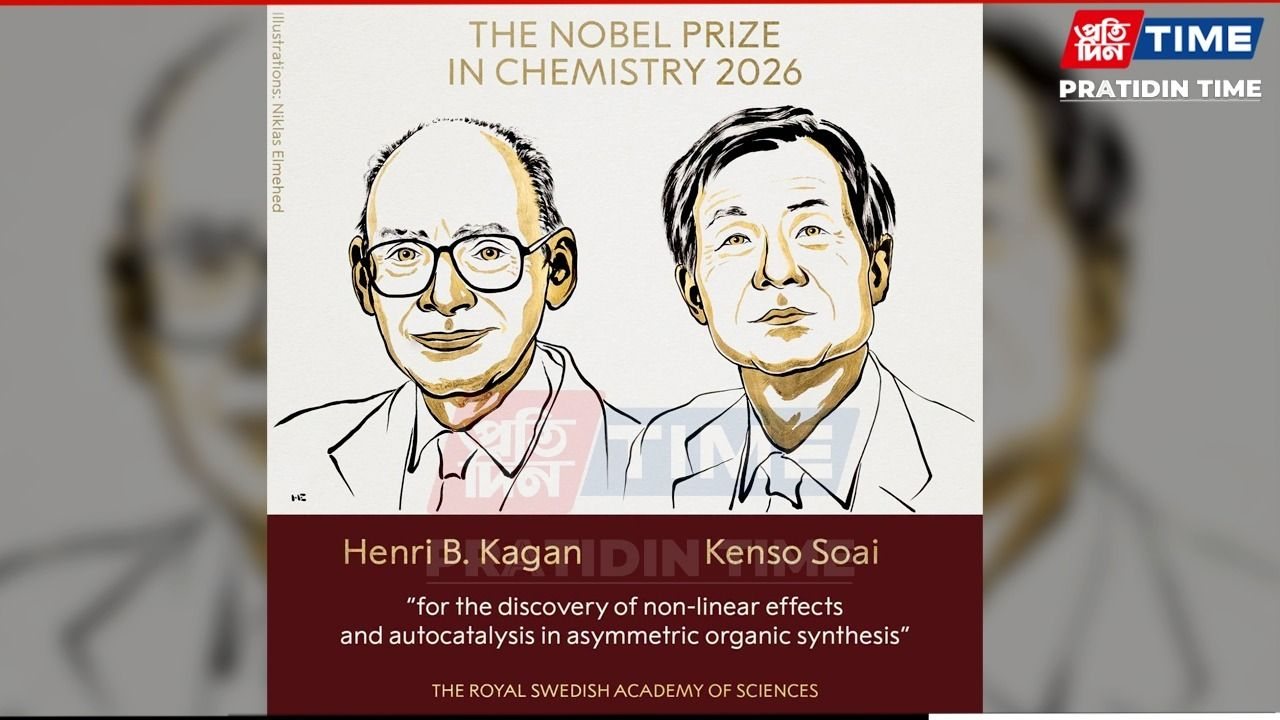
Henri B. Kagan and Kenso Soai have been awarded the Nobel Prize in Chemistry for developing chemical reactions that resolve a mystery over a century old: how homochirality — the preference for one mirror-image form of a molecule — can emerge spontaneously. The Royal Swedish Academy of Sciences announced the prize Wednesday in Stockholm.
Heiner Linke, chair of the Nobel Committee for Chemistry, said in a news release that Kagan and Soai «have provided a solution to a chemical mystery that is over a century old: how homochirality can emerge spontaneously.» He added that «the chemical reactions they have developed are spectacular.»
Kagan, 95, was born in France and is affiliated with Universite Paris-Sud in Orsay, France. Soai, born in Japan, is affiliated with the Tokyo University of Science. Soai said he was shopping near his home when he was reached by the Nobel committee.
The prize recognizes work on chirality, a property of molecules that exist in two mirror-image forms, much like a left and right hand. In living organisms, these forms are often not interchangeable: one version can be biologically active while its mirror is not. How this preference for a single form — homochirality — arose from ordinary chemical reactions has been a longstanding puzzle.
The reactions developed by the laureates demonstrate how such a preference can emerge and amplify spontaneously, offering a chemical explanation for a phenomenon that has implications for the origin of life and for the synthesis of pharmaceuticals and other compounds where molecular shape determines function.
The chemistry award is the third Nobel Prize announced this week. On Monday, the medicine prize went to three scientists whose work led to a tool that uses light to help unravel how the brain works. On Tuesday, the physics award recognized a scientist’s efforts to demystify a rare group of neutrinos.
The literature prize is set to be awarded Thursday. After Friday’s peace prize is awarded, the Nobel Memorial Prize in Economic Sciences will be announced Monday.
Last year, three scientists won the chemistry Nobel for their development of new molecular structures that can trap vast quantities of gas inside, laying the groundwork to potentially suck greenhouse gases out of the atmosphere or harvest moisture from desert environments.
The prize money this year is 12 million Swedish kronor, about USD 1.2 million, whether for an individual, a small group of laureates or an organization.
15