For more than half a century, the idea of extracting energy from a rotating black hole remained a theoretical curiosity, a prediction of general relativity that seemed impossible to test in a laboratory. Now, a team of physicists at the Advanced Science Research Center of the City University of New York (CUNY ASRC) has found a way to bring that exotic physics onto a benchtop, demonstrating a phenomenon known as rotational superradiance without needing a black hole at all.
The experiment, published in the journal Nature, directly observes the amplification of electromagnetic waves as they interact with a system that mimics a rapidly rotating object. The work realizes a concept first proposed by physicist Sir Roger Penrose in 1969, who imagined that energy could be extracted from a spinning black hole. Shortly after, Yakov Zel'dovich refined the idea, predicting that a wave striking a rotating object would gain energy and be amplified, while the object itself would slow down imperceptibly. This effect, known as superradiance, is related to other physical processes where exceeding a critical speed triggers emission or amplification, such as the Cherenkov effect.
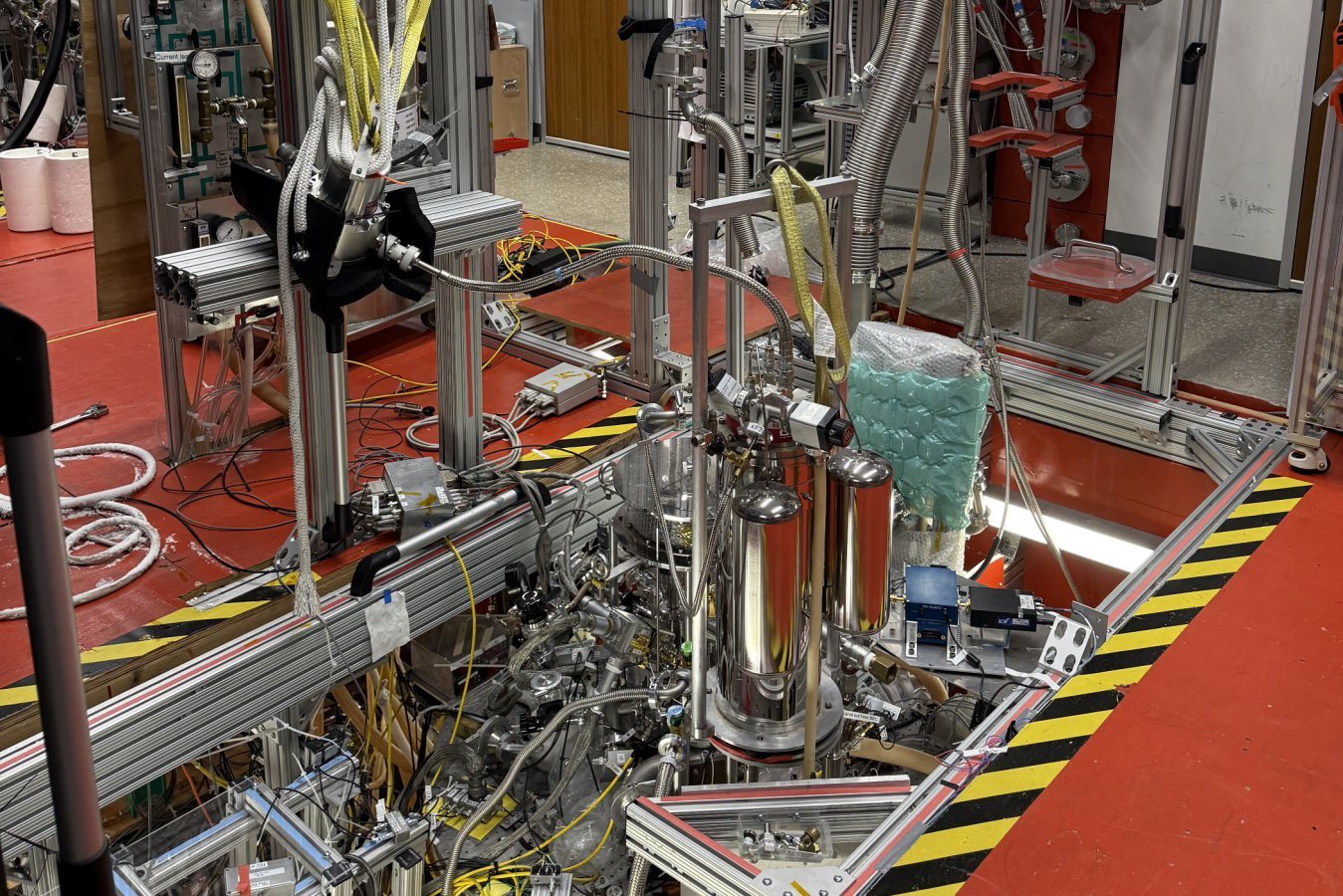
The central challenge that kept the Penrose-Zel'dovich effect in the realm of theory for decades is the extreme rotational speed required. No physical material can spin fast enough to produce the effect without tearing itself apart. The CUNY team circumvented this limitation with an ingenious approach: they did not spin anything at all. Instead, they built a ring of electronic resonators whose properties were rapidly modulated in a carefully calibrated temporal sequence, creating a moving pattern around the ring.
Although the device itself remained stationary, the moving pattern caused electromagnetic waves passing through the system to behave as if they were interacting with an object rotating at extraordinary speed. This synthetic rotation can be made extremely fast, far beyond the limits of any mechanical rotation, and can even simulate speeds faster than light without violating physical laws, because it is a pattern that moves, not a physical object. At these simulated extreme speeds, the predicted effect manifested clearly: waves with the right rotational characteristics extracted energy from the system and emerged amplified.
Hady Moussa, a coauthor of the study from CUNY ASRC, explained that the waves with appropriate rotational properties drew energy from the system and were amplified, reproducing the essential physics of the Penrose-Zel'dovich process. He noted that the approach relies on engineered metamaterials designed to control how waves propagate. Lead author Hadiseh Nasari, also a researcher at CUNY ASRC, emphasized that the success of the experiment moves ideas about extreme rotational dynamics from theory into practice and creates a versatile experimental platform for exploring phenomena at the intersection of astrophysics, wave physics, and quantum science.
The result brings a type of physics that could previously only be calculated by thinking about black holes into a controlled laboratory setting. This new playground is controllable and reproducible, allowing researchers to investigate extreme regimes that are otherwise inaccessible. Looking ahead, the same concepts could be extended to photonic and quantum platforms, with potential applications ranging from fundamental research to wireless communications and classical and quantum optics.
The experiment marks a significant step in experimental physics, demonstrating that effects once confined to the most exotic objects in the universe can be studied under ordinary laboratory conditions. By creating a synthetic rotating system, the researchers have opened a door to exploring the dynamics of rotating systems in ways that were previously unimaginable, providing a new tool for understanding the behavior of waves and energy in extreme environments.
192