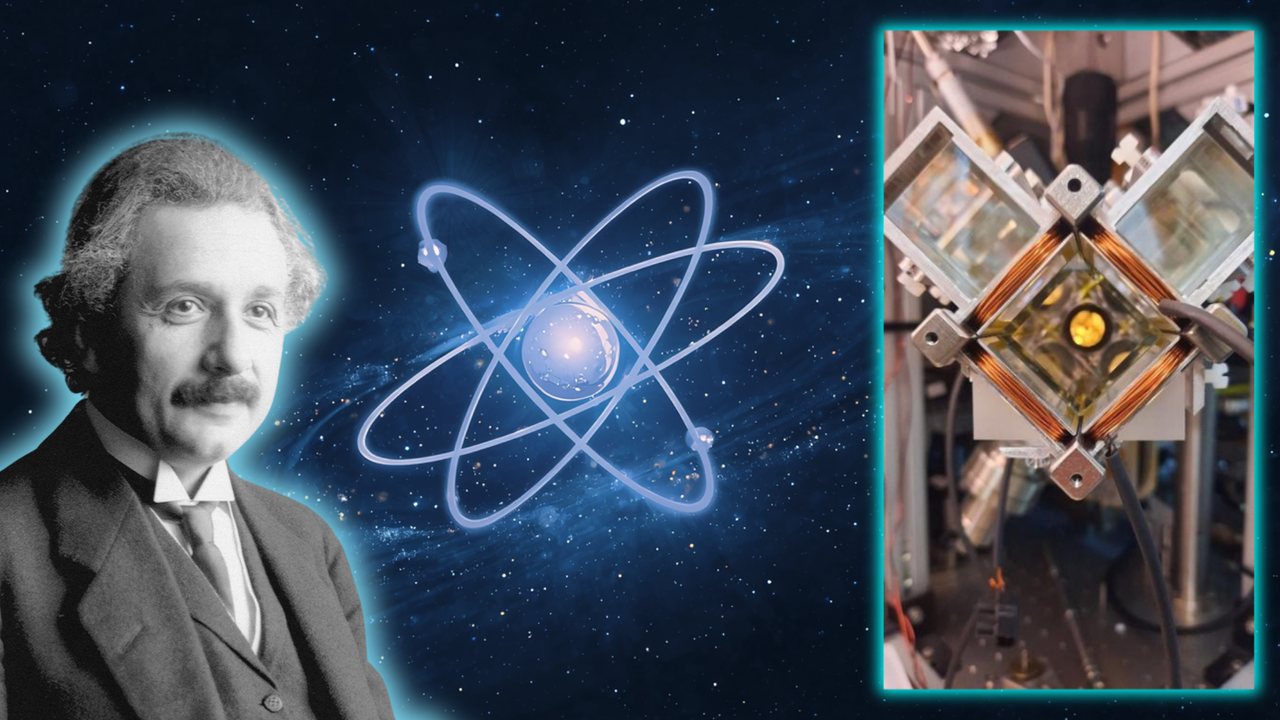
Physicists have directly observed a long-predicted quantum effect of gravity, putting one of Albert Einstein's foundational ideas to a striking new test. The experiment, described as a first-of-its-kind observation, demonstrates that gravity can be measured acting on a quantum object, bridging two pillars of modern physics that have historically resisted unification.
Using ultracold atoms, the research team split an atom's quantum wave so that one part was held in place while the other fell freely under gravity. The two parts were then reunited, allowing the scientists to measure the tiny difference that emerged from the gravitational interaction. This subtle measurement provides direct evidence of gravity's influence on a system governed by quantum mechanics, a regime where the force has never before been observed in isolation.
The result is significant because it addresses a central puzzle in physics. Einstein's general relativity describes gravity as the curvature of spacetime, a theory that works remarkably well at large scales. Quantum mechanics, by contrast, governs the behavior of particles at the smallest scales. For decades, physicists have struggled to reconcile the two, and observing gravity's effect on a quantum object is considered a crucial step toward understanding how they might fit together.
The experiment relies on a technique known as atom interferometry, which exploits the wave-like nature of matter. By cooling atoms to temperatures near absolute zero, researchers can manipulate their quantum states with extreme precision. In this case, the team created a superposition in which one part of the atom's wave function remained stationary while the other moved under the influence of Earth's gravitational pull. When the two parts were recombined, the interference pattern revealed the gravitational phase shift, a measurable consequence of the force acting on the quantum system.
This approach offers a new window into the quantum world, potentially opening the door to experiments that probe the intersection of gravity and quantum mechanics more deeply. The findings could inform future efforts to develop a theory of quantum gravity, a framework that would describe how gravity behaves at the smallest scales, where current models break down.
The observation also has implications beyond fundamental physics. Techniques developed for this experiment may find applications in precision measurement, including sensors that detect gravitational variations with unprecedented accuracy. Such devices could be used in geophysics, navigation, and even tests of fundamental constants.
While the experiment does not resolve the long-standing theoretical conflict between general relativity and quantum mechanics, it marks a practical milestone: gravity has now been observed in a regime where quantum effects dominate. The researchers note that further work will be needed to extend these measurements and explore whether gravity itself exhibits quantum behavior, a question that remains open.
The study adds to a growing body of research aimed at understanding the quantum nature of the universe. As experimental techniques improve, scientists are increasingly able to test ideas that were once purely theoretical, bringing the dream of a unified description of nature closer to reality.
274