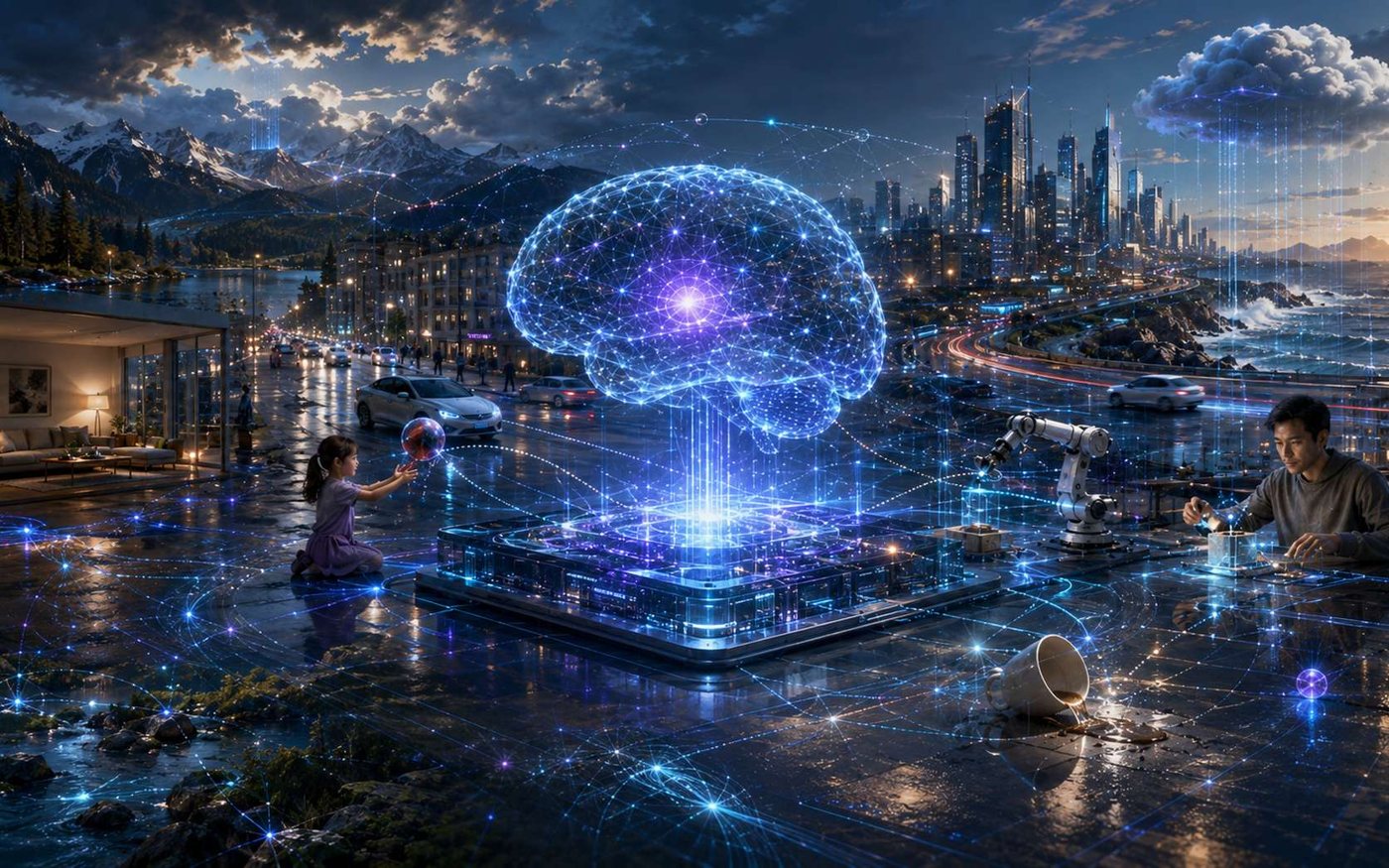
Large language models have transformed artificial intelligence by learning to summarize, translate, code, and argue using vast amounts of text. Yet their intelligence remains confined to the domain of signs and symbols. A growing field of research now aims to break that barrier by developing what researchers call « world models » — AI systems designed to understand the physical world in a way that current language models cannot.
World models represent a fundamental shift in how researchers think about machine intelligence. Instead of learning statistical patterns in text, these systems attempt to build internal representations of how the world works: how objects move, how cause and effect operate, how space and time structure events. The goal is to give AI a grounded understanding of reality rather than a superficial fluency in language.
The concept draws inspiration from cognitive science and neuroscience. Humans and animals do not simply process symbols; they construct mental models of their environment that allow them to predict outcomes, plan actions, and reason about unseen situations. World models aim to replicate that ability in machines by training them on data that includes not just text but also images, video, sensor readings, and interactive environments.
Several research groups and companies are actively pursuing this approach. One prominent example is the work being done at DeepMind, where scientists have developed systems that learn to model physical environments from visual input alone. These systems can predict future frames in a video, simulate the effects of actions, and generalize to new situations without explicit programming. Another line of research comes from the University of California, Berkeley, where researchers have built world models that allow robots to learn manipulation tasks by imagining the outcomes of their actions before executing them.
The potential applications are broad. In robotics, world models could enable machines to operate in unstructured environments without needing exhaustive training data for every possible scenario. In autonomous driving, they could help vehicles anticipate the behavior of pedestrians and other cars by simulating possible futures. In scientific research, they could accelerate discovery by allowing AI to reason about physical systems, from protein folding to climate dynamics, in ways that go beyond pattern matching.
Despite the promise, significant challenges remain. Building accurate world models requires enormous amounts of diverse data and sophisticated architectures that can capture the complexity of the physical world. Current models still struggle with long-term predictions, rare events, and situations that differ substantially from their training data. There is also the question of how to evaluate whether a world model truly understands the world or is merely simulating understanding through statistical approximation.
Critics argue that the field risks repeating the mistakes of earlier AI paradigms by overpromising what world models can achieve. Some researchers caution that without a clear theoretical foundation, world models may simply become larger and more opaque versions of existing systems, lacking the genuine causal understanding that the term implies. Others point out that even if world models succeed, they will still need to be integrated with language models to communicate their reasoning to humans.
Proponents counter that world models represent a necessary evolution for AI. They note that language models, for all their impressive capabilities, remain brittle and prone to errors that reveal a lack of real understanding. A language model can write a plausible essay about physics but cannot predict the trajectory of a ball thrown in the air. World models, by grounding AI in physical reality, could address that fundamental weakness.
The research community is still debating the best path forward. Some advocate for hybrid systems that combine language models with world models, allowing AI to reason about both symbols and physical reality. Others argue for a more radical departure, building entirely new architectures from the ground up that treat world understanding as the primary objective rather than an add-on.
Funding and institutional support are growing. Major tech companies, including Google, Meta, and OpenAI, have invested in world model research, and academic conferences increasingly feature papers on the topic. Government agencies such as DARPA have also launched programs aimed at developing AI systems with robust world understanding for defense and scientific applications.
The timeline for practical world models remains uncertain. Some researchers believe that within five to ten years, AI systems will routinely incorporate world models for tasks that require physical reasoning. Others are more cautious, pointing out that the challenges of scaling, generalization, and evaluation are not trivial and may require fundamental breakthroughs in machine learning theory.
What is clear is that the conversation about AI intelligence is shifting. The era of models that can only manipulate text is giving way to a broader vision of machines that can perceive, reason, and act in the world. Whether world models will fulfill that vision or remain a research curiosity will depend on the ingenuity of the scientists pursuing them and the willingness of the field to embrace new paradigms.
102