Twice a year, much of Europe and North America performs a strange legal trick on the Sun. Nothing astronomical changes when the clock jumps forward in spring or backward in autumn. Earth keeps rotating at the same rate. What changes is the label society places on a particular slice of daylight.
That distinction explains both the appeal of daylight saving time and the argument against it. The system cannot create a single extra minute of sunlight. It can only move daylight, by the clock, from one part of the human day to another. In summer, the advance makes sunrise and sunset appear an hour later on civil clocks. The intended prize is a brighter evening; the price is a darker morning.
The debate has lasted for more than a century because the clock sits at the intersection of three different systems: the astronomical day, the biological clock inside the body and the social timetable of work, school, transport and leisure. They do not always want the same thing.
Daylight saving time is a scheduling technology
Standard time is an agreement about how clock time relates to longitude. It is not perfectly synchronized with the Sun everywhere inside a time zone, but it generally keeps solar noon closer to the middle of the civil day. Daylight saving time advances the legal clock by one hour, so the same sunrise, sunset and solar noon receive later clock labels.
In practical terms, it is a seasonal scheduling intervention. A summer hour of light that might otherwise arrive before many people wake is transferred, on the clock, toward the evening, when shops, restaurants, sports grounds and households are more active.
That can be useful in mid-latitude summers, where days are long enough to redistribute. The logic becomes weaker near the equator, where day length changes little through the year, and stranger at very high latitudes, where summer and winter daylight are already extreme. One uniform policy therefore produces different lived effects in Florida, Berlin, Stockholm or Wellington.
The fundamental question is not whether evening light is pleasant. It is what society is trying to optimize: energy, commerce, outdoor activity, road safety, sleep, school mornings or biological alignment.
Before daylight saving, there had to be standard time
For most of history, local time was genuinely local. Noon was tied to the Sun's position, so neighboring towns could keep slightly different times. That was manageable when travel was slow. Railways made it a problem.
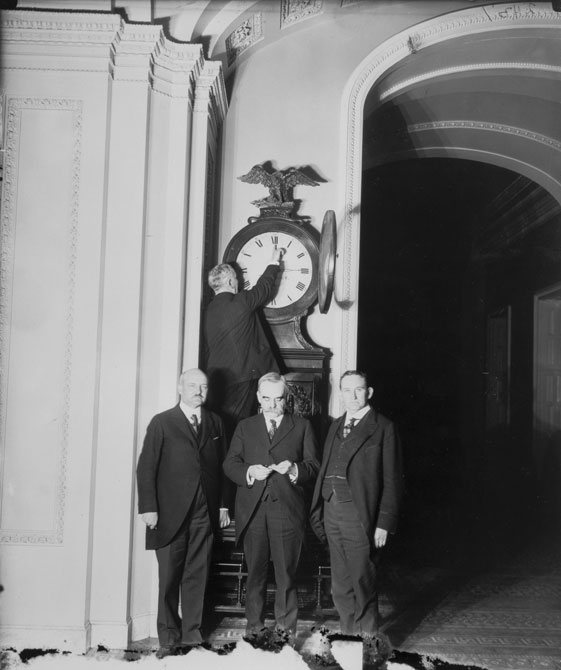
North American railroads adopted standardized railway time zones in 1883. The International Meridian Conference chose Greenwich as the prime meridian in 1884, and the United States put standard time on a federal legal footing in 1918. Once millions of people were living by synchronized regional clocks, governments could contemplate moving those clocks seasonally as a single administrative act.
Benjamin Franklin is often pulled into the origin story, but the familiar version is misleading. In a satirical 1784 letter published in Paris, Franklin calculated that people could save candles by getting out of bed earlier and using morning sunlight. He proposed changing behavior, not the modern legal mechanism of advancing clocks.
The recognizably modern idea emerged later. New Zealand entomologist George Vernon Hudson presented a seasonal time-adjustment proposal in 1895, motivated in part by the value of after-work daylight. In Britain, builder William Willett turned the same frustration into a political campaign after publishing The Waste of Daylight in 1907.
Willett did not live to see Britain adopt summer time. War supplied the political pressure that peacetime lobbying had not. Germany introduced daylight saving in April 1916 amid efforts to conserve fuel and improve wartime efficiency. Britain followed with the Summer Time Act in May.
The United States adopted federal daylight saving in 1918, then retreated from a national seasonal mandate after World War I. A patchwork followed until the Uniform Time Act of 1966 imposed greater consistency while allowing states to opt out. Later laws changed the start and end dates, producing the current American pattern of a longer daylight-saving season.
The energy argument is real, but much smaller than the slogan
The original economic case was intuitive in an age when lighting consumed a larger share of household energy: if more waking life happened in natural evening light, people would burn less fuel or use less electricity for lamps.
But modern homes do more than light rooms. They heat and cool them. Air conditioning can turn a bright, warm evening into an electricity cost. Heating demand can move in the opposite direction on darker mornings. The net result depends on climate, latitude, building stock, technology and daily habits.
The United States' own experiments illustrate the uncertainty. During the 1970s energy crisis, Congress tried extended year-round daylight saving time. The policy quickly ran into resistance over very dark winter mornings, and lawmakers restored a period of standard time. Federal assessments at the time found potential benefits, but the energy and safety effects were small or difficult to isolate cleanly.
A more modern federal test came after the United States extended daylight saving time by four weeks in 2007. The Department of Energy estimated that the extension saved about 1.3 terawatt-hours of electricity. That sounds large until it is placed against the national system: about 0.03% of annual U.S. electricity consumption. Estimated primary-energy savings were about 0.02% of annual consumption.
Other natural experiments complicate the picture further. Researchers examining millions of residential electricity bills in Indiana found that daylight saving increased household electricity demand by roughly 1% overall. Lighting savings were outweighed by additional heating and, especially, air-conditioning use. A study of Western Australia's daylight-saving experiment found little change in total electricity use but a meaningful shift in late-afternoon demand. Research in southern Norway and Sweden, by contrast, reported reductions in electricity consumption.
Those findings are not necessarily contradictory. They reveal that daylight saving is not an energy constant. A clock policy interacting with Norwegian lighting demand, Indiana air conditioning or Australian peak loads can produce different outcomes. The stronger the world moves toward efficient lighting while electrifying heating and cooling, the less credible it becomes to assume that an extra bright evening automatically saves energy everywhere.
Biology cares about when light arrives
The human circadian system is not a wristwatch. It is a roughly 24-hour biological timing network that is adjusted every day by environmental signals, with light playing the central role.
Morning light tends to shift the circadian system earlier. Bright light in the evening tends to push it later. Darkness is not merely the absence of visibility; its timing helps regulate the biological night. That is why the daylight-saving debate looks different from a sleep laboratory than it does from a restaurant terrace.
The spring clock change creates an acute problem. The clock jumps ahead, but the body does not instantly follow. People must wake by a new social time while their circadian system still carries yesterday's timing, and many lose sleep during the transition.
The American Academy of Sleep Medicine's 2024 position statement therefore argues for eliminating seasonal clock changes and using permanent standard time. Its reasoning is not nostalgia for winter sunsets. Standard time places morning light and evening darkness in a pattern that generally aligns better with human circadian biology.
That does not mean every dramatic health claim attached to daylight saving is equally settled. Evidence for short-term sleep loss and circadian disruption around the spring transition is stronger than evidence about the long-term health consequences of living on daylight saving time for months or permanently.
A 2026 Australian study is an important caution against overstating the chronic case. Researchers compared people in states observing daylight saving with people in states remaining on standard time during the middle-to-late daylight-saving period. The daylight-saving group kept later bed and wake times by the clock, but the study found no persistent reduction in self-reported sleep duration, sleep-onset latency, health or daytime performance. Because the research was cross-sectional and relied on self-report, it cannot settle the question. It does show why an acute one-hour shock should not automatically be treated as proof of permanent damage months later.
Road safety exposes the hidden trade-off
Traffic research shows why a one-line verdict on daylight saving is so difficult. Sleep and light can pull risk in opposite directions.
A 2016 study in the American Economic Journal: Applied Economics estimated that the spring transition increased fatal crashes and argued that the short-run mechanism was sleep deprivation rather than the new distribution of daylight.
A 2025 study in the Journal of Safety Research added a revealing distinction. Using U.S. fatal-crash data from 2010 through 2019, the researchers found that fatal crashes involving motor-vehicle occupants increased after the spring change, while fatal pedestrian and bicyclist crashes decreased. Around the autumn return to standard time, the pattern moved in the opposite direction.
The daylight had not become safer or more dangerous in itself. It had moved between commuting periods. A lighter evening can protect vulnerable road users at one time of day while a darker morning, combined with sleep disruption, changes risks elsewhere.
That is daylight saving time in miniature: a redistribution policy whose benefits and costs fall on different people at different hours.
So is changing the clocks a good idea?
If the objective is to create more summer daylight after conventional work and school hours, daylight saving time works exactly as designed. Sunset appears later by the clock, giving people more usable evening light without asking every employer, school, railway and television schedule to move independently.
If the objective is energy conservation, the evidence is far less persuasive. Some places and periods show savings, others show increases, and even favorable national estimates are small relative to total energy use. Energy can still matter at the margin, especially for peak demand, but it is no longer a universal scientific justification.
If the objective is to minimize circadian disruption, the twice-yearly transition is the system's clearest weakness. The spring change abruptly compresses sleep opportunity and shifts light exposure relative to social time. This is why sleep and circadian organizations have increasingly argued not merely for ending the clock changes, but for doing so on standard time rather than permanent daylight saving time.
That distinction matters. 'Stop changing the clocks' sounds like one policy, but it hides two incompatible choices. Permanent daylight saving preserves later summer evenings and extends that clock into winter, producing later winter sunrises. Permanent standard time protects morning light and closer circadian alignment but gives up an hour of clock-labeled evening light in summer.
The preference for one or the other is partly scientific and partly social. Biology can measure the consequences of light timing. Economics can estimate electricity use, spending and peak demand. Safety researchers can count crashes. None of those disciplines can decide how much a society should value a bright 8 p.m. dinner against a bright 7 a.m. school journey. That is a political choice about daily life.
Why the argument refuses to end
The policy debate in 2026 reflects that unresolved conflict. In the United States, the Sunshine Protection Act introduced in 2025 would make daylight saving time permanent, but it has not become law. A separate House proposal introduced in 2026 takes an unusual compromise route: abolish the seasonal switch and move permanent civil time by half an hour, splitting the difference between today's standard and daylight-saving offsets.
Europe has reached a similar impasse by a different route. The European Commission proposed ending seasonal clock changes in 2018, and the European Parliament supported ending them in 2019. The Council has not agreed on a common position, so the system continues; the Commission has already published the scheduled summer-time dates for 2027 through 2031.
That persistence makes sense. Daylight saving time survives not because the original fuel-saving argument has been decisively vindicated, but because civil time is a collective coordination problem. Changing it affects nearly everyone at once, while the gains and losses differ by season, latitude, age, occupation and daily schedule.
A century after governments first advanced their clocks in wartime, the core mechanism remains almost embarrassingly simple: take one hour of summer morning light and rename it as evening light. The scientific question is what that trade does to bodies, energy systems and safety. The political question is which inconvenience society is willing to institutionalize — darker winter mornings, earlier summer sunsets, or a biological jolt twice each year.
78