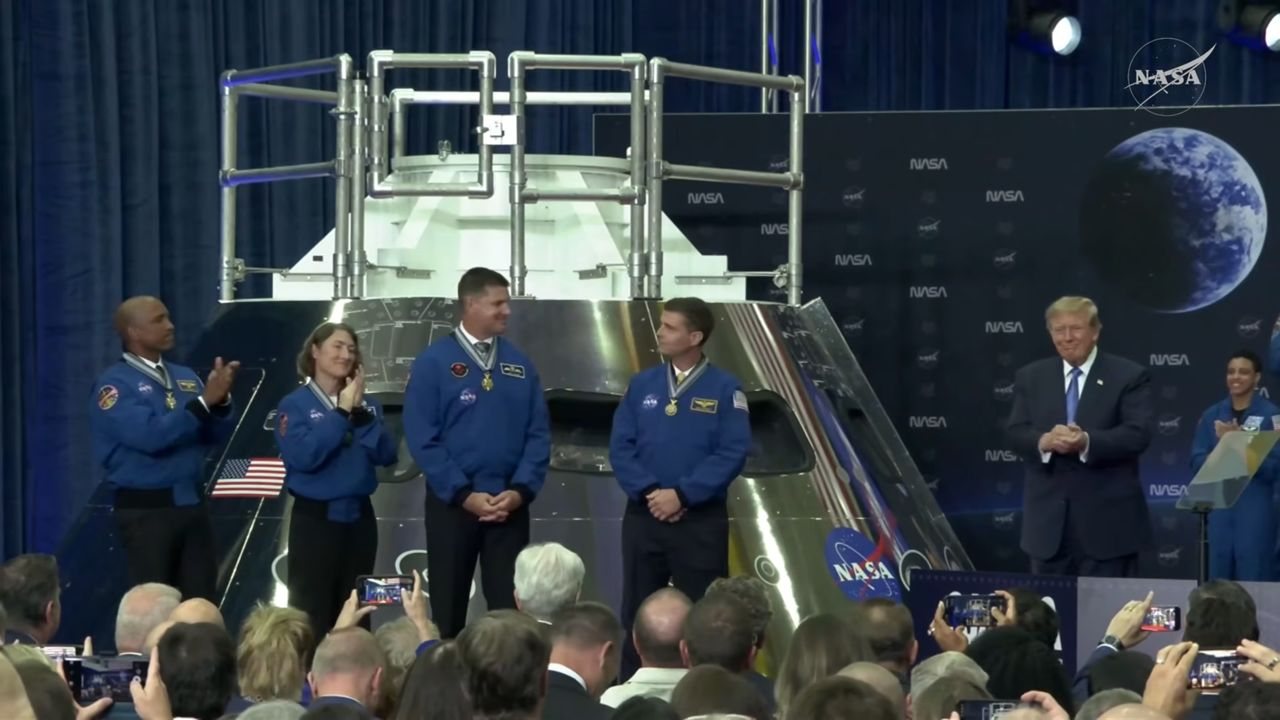
The four Artemis II astronauts who completed a lunar flyby in April received the Congressional Space Medal of Honor on Friday, the highest space honor the United States can bestow. President Donald Trump presented the medal to NASA astronauts Reid Wiseman, Victor Glover, and Christina Koch, along with Canadian Space Agency astronaut Jeremy Hansen, in a ceremony recognizing their historic mission around the Moon.
The Artemis II crew set a new distance record for humanity during their flight, venturing farther from Earth than any humans before them. The mission marked NASA's first crewed lunar voyage since the Apollo program ended in 1972, and it served as a critical proving ground for the agency's broader Artemis campaign aimed at establishing a sustained human presence on and around the Moon.
Wiseman, a former chief of the NASA astronaut office, commanded the mission. Glover, a naval aviator and test pilot, served as pilot, becoming the first person of color to travel to lunar vicinity. Koch, an electrical engineer who previously held the record for the longest single spaceflight by a woman, served as mission specialist. Hansen, a fighter pilot with the Royal Canadian Air Force, became the first non-American to fly to the Moon as a mission specialist, representing the Canadian Space Agency under a partnership agreement with NASA.
The Congressional Space Medal of Honor was established by Congress in 1969 to recognize astronauts who distinguish themselves by exceptionally meritorious efforts and contributions to the welfare of the nation and humanity. It is awarded by the president on behalf of Congress and has been conferred only a handful of times, including to Neil Armstrong, Buzz Aldrin, John Glenn, and Sally Ride.
The April mission itself was a major milestone in the Artemis program, which aims to return humans to the lunar surface later this decade. Artemis II tested the Orion spacecraft's life-support systems, navigation, and manual handling capabilities in deep space, gathering data that will inform the Artemis III landing mission. The crew spent several days in lunar orbit, capturing imagery of the Moon's far side and conducting a series of engineering checkouts before returning to Earth.
Friday's ceremony highlighted the international dimension of the Artemis program, with Hansen's presence underscoring the role of partner agencies in NASA's deep-space exploration plans. The Canadian Space Agency has committed to providing the robotic arm for the planned lunar Gateway station, and its astronauts are slated to fly on future Artemis missions.
The honor comes at a moment of renewed public attention on crewed spaceflight, as NASA prepares for the next Artemis launch and commercial partners continue to expand access to low Earth orbit. The Artemis II crew's achievement, and the recognition it received, signal the beginning of a new era of lunar exploration that will extend beyond the Apollo generation.
158